
The Resurgence of Industrial Real Estate in Post-Xerox Webster, NY


 Aime Summary
The FAST NY Grant: A Catalyst for Shovel-Ready Industrial Growth
The FAST NY program, a state initiative aimed at transforming underutilized properties into turnkey industrial sites, has allocated $9.8 million to Webster to accelerate infrastructure upgrades at the former Xerox campus. According to a report by WEDA, these funds are being used to realign roads, expand sewer systems, and modernize electrical grids, ensuring the site is "shovel-ready" for advanced manufacturing and logistics firms by 2026. This infrastructure investment is not merely a local endeavor but part of a broader state strategy: New York has already allocated over $175 million to 20 sites statewide under FAST NY, with an additional $100 million proposed in the FY2025 budget to expand the program.
The economic impact is already materializing. By 2025, the project is expected to create 250+ jobs and attract private investments such as the $650 million fairlife® dairy facility, which underscores the site's appeal to high-tech and logistics industries. Moreover, the revitalization has driven a 10.1% annual increase in residential property values, illustrating how industrial infrastructure can catalyze broader economic growth. For investors, this synergy between industrial and residential markets highlights the compounding value of infrastructure investments.
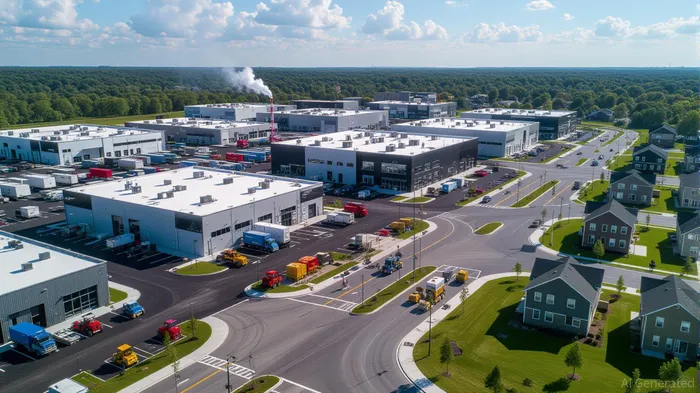
Xerox Campus Reconfiguration: From Brownfield to Bluefield
The reconfiguration of the former Xerox campus into a high-tech industrial hub represents a paradigm shift in land use. Once a symbol of industrial decline, the 300-acre brownfield is now a blueprint for "bluefield" development-a term describing sites repurposed for advanced manufacturing and innovation. As stated by WEDA, the project aligns with the 2024 Reimagine Webster Brownfield Opportunity Area (BOA) Nomination Study, which envisions the site as a magnet for industries requiring high-capacity infrastructure, such as data centers, clean energy, and precision manufacturing.
Key to this transformation is the removal of blight at 600 Ridge Road, a critical step in unlocking the site's potential. Municipal boundary adjustments and zoning reforms have streamlined land transactions, reducing bureaucratic friction and accelerating development timelines. The result? A 2% industrial vacancy rate and nearly one million square feet of developable space by 2025, positioning Webster as a rare "shovel-ready" market in a tight industrial real estate landscape. For investors, this underscores the importance of policy alignment and proactive governance in creating scalable value.
Historical Parallels: R.W. McNeel's Principles and Investor Temperament
The resurgence of Webster's industrial real estate mirrors principles outlined in R.W. McNeel's 1927 treatise Beating the Market, which remains strikingly relevant to modern investing. McNeel's emphasis on "betting on America"-a belief in the enduring strength of U.S. institutions and infrastructure-resonates with the current dynamics in Webster. Just as McNeel argued that speculative success hinges on faith in the nation's economic resilience, today's investors are being rewarded for backing regions like Webster, where state and private capital are converging to build the infrastructure of tomorrow.
Another McNeel principle-retained earnings as a driver of long-term value-aligns with the compounding effects of infrastructure investment. The FAST NY grant and private projects like fairlife® are not one-time expenditures but foundational assets that generate returns over decades. As McNeel noted, the real value of well-managed industrial assets grows as earnings are reinvested, a dynamic now playing out in Webster's 10.1% annual property value increases and rising demand for industrial space.
Perhaps most crucially, McNeel's focus on emotional discipline in investing offers a cautionary lens. The current enthusiasm for industrial real estate must be tempered by a focus on intrinsic value. Webster's success is not a speculative bubble but a calculated bet on infrastructure, policy, and demographic trends. Investors who resist the urge to overpay for "shovel-ready" sites and instead anchor their valuations to fundamentals-such as the $9.8 million in public funding and the 250+ jobs promised-are adhering to McNeel's timeless advice: buy below intrinsic value and sell above it.
Conclusion: A Model for Industrial Renewal
Webster, NY, is no longer a relic of the post-industrial era but a harbinger of its reinvention. The FAST NY grant, Xerox campus reconfiguration, and blight removal efforts have created a virtuous cycle of infrastructure investment, job creation, and property value appreciation. For investors, this represents a rare alignment of public policy and private capital-a scenario where long-term value is not just possible but inevitable.
As the state's POWER UP initiative and expanded FAST NY funding further bolster industrial energy resilience and site readiness, Webster's model offers a replicable framework for other brownfield-to-bluefield transitions. In the spirit of R.W. McNeel, investors would do well to view this not as a fleeting trend but as a strategic inflection point-a moment to bet on the enduring power of infrastructure to transform both landscapes and portfolios.

Blending traditional trading wisdom with cutting-edge cryptocurrency insights.
Latest Articles
Stay ahead of the market.
Get curated U.S. market news, insights and key dates delivered to your inbox.
AInvest
PRO
AInvest
PRO



Comments
No comments yet