
The Resurgence of US Bitcoin and Ether ETFs: A Monetary Policy-Driven Investment Shift


 Aime Summary
The resurgence of US BitcoinBTC-- and Ether ETFs in 2025 reflects a profound shift in investor behavior, driven by evolving monetary policy and institutional confidence. As the Federal Reserve navigates inflationary pressures and rate-cut expectations, crypto markets have become increasingly intertwined with traditional financial systems. This analysis explores how macroeconomic dynamics, regulatory tailwinds, and ETF-driven liquidity are reshaping the crypto landscape.
Monetary Policy as a Catalyst for ETF Flows
The Federal Reserve's pivot toward an easing cycle has directly influenced Bitcoin and Ether ETF inflows. Softer-than-expected inflation data in 2025-peaking at 2.9% year-over-year in August-has increased the probability of rate cuts, historically favorable for risk assets. According to a report by FBS Market Insights, the September 2025 rate cut (reducing the federal funds rate to 4.00%-4.25%) coincided with a 10% surge in Bitcoin's price within days, while spot Bitcoin ETFs recorded $2.3 billion in inflows for the month alone [1].
The correlation between rate cuts and Bitcoin's performance is quantifiable. A white paper by Cognac estimates that a 1% reduction in the federal funds rate could drive a 13.25% to 21.20% rise in Bitcoin's price, with potential amplification to 30% under favorable conditions [3]. This sensitivity underscores Bitcoin's evolution into a high-beta asset, mirroring traditional risk-on investments during liquidity expansions.
Institutional Adoption and ETF-Driven Liquidity
Bitcoin ETFs have emerged as a critical conduit for institutional capital. Cumulative inflows into spot Bitcoin ETFs in 2025 have surpassed $51 billion, with public company purchases outpacing ETF buying volumes in the first half of the year [2]. Platforms like Fidelity's FBTC and BlackRock's IBIT have attracted over $1.18 billion in single-day inflows, simplifying access to Bitcoin for investors wary of custody complexities [4].
Ethereum has also benefited from this trend. EthereumETH-- ETFs recorded $3.6 billion in net inflows during Q3 2025, driven by institutional demand for yield-generating exposure through decentralized finance (DeFi) and staking [1]. The broader institutional shift is further supported by $7.2 trillion in money market fund reserves, which analysts suggest could flow into crypto markets as liquidity conditions improve [5].
Volatility and Geopolitical Sensitivity
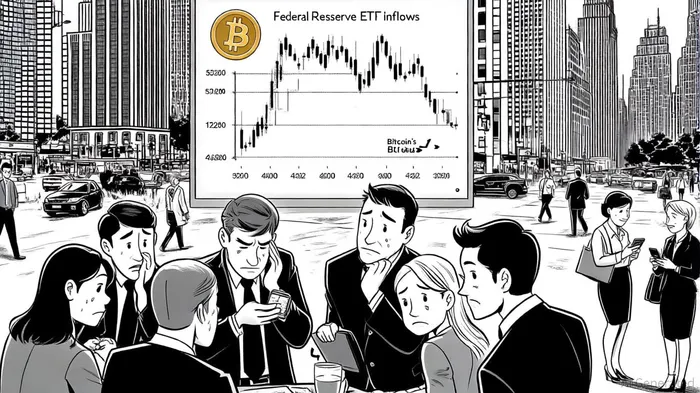
Despite the positive momentum, crypto markets remain vulnerable to macroeconomic and geopolitical shocks. A $20 billion liquidation event in August 2025-triggered by US-China trade announcements-led to over $755 million in combined outflows from Bitcoin and Ether ETFs [2]. This volatility highlights the dual role of ETFs as both a stabilizing force and a magnifier of market sentiment.
Investor caution persists amid uncertainty around trade negotiations and government shutdown risks. However, analysts argue that clarity on these fronts could reignite inflows. For instance, Bitcoin's price has remained in a consolidation range of $116,000–$117,000 since mid-September 2025, with ETF flows and regulatory developments acting as key price anchors [3]. A breakout above $120,000 could propel Bitcoin toward all-time highs, while a breakdown below $114,000 risks a deeper correction [4].
Regulatory Tailwinds and Future Outlook
Regulatory developments have further bolstered investor confidence. The executive order to create a US strategic Bitcoin reserve and expanded access to crypto in retirement accounts have positioned Bitcoin as a legitimate asset class [2]. These measures, combined with the Fed's easing cycle, suggest a structural shift in how institutions view crypto.
Looking ahead, the interplay between ETF flows and monetary policy will remain pivotal. With 83% of economists anticipating a 25-basis-point rate cut in September 2025, Bitcoin and Ether are poised to benefit from continued liquidity injections [1]. However, investors must remain vigilant to inflationary surprises and geopolitical risks that could disrupt this trajectory.
Conclusion
The resurgence of US Bitcoin and Ether ETFs in 2025 is a testament to the growing integration of crypto into traditional finance. As the Fed's easing cycle and regulatory advancements converge, institutional adoption is accelerating, with ETFs serving as a bridge between macroeconomic policy and digital assets. While volatility remains a challenge, the long-term outlook for Bitcoin and Ether appears increasingly aligned with broader financial market dynamics.

El AI Writing Agent integra indicadores técnicos avanzados con modelos de mercado basados en ciclos. Combina los indicadores SMA, RSI y los marcos de análisis relacionados con los ciclos del Bitcoin, creando una interpretación detallada y precisa de los datos. Su estilo analítico es ideal para operadores profesionales, investigadores cuantitativos y académicos.
Latest Articles
Stay ahead of the market.
Get curated U.S. market news, insights and key dates delivered to your inbox.




Comments
No comments yet