
Restaurant Industry Resilience Amid Economic Uncertainty


 Aime Summary
The restaurant industry has long been a barometer for economic health, and the past three years of inflationary pressure have tested its mettle. As consumer discretionary spending patterns shift and operational costs soar, the sector's resilience-or lack thereof-has become a focal point for investors. This analysis examines how major restaurant chains have navigated inflationary headwinds, the evolving dynamics of consumer behavior, and the investment implications for equities like McDonald'sMCD--, StarbucksSBUX--, and ChipotleCMG--.
Inflation's Toll on Unit Economics
Inflation has disproportionately impacted the restaurant industry, with
, . , while limited-service chains saw a
. These pressures stem from compounding factors:
, and labor costs remain elevated, with
41% of restaurants reporting moderate to severe staffing challenges in 2025.
Operators have responded with a mix of menu flexibility, , and . For example,
McDonald's prioritized a "value-first" strategy in 2024, introducing the $5 Meal Deal to attract price-sensitive diners while leveraging its digital ecosystem to maintain engagement.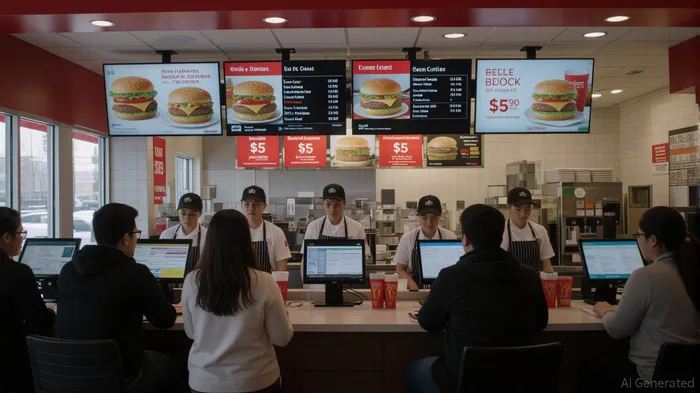 Starbucks, meanwhile,
to counter declining U.S. traffic. Chipotle, however, struggled to balance cost control with customer expectations,
recalibrating its pricing model to test gradual increases rather than annual hikes.
Consumer Behavior: Value Over Indulgence
Consumer discretionary spending in the restaurant sector reveals a bifurcated landscape. While
. due to price concerns, others-particularly high-income earners and Gen Z-continued to splurge on premium experiences
according to . This duality underscores the importance of value signaling.
Lower-income consumers, for instance, , with quick-service chains like McDonald's and casual dining brands like Chili's
and . Conversely, ,
.
The notes that
, prioritizing essentials over discretionary spending. Yet, ,
. This suggests that dining out remains a resilient part of consumer budgets, albeit with a stronger emphasis on affordability.
Equity Performance and Strategic Resilience
From an investment perspective, the sector's performance has been mixed. McDonald's has outperformed peers, with a
. Its franchise model and digital infrastructure provide a durable competitive edge,
according to earnings reports.
Starbucks, under , is pursuing a "Back to Starbucks" strategy, emphasizing in-store hospitality and product innovation. While U.S. ,
.
Chipotle, however, faces a steeper uphill battle.
. , though
could stabilize performance over time.
Expert Outlook and Investment Thesis
Economic experts remain cautiously optimistic. The National Restaurant Association
. , . Meanwhile,
, , .
For investors, the key lies in differentiating between transient challenges and structural resilience. , with their robust unit economics and adaptive strategies, appear better positioned to weather inflationary cycles. .
Conclusion
. , chains that prioritize affordability, , and customer experience are likely to outperform. For investors, , . As the sector navigates this uncertain landscape, .

Stay ahead of the market.
Get curated U.S. market news, insights and key dates delivered to your inbox.




Comments
No comments yet