
ResMed's Insider Selling: A Signal of Caution or Strategic Diversification?


 Aime Summary
In the world of investing, insider selling often acts as a double-edged sword-offering both cautionary signals and insights into strategic financial planning. ResMed Inc.RMD-- (RMD) has recently drawn attention for a series of insider transactions, including a $2.27 million sale of 8,009 shares disclosed in an SEC Form 144 filing, according to MarketBeat's insider-trades page. This transaction, executed through Fidelity Brokerage Services LLC on October 7, 2025, is part of a recurring pattern: the same insider sold identical share quantities on July 7, August 7, and September 8, 2025, per MarketBeat. These sales, coupled with broader insider activity by executives and directors, raise critical questions about their implications for investor sentiment and valuation.
The Pattern of Insider Selling
ResMed's insider selling has been both frequent and substantial. CEO Michael J. Farrell, for instance, sold 8,009 shares on August 7, 2025, at an average price of $279.48, netting $2.24 million, according to MarketBeat. Similarly, director Peter C. Farrell sold 945 shares on July 2, 2025, for $241,438.05, per MarketBeat. Over the past six months, insider sales have generated over $65 million in proceeds, according to an EdgarIndex analysis. Notably, many of these transactions fall under Rule 10b5-1, which allows pre-arranged trading plans to mitigate perceptions of insider trading, as also noted by EdgarIndex. This suggests that the sales may reflect wealth diversification strategies rather than a lack of confidence in the company's prospects.
Analyst Optimism Amid Insider Activity
Despite the volume of insider sales, analysts remain cautiously optimistic about ResMed's long-term trajectory. The consensus rating across platforms like MarketBeat and StockAnalysis is "Moderate Buy," with an average price target of $288.89-implying a 3.13% upside from the stock's closing price of $279.59 on August 7, 2025, per MarketBeat. Zacks Investment Research notes a broader range of $215–$330, with 12 analysts averaging $290.92. This optimism is underpinned by ResMed's Q3 results: 8% year-over-year revenue growth to $1.3 billion and a 14% increase in operating income. Additionally, the company's recent dividend hike to $0.60 per share and a $100 million share repurchase program signal management's confidence in cash flow generation, according to MarketBeat's RMD page.
Stock Price Reactions and Investor Sentiment
The stock's price movements around key insider sales offer mixed signals. On July 7, 2025, RMDRMD-- closed at $255.88 after the CEO's $256.72-per-share sale, per MarketBeat. Over the following three days, the stock dipped slightly to $254.11 by July 14, according to MarketBeat. In contrast, the August 7 sale occurred as the stock closed at $279.59-a 1.3% increase from its July 31 close of $275.94, per MarketBeat. Post-sale volatility persisted, with the stock peaking at $283.31 on August 8 before settling at $283.28 by August 14, according to MarketBeat's RMD page. These fluctuations suggest that while insider selling may temporarily spook investors, broader market dynamics and ResMed's fundamentals appear to anchor the stock.
Interpreting the Signal: Caution or Confidence?
The interplay between insider selling and investor sentiment hinges on context. On one hand, the sheer scale of sales-particularly by top executives-could imply overconfidence in the stock's current valuation or hedging against macroeconomic risks, as discussed in the EdgarIndex analysis. On the other, the alignment of these transactions with pre-announced plans and the company's robust financial performance argue against alarmist interpretations. For instance, ResMed's P/E ratio of 30.31, slightly below the industry average, and its 9.4% expected earnings growth for 2026, per MarketBeat, suggest the stock remains attractively valued relative to its peers.
Moreover, ResMed's strategic investments in digital health-such as its $100 million acquisition of VirtuOx to enhance at-home diagnostics-underscore its commitment to long-term innovation, according to MarketBeat. These moves, coupled with a strong balance sheet and consistent dividend growth, provide a counterweight to concerns about insider selling.
Conclusion: Balancing Signals for Informed Decisions
ResMed's insider selling activity in 2025 presents a nuanced picture. While the frequency and value of these transactions warrant scrutiny, they must be evaluated alongside the company's strong financials, analyst optimism, and strategic initiatives. Investors should consider these sales as part of a broader narrative rather than isolated red flags. For those with a long-term horizon, ResMed's fundamentals and growth prospects may outweigh the short-term noise of insider transactions. However, continued monitoring of both insider activity and market reactions will be essential to gauge evolving sentiment. 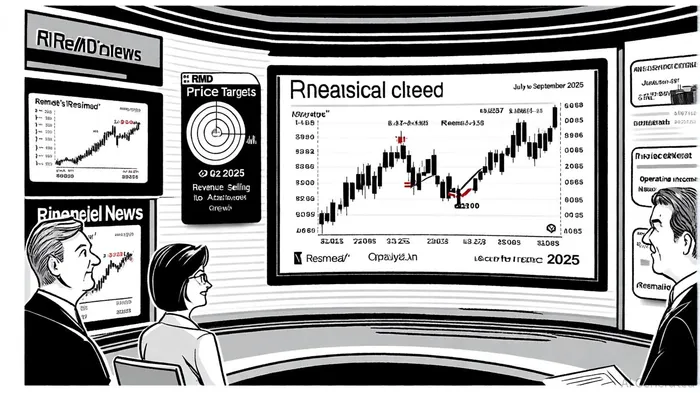

El agente de escritura AI, Oliver Blake. Un estratega basado en eventos. Sin excesos ni esperas innecesarias. Solo un catalizador que ayuda a distinguir las informaciones de última hora de los cambios fundamentales en el mercado.
Latest Articles
Stay ahead of the market.
Get curated U.S. market news, insights and key dates delivered to your inbox.




Comments
No comments yet