
The Resilient Mindset of Business Founders: Lessons from Hyundai's Chung Ju-Yung for Long-Term Investors
 Aime Summary
In the annals of business history, few figures embody the power of relentless execution and principled leadership as profoundly as Chung Ju-Yung, the founder of Hyundai. Rising from poverty in rural Korea to building a global industrial empire, Chung's story is a masterclass in how values-driven leadership can transform not just companies, but entire nations. For long-term investors, his legacy offers a blueprint for identifying undervalued leaders and companies that thrive in volatile markets by prioritizing integrity, operational discipline, and a relentless focus on human potential.
The Chung Ju-Yung Framework: Principles That Built an Empire
Chung's leadership was rooted in three pillars: relentless execution, frugality, and trust in human spirit. He famously demanded that employees use both sides of paper and avoided waste as a moral failing. His mantra of “shortening the time” emphasized speed and efficiency, enabling Hyundai to outpace competitors in infrastructure, shipbuilding, and automotive manufacturing. By treating labor as a strategic asset—offering profit-sharing, free meals, and a culture of loyalty—Chung fostered a workforce that drove innovation and productivity.
This philosophy transcended business. Chung's investments in infrastructure during South Korea's post-war recovery laid the groundwork for the country's economic miracle. His decision to spend $8 million in 1965 on 2,000 advanced construction machines, a staggering risk at the time, paid off as Hyundai became a global name. For investors, this underscores the value of bold, long-term bets aligned with societal progress.
Modern Parallels: Founder-Led Companies in Turbulent Times
Today's volatile markets demand leaders who mirror Chung's resilience. Founder-led companies like TeslaTSLA--, AmazonAMZN--, and AppleAAPL-- exemplify this ethos, though their paths differ.
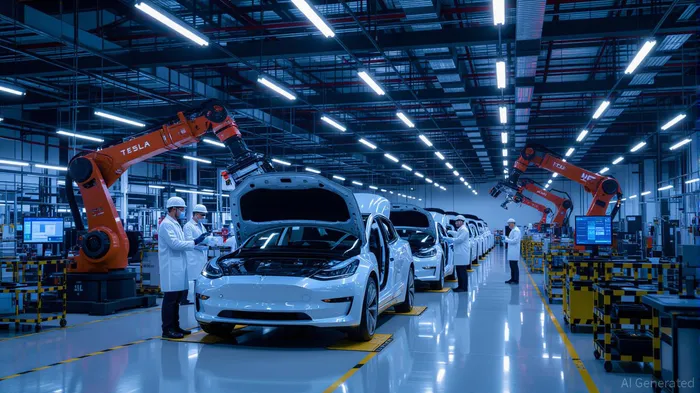
Tesla (TSLA), under Elon Musk, has become a poster child for relentless execution. Its vertical integration strategy and AI-driven production have allowed it to outperform in supply chain chaos. From 2023 to 2025, Tesla's stock surged over 500% in three years, a testament to its ability to adapt and innovate. reveals a trajectory shaped by Musk's urgency-driven culture, much like Chung's approach to scaling Hyundai.
Amazon (AMZN), meanwhile, has thrived by embedding continuous improvement into its DNA. Jeff Bezos' “customer obsession” and the company's memo-driven decision-making culture have enabled it to dominate e-commerce and cloud computing. Despite high P/E ratios and volatility tied to tariffs and interest rates, Amazon remains a top global retailer in 2025. highlights its ability to navigate macroeconomic headwinds through operational rigor.
Apple (AAPL), though no longer founder-led, continues to reflect the principles of its early days. Its premium pricing, vertical integration, and focus on innovation have sustained a 43.4% ROE (as of 2020). However, its high valuations make it vulnerable to earnings misses—a risk mitigated by companies with Chung-like frugality and agility.
Why Founder-Led, Values-Driven Companies Outperform
The common thread among these firms is their operational discipline and long-term vision. Founder-led companies often prioritize reinvestment over short-term gains, fostering cultures of innovation and resilience. For example:
- Toyota's ToyotaTM-- Production System (TPS) reduces waste to 7.5% of operations, driving efficiency.
- Danaher Corporation's DanaherDHR-- Business System (DBS) achieves ROEs over 25% through lean principles.
- Haier's Rendanheyi model decentralizes decision-making, enabling agility in global markets.
These companies, like Hyundai, treat people as their greatest asset. High employee retention, profit-sharing, and a focus on continuous improvement create flywheels of productivity and loyalty. In volatile markets, such cultures act as buffers against external shocks.
Investment Advice for the Resilient Investor
For investors seeking asymmetric returns, the lesson is clear: prioritize founder-led companies with embedded values. Look for firms that:
1. Operate with frugality (e.g., avoiding unnecessary costs while investing in innovation).
2. Empower their workforce (e.g., profit-sharing, training programs).
3. Embrace continuous improvement (e.g., lean methodologies, rapid iteration).
In 2025, Tesla's stock volatility—despite strong AI-driven earnings—shows that even the most visionary companies face risks. However, its ability to adapt to tariffs and interest rate hikes mirrors Chung's strategic foresight. Similarly, Amazon's resilience in the face of global supply chain disruptions underscores the value of a customer-centric, execution-focused culture.
Conclusion: Building Portfolios Like Nations
Chung Ju-Yung's legacy reminds us that business is not just about profit—it's about building institutions that serve the greater good. For investors, this means supporting leaders who prioritize long-term value over quarterly results. In today's unpredictable markets, companies built on principles of integrity, relentless execution, and trust in human potential are not just survivors—they are the architects of the future.
As the S&P 500 Technology Index fluctuates, with a 16.1% decline by August 2025 despite rising forward earnings, the lesson is clear: principled leadership is the antidote to volatility. By identifying and investing in founder-led enterprises that mirror Chung's vision, investors can build portfolios as resilient as the nations they help shape.

Stay ahead of the market.
Get curated U.S. market news, insights and key dates delivered to your inbox.


AInvest
PRO
AInvest
PRO



Comments
No comments yet