
Resilient Leadership in Adversity: Lessons from Chung Ju-Yung and Implications for Long-Term Business Investment
 Aime Summary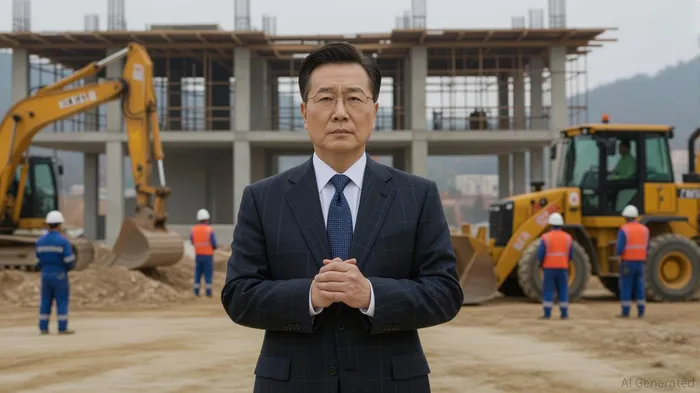
In the annals of industrial history, few leaders embody the fusion of resilience, frugality, and long-term vision as profoundly as Chung Ju-Yung, the founder of Hyundai. Rising from a rural Korean family with limited formal education, Chung transformed a war-torn nation into a global industrial861072-- powerhouse by prioritizing culture, execution, and stakeholder value over short-term gains. His story is not just a blueprint for corporate triumph but a lens through which investors can identify undervalued companies led by adversity-tested leaders in today's volatile markets.
The Chung Ju-Yung Framework: Principles for Resilient Leadership
Chung's leadership was defined by three pillars:
1. Strategic Frugality: He reinvested savings into innovation and infrastructure, famously using both sides of paper and investing in advanced machinery during downturns.
2. People-Centric Culture: Profit-sharing, open communication, and treating employees as partners fostered loyalty and collective ownership.
3. Relentless Execution: Rapid project completion and a refusal to quit in the face of adversity became hallmarks of Hyundai's global reputation.
These principles enabled Hyundai to weather crises like the 1997 Asian Financial Crisis, where Chung retained workers and doubled down on R&D, while competitors cut costs. The result? A diversified industrial empire spanning automobiles, construction, and shipbuilding, with a legacy of adaptability.
Modern Parallels: Adversity-Tested Leaders in Action
Today's markets offer similar opportunities in companies led by leaders who mirror Chung's ethos. Consider Kroger (KR), a 2025 retail sector standout. Despite sector-wide stagnation, KrogerKR-- achieved 3.2% same-store sales growth in Q1 2025, driven by pharmacy, e-commerce, and fresh food segments. Its EV/EBITDA of 9.3x (below the peer median of 11.3x) and $2.8 billion in free cash flow highlight undervaluation, while a $5 billion share repurchase program underscores disciplined capital allocation.
Kroger's leadership exemplifies anticipation advantage—years of investment in digital transformation and private-label health products positioned it to thrive during the pandemic and post-COVID shifts. Similarly, Nvidia (NVDA) leveraged its shaping advantage by dominating AI and cloud computing, with R&D spending 1.5x the industry average, enabling it to redefine tech industry norms.
Actionable Investment Criteria: Screening for Resilience
To identify companies with Chung-like leadership, investors should focus on four competitive advantages:
- Anticipation Advantage:
- Look for: Long-term investments in digital transformation, R&D, or supply chain resilience.
Example: Kroger's early e-commerce and omnichannel investments cushioned it during the pandemic.
Cushioning Advantage:
- Look for: Strong balance sheets, low debt-to-EBITDA ratios, and disciplined cost management.
Example: Kroger's net debt-to-EBITDA of 1.69 (vs. a target range of 2.30–2.50) provides flexibility during downturns.
Adaptation Advantage:
- Look for: Agile pivots in response to market shifts, such as Square's (now Block) transformation into a financial services platform.
Example: Square's Cash App revenue surged 440% in 2020 by adapting to remote work and digital banking trends.
Shaping Advantage:
- Look for: Companies redefining industry standards through innovation or strategic acquisitions.
- Example: Nvidia's proposed Arm acquisition aims to shape the future of AI and semiconductor ecosystems.
The Case for Contrarian Investing
Undervalued companies with adversity-tested leaders often trade at discounts due to market pessimism. Kroger's forward P/E of 14.56 (vs. industry average of 15.03) and PEG ratio of 2.21 (vs. 1.82) suggest the market underestimates its growth potential. Similarly, Expedia (EXPE) capitalized on the shift to private accommodations by acquiring Vrbo in 2015, turning a crisis into a 400% revenue surge during the pandemic.
Conclusion: Building a Portfolio of Industrial Champions
Chung Ju-Yung's legacy teaches us that resilience is not born from avoiding adversity but from embracing it as a catalyst for innovation. For investors, the key lies in identifying leaders who prioritize culture, execution, and long-term value—qualities that enable companies to outperform in volatile markets. By applying the four competitive advantages outlined above, investors can uncover undervalued champions poised to thrive in the next industrial revolution, much like Hyundai did in the 20th century.
In a world where short-termism often dominates, the next generation of Hyundai-like leaders will be those who, like Chung, see adversity not as a barrier but as an opportunity to build enduring value.

Delivering real-time insights and analysis on emerging financial trends and market movements.
Latest Articles
Stay ahead of the market.
Get curated U.S. market news, insights and key dates delivered to your inbox.


AInvest
PRO
AInvest
PRO



Comments
No comments yet