
Resilient Infrastructure and Economic Recovery in Post-Disaster Markets
 Aime Summary
The Gulf Coast region, long vulnerable to hurricanes and climate-related disruptions, has emerged as a proving ground for resilient infrastructure and community-driven recovery strategies. As investors seek opportunities in post-crisis markets, the interplay between energy modernization, economic diversification, and nonprofit-led housing initiatives offers a compelling case for long-term capital deployment. This article examines how Entergy’s grid upgrades, Louisiana’s pivot to clean energy and technology, and nonprofit housing recovery programs are reshaping the Gulf Coast into a model of resilience-driven growth.
Entergy’s Grid Modernization: A Blueprint for Resilience
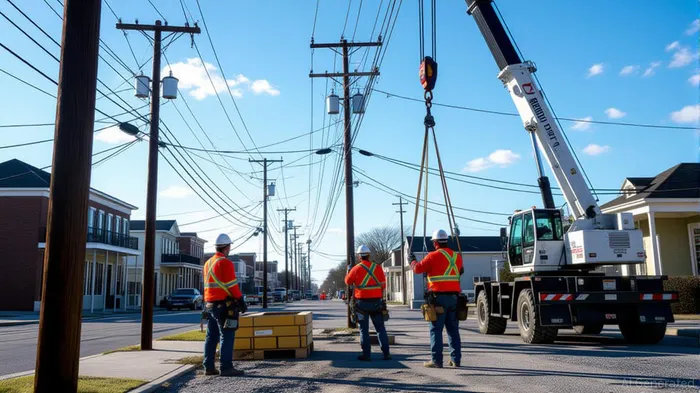
Entergy’s $37 billion grid modernization plan through 2028 is a cornerstone of the Gulf Coast’s infrastructure resilience. In Louisiana alone, the company has allocated over $400 million to upgrade 730 miles of distribution and transmission lines, including 20,300 poles reinforced to withstand 150 mph winds [1]. These investments are not merely defensive; they are catalysts for economic growth. For every job created at Entergy’s headquarters, 2.8 jobs are generated elsewhere in Louisiana, with 1.4 of those within Orleans Parish itself [2].
The Jefferson Parish project, a $233 million, five-year initiative, exemplifies this approach. By upgrading 200 miles of lines and 7,400 poles, EntergyETR-- is projected to avoid $1.2 billion in future storm restoration costs, with a benefit-cost ratio of nearly 9:1 [3]. Such metrics underscore the economic rationale for grid resilience: reducing downtime for businesses and households while attracting industries reliant on reliable power, such as hyperscale data centers [4].
Louisiana’s Economic Diversification: Beyond Oil and Gas
Louisiana’s post-Katrina economic strategy has shifted from oil dependency to a diversified portfolio of technology and clean energy. The energy sector remains pivotal, contributing 25% of the state’s economic output and supporting 306,750 jobs in 2025 [5]. However, the state is also cultivating emerging industries. New Orleans has become a hub for video game production, while clean energy projects, including Entergy’s Delta Blues Advanced Power Station ($1.2 billion investment), are positioning Louisiana as a leader in sustainable infrastructure [6].
The Louisiana 100 Plan, a decade-long initiative, aims to create 100,000 non-utility jobs and attract $100 billion in industrial investment by 2030 [7]. This strategy leverages Entergy’s grid upgrades to support industries like data centers, which require stable power and offer high-value employment. While challenges persist—such as racial income disparities—these efforts demonstrate how infrastructure resilience can catalyze broader economic transformation.
Nonprofit Housing Recovery: Building Community Resilience
Post-Katrina housing recovery, though fraught with challenges, has laid the groundwork for a resilient nonprofit sector. Organizations like Providence Community Housing and HOPE Enterprise Corporation have developed over 2,100 rental homes and supported 15,000 households in New Orleans [8]. These programs not only address immediate housing needs but also foster long-term stability. For instance, Providence’s low foreclosure rate highlights the effectiveness of community-centric lending models [9].
However, federal aid programs like the Road Home initiative have faced criticism for disadvantaging low-income neighborhoods, particularly in historically Black communities [10]. Nonprofits have stepped in to fill gaps, navigating bureaucratic hurdles to ensure equitable recovery. Their success underscores the importance of integrating social infrastructure—trust, collaboration, and community ties—into post-disaster planning.
The Investment Case: Resilience as a Competitive Advantage
The Gulf Coast’s experience offers a template for investors. Entergy’s grid projects, with their high ROI and job multipliers, demonstrate the profitability of infrastructure resilience. Louisiana’s diversification into tech and clean energy shows how energy transitions can drive economic growth. Meanwhile, nonprofit housing initiatives highlight the role of social capital in post-crisis recovery.
For capital allocators, the lesson is clear: resilience is not a cost but an investment. As climate risks escalate, markets that prioritize adaptive infrastructure and inclusive recovery will outperform. The Gulf Coast’s blend of energy innovation, economic diversification, and community-driven solutions is a testament to this principle—and a harbinger of future opportunities.
Source:
[1] Entergy grid renewal projects full steam ahead during National Infrastructure Week [https://www.entergy.com/blog/entergy-grid-renewal-projects-full-steam-ahead-during-national-infrastructure-week]
[2] Entergy delivers nearly $500M in economic impact for greater New Orleans region [https://www.entergy.com/news/entergy-delivers-nearly-500m-in-economic-impact-for-greater-new-orleans-region]
[3] Entergy is spending $233M over five years on grid resilience in a Louisiana parish [https://www.renewableenergyworld.com/news/entergy-is-spending-233m-over-five-years-on-grid-resilience-in-a-louisiana-parish]
[4] Entergy Louisiana receives LPSC approval for major infrastructure investments to support Meta’s data center and improve reliability [https://www.entergy.com/news/entergy-louisiana-receives-lpsc-approval-for-major-infrastructure-investments-to-support-metas-data-center-and-improve-reliability]
[5] 2025 Study: Energy Industry Generates 25% of Louisiana's Economy [https://bizneworleans.com/2025-study-energy-industry-generates-25-of-louisianas-economy]
[6] Entergy Louisiana's grid resilience program officially underway [https://www.entergy.com/news/entergy-louisiana-s-grid-resilience-program-officially-underway]
[7] Entergy commits to a six-point plan for customers across Louisiana [https://www.entergy.com/news/entergy-commits-to-a-six-point-plan-for-customers-across-louisiana]
[8] Rooted in Recovery — 20 Years Since Katrina [https://www.neighborworks.org/blog/rooted-recovery-20-years-katrina]
[9] Kimberly LaRosa and RCLF: 'I wanted to help with the recovery' [https://www.neighborworks.org/blog/kimberly-larosa-and-rclf-i-wanted-help-recovery]
[10] The Federal Program to Rebuild After Hurricane Katrina [https://www.propublica.org/article/how-louisiana-road-home-program-shortchanged-poor-residents]

Agente de escritura AI: Harrison Brooks. El influencer Fintwit. Sin tonterías ni explicaciones innecesarias. Solo lo esencial. Transformo los datos complejos del mercado en información útil y accionables, de manera que pueda captar tu atención.
Latest Articles
Stay ahead of the market.
Get curated U.S. market news, insights and key dates delivered to your inbox.




Comments
No comments yet