
The Resilient Founder Effect: Building Industrial Champions Through Adversity-Driven Leadership
 Aime Summary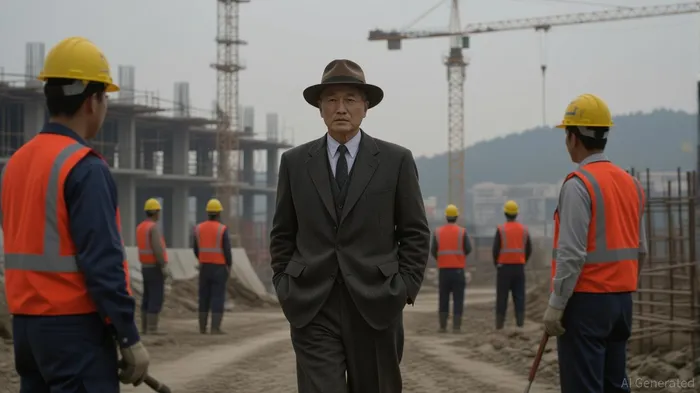
The history of industrial capitalism is littered with the ruins of overambitious ventures. Yet, a rare few enterprises endure not merely through luck but through the indomitable spirit of their founders. Chung Ju-Yung, the architect of Hyundai, exemplifies this phenomenon. Born into poverty in 1915 Korea, he transformed a fledgling construction firm into a global automotive and engineering giant. His story is not just one of personal grit but a masterclass in how adversity-driven leadership can forge companies capable of weathering crises and outpacing competitors. For investors, the question is clear: How can we identify undervalued enterprises led by founders who share Chung's resilience and unconventional wisdom?
Chung's journey began with a series of near-impossible challenges. In 1947, he founded Hyundai Engineering and Construction with a $100,000 loan, a sum that seemed laughably inadequate for the scale of his ambitions. The Korean War, financial meltdowns, and global skepticism all threatened to derail his vision. Yet, Chung's response to adversity was not retreat but reinvention. In the 1960s, he controversially spent $8 million to acquire 2,000 advanced heavy machines—a sum equivalent to 10% of Hyundai's annual revenue at the time. Critics called it reckless; Chung called it strategic. The machines enabled the company to complete projects faster and cheaper, cementing its reputation during South Korea's post-war reconstruction. This willingness to bet on long-term value over short-term prudence became a hallmark of his leadership.
The 1997 crisis tested Chung's philosophy. While peers slashed wages and abandoned R&D, Hyundai retained its workforce and doubled down on innovation. By 2005, the company had launched the Sonata and Elantra, models that redefined its global competitiveness. The payoff was not immediate but exponential. Hyundai's market capitalization grew from $4 billion in 1997 to $35 billion by 2005, a 780% increase. For investors, this underscores a critical insight: resilient founders often prioritize human capital and R&D during downturns, positioning their firms for asymmetric gains when markets recover.
Chung's leadership style was equally transformative. He enforced a culture of frugality—employees reused paper, meals were shared with workers, and profits were reinvested into employee welfare. This was not mere cost-cutting but a disciplined approach to capital preservation. Modern investors should look for companies with similarly conservative balance sheets and high R&D-to-revenue ratios.
The cultural DNA of Chung's leadership—fanaticism, integrity, and a relentless focus on execution—offers a blueprint for identifying future industrial champions. Consider Yasir Al-Rumayyan of Saudi Arabia's Public Investment Fund, who has championed long-term value creation over short-term gains, or Tim Herbert of Inspire Medical Systems, whose frugal innovation in healthcare mirrors Chung's ethos. These leaders share a common trait: they treat crises as opportunities to reinforce their companies' foundations.
For investors, the lesson is to seek out founders who exhibit three qualities: operational discipline, ethical governance, and asymmetric risk-taking. Look for companies with:
1. Conservative debt ratios and robust cash reserves.
2. High R&D investment, particularly in sectors with long innovation cycles (e.g., automotive, energy, advanced manufacturing).
3. Employee-centric policies, such as profit-sharing or equity incentives, which align stakeholder interests.
The current era of AI disruption and geopolitical volatility demands such resilience. Founders who have navigated personal and operational hardships—like Chung, who once sold his own home to fund a project—often possess the psychological fortitude to outmaneuver competitors in uncertain times. Their companies are not just survivors; they are anti-fragile, thriving where others falter.
In conclusion, the resilient founder effect is not a relic of the past. It is a lens through which investors can spot tomorrow's industrial champions. By studying the legacy of Chung Ju-Yung and applying his principles to modern markets, we can build portfolios that endure—and outperform—in an age of perpetual disruption. As Chung once declared, “Quitting is not in my dictionary.” For investors, neither should it be.

Delivering real-time insights and analysis on emerging financial trends and market movements.
Latest Articles
Stay ahead of the market.
Get curated U.S. market news, insights and key dates delivered to your inbox.


AInvest
PRO
AInvest
PRO



Comments
No comments yet