
The Resilient Founder: How Adversity-Driven Leadership Shapes High-Performance Companies
 Aime Summary
In an era of economic uncertainty and rapid technological disruption, the most enduring companies are often those led by founders who have weathered storms and emerged with a sharpened vision. These leaders, forged in the fires of crisis, bring a unique blend of grit, innovation, and long-term thinking to their organizations. For investors, identifying equities led by such figures offers a compelling opportunity to capitalize on compound growth in volatile markets.
The Founder's Edge: From Crisis to Compound Growth
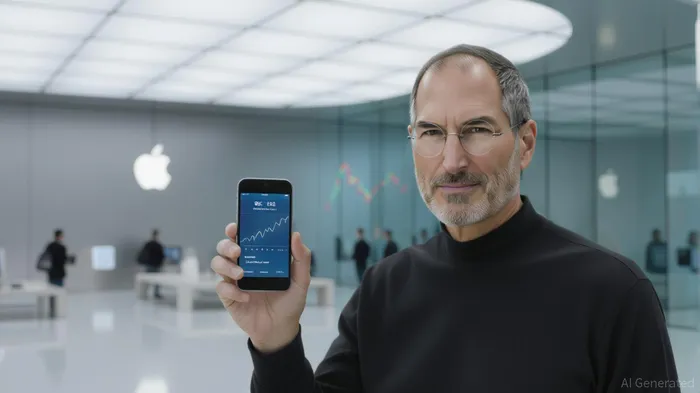
Founder-led companies consistently outperform their peers in uncertain environments. A 2024 study of 462 S&P 500 firms revealed that CEOs with high future temporal depth (FTD)—a focus on long-term outcomes—experienced less severe economic losses during downturns. This is no accident. Founders often embed operational discipline, innovation buffers, and a relentless focus on core strengths into their companies' DNA. Consider Apple Inc.AAPL-- (AAPL), which was nearly bankrupt in 1997 when Steve Jobs returned. His decision to pivot from fruitless diversification to design-driven innovation not only saved the company but transformed it into a $3 trillion empire. Today, Apple's ecosystem of services and AI-driven products continues to deliver 500% stock growth since 2015.
Undervalued Gems: Founders Who Defied the Odds
While some founder-led giants are already household names, others remain undervalued despite their proven resilience. Take NVIDIA (NVDA), a semiconductor pioneer led by Jensen Huang. In the early 2010s, NVIDIANVDA-- struggled to compete with IntelINTC-- and AMDAMD--, but Huang's bet on GPU-driven AI and data center computing paid off. Today, with a $3 trillion market cap and a P/E ratio of 31, NVIDIA is a cornerstone of the AI revolution. Analysts project a 24% upside, driven by its Blackwell architecture and aggressive share repurchases.
Similarly, AppLovin (APP), under CEO Frank Gaudiosi, has reinvented itself from a mobile ad network to a software-centric platform. Its AI-driven Axon 2 system has boosted margins and user acquisition efficiency, making it a 129.7 billion-dollar market cap story. Despite its success, AppLovinAPP-- trades at a P/E ratio of 15, suggesting it remains undervalued relative to its growth trajectory.
The Power of Crisis-Tested Execution
Founder-led companies thrive when adversity forces them to adapt. Tesla (TSLA), led by Elon Musk, is a prime example. After near-bankruptcy in 2008 and production delays in the 2010s, TeslaTSLA-- became a $12 billion company by 2025. Musk's ability to maintain investor confidence during supply chain crises and regulatory scrutiny has positioned Tesla for sustained growth. With a 1,700% stock surge since 2015, Tesla's story is a testament to the power of crisis-tested execution.
Another standout is Anta Sports Products (2020.HK), founded by Ding Shizhong. Starting as a small shoe enterprise, Anta leveraged a long-term vision and strategic acquisitions (like Finland's Amer Sports) to become the third-largest sportswear company globally. Its 2018 acquisition of Amer SportsAS--, initially seen as a high-risk move, proved transformative, with Anta's revenue growing 300% since 2015.
Investment Strategy: Spotting the Signal in the Noise
For investors, the key is to identify founder-led companies with three traits:
1. Operational Discipline: Strong free cash flow generation and stakeholder trust.
2. Innovation Buffers: R&D investment and execution models tested in adversity.
3. Long-Term Vision: Avoidance of short-termism and a focus on compounding growth.
Consider Pinterest (PINS), which trades at a P/E of 18 with a 26% analyst upside. Its AI-driven ad platform and Gen Z user base position it to outperform in the digital advertising space. Similarly, Dell Technologies (DELL), with a $75.5 billion market cap, is benefiting from AI server demand and strategic partnerships with NVIDIA and AMD.
Conclusion: Building a Resilient Portfolio
The 2025 market environment, marked by macroeconomic volatility and AI-driven disruption, favors companies led by adversity-tested founders. These leaders, armed with institutional knowledge and a willingness to take bold risks, are uniquely positioned to navigate uncertainty and deliver compound growth. For investors, the challenge is to separate the signal from the noise—focusing on companies with strong founder alignment, crisis-tested strategies, and undervalued potential.
As the examples of AppleAAPL--, NVIDIA, and Anta demonstrate, the resilient founder is not just a relic of the past but a catalyst for the future. By investing in these visionaries, we can build portfolios that thrive in the face of adversity.

Delivering real-time insights and analysis on emerging financial trends and market movements.
Latest Articles
Stay ahead of the market.
Get curated U.S. market news, insights and key dates delivered to your inbox.
AInvest
PRO
AInvest
PRO



Comments
No comments yet