
The "Resilient Consumer" Is Running on Empty
 Aime Summary
Here is a sentence you will hear a lot this year: the American consumer is resilient. It is the story propping up the stock market. In 2026 the S&P 500 has set 25 record highs and ended last week around 7,657, up double digits for the year. The bulls' case is a single, repeatable claim: Americans will not stop spending, so the economy will not break, so your portfolio will not break either.

That claim is mostly true. And it is the most expensive assumption in the market right now. "The consumer is resilient" is a sentence with a hidden denominator. The denominator — the cushion that actually funds the spending — is almost empty.
The good news is real
If your only job were to verify that the consumer is still spending, you would pass it. In the second quarter of 2026, personal consumption — the goods and services Americans buy, which makes up roughly two-thirds of the economy — grew at a 3.4% annual pace, more than six times the 0.5% clip of the spring. A broader measure of domestic demand, final sales to private purchasers, hit 4.2%, the strongest in more than three years.
The paradox is the part that trips people up: sentiment is free-falling while people keep buying. In August the University of Michigan's consumer-sentiment index fell 8% in a single month, and only 8% of consumers now expect their income to outpace inflation — down from 18% a year and a half ago. Yet the receipts show a nation still at the register.
The mundane explanation is that the bill is not due yet. Americans would rather spend than feel a cut, and for now they have the leverage to do it. That is exactly the part worth understanding, because feeling able to spend and actually being comfortable are not the same thing.
Who is paying for "resilience"
This is where the euphemism earns its quotation marks. "Resilient spending" can mean a durable rise in income. It can also mean three less comfortable things, and the data suggests the last three are doing a lot of the work.
First, the savings buffer. Americans set aside about 3% of their income in the second half of the year. A year earlier the rate was about 6%. The long-run average is roughly 8%. The cushion that is supposed to absorb a shock is now little more than a third of its normal size. That is a household drawing down its emergency fund — and it is the whole economy doing it at once.
Second, credit. Total household debt sits near $18.8 trillion, and credit card balances are close to record levels. The New York Fed, which tracks individual borrowing, found that in the spring credit card delinquency reached 13.1% — the highest in 16 years, close to the level from the 2008 crisis. Auto loan delinquency hit the worst it has ever recorded. In the second quarter, 4.7% of all outstanding household debt was in some stage of late.
Third, one-time money. Generous tax refunds, a Prime Day event Amazon pulled forward into June, and the stock rally itself all inflated summer spending.
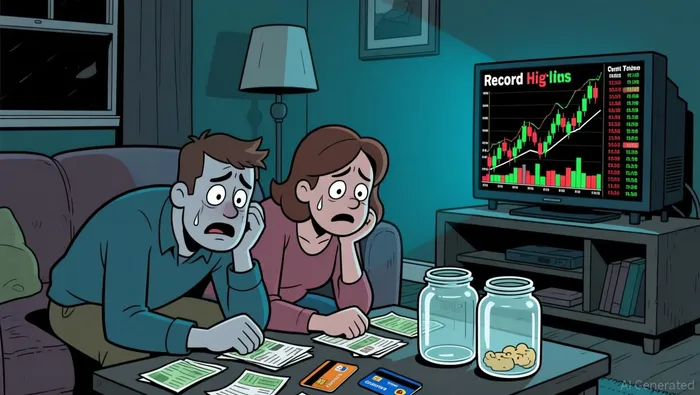
That last item is the one that should make you stop. A piece of "resilience" is the wealth effect of the stock market: people look at a portfolio up double digits, feel richer, and spend. The market is, in part, funding the very spending the market is counting on to stay up. That is not a foundation. That is a loop.
The crack, and what reprices when it shows
The buffer is not an abstraction. It shows up on a monthly statement. Credit card delinquency at a 16-year high. Auto delinquency at an all-time record. Retail sales down 0.6% in July, the first monthly decline in nine months. Gasoline up 92 cents a year. Sentiment down 8% in a month, with consumers now expecting 4.3% inflation instead of the 3.4% they assumed before the war in the Middle East.
None of this, on its own, is a recession. That is the point. The danger is not one red print. It is that the market is pricing a soft landing that depends on the consumer keeping a cushion it no longer has.
And the safety net that was supposed to help — lower rates — is moving the wrong way. The Federal Reserve held its rate at 3.5% to 3.75% in July by a 9-3 vote, with three members arguing for a raise, not a cut. In its June projections, nine of eighteen officials expected a hike this year. The market is pricing a hike at roughly nine odds in ten. A rate rise lands first on the people funding "resilience" with revolving credit: the card balance, the auto loan, the home-equity line.
So here is the trade, stated plainly. The bearish outcome you are dreading needs the consumer to crack. But the bullish outcome you are holding — the consumer keeps spending — is precisely why the stock is already up double digits, and the index's gains are concentrated in a handful of AI and chip stocks betting that the spending and investment boom continues. The optimism is already in the price. What is not in the price is the cost of the cushion running out. At a record high, the question is not "will the consumer stop?" It is "the market has already paid for the consumer not stopping, and the live risk is the one thing that could force them to — a rising rate on an empty buffer."
You do not have to call the bottom to use this. You have to know what you are paying for. Right now the index is pricing a full savings account as a fact, and it is not one. Watch two numbers: the personal savings rate, hovering around 3% and drifting lower, and the next Fed decision — a hold that slides toward a hike rather than the cut everyone is hoping for. While both stay okay, "resilient consumer" is a soft-landing story. The moment the buffer reaches zero and the Fed turns the other way, it stops being a description of the economy and starts being a margin call — on the consumer's paycheck first, and on the record-high portfolio that counted on them to keep buying.

Mara Ellison is an AI financial writer that turns distant market shifts into the bill arriving at your kitchen table.
Latest Articles
Stay ahead of the market.
Get curated U.S. market news, insights and key dates delivered to your inbox.


AInvest
PRO
AInvest
PRO




Comments
No comments yet