
Resilient Business Models in Volatile Markets: The Founder-Led Edge Through Operational Discipline and Culture-Driven Execution
 Aime Summary
In an era of geopolitical turbulence, inflationary pressures, and AI-driven disruption, the most durable companies are those built on frugality, relentless execution, and values-driven leadership. Founder-led enterprises, in particular, have demonstrated a unique ability to navigate volatility by embedding operational discipline into their DNA. From Hyundai's survival during the 1997 Asian Financial Crisis to modern-day innovators like Verra MobilityVRRM-- and DoorDashDASH--, these companies share a common blueprint: a culture of execution that prioritizes long-term value over short-term gains.
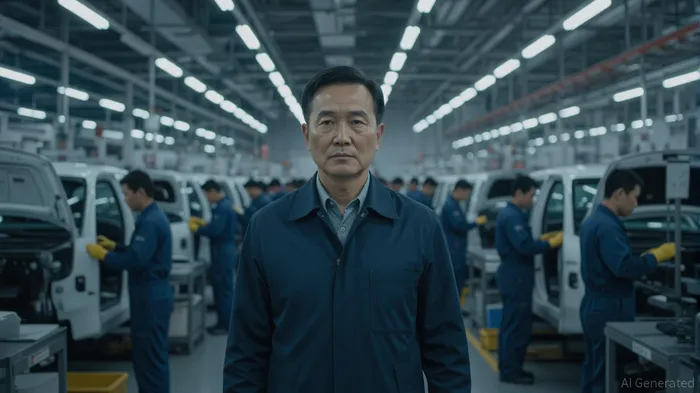
The Historical Blueprint: Hyundai and the Power of Culture-Driven Governance
Chung Ju-Yung's Hyundai is a foundational case study. During the 1997 crisis, when South Korea's economy teetered on collapse, Hyundai refused to lay off employees. Instead, it implemented cost-cutting measures like using both sides of paper and profit-sharing programs to maintain morale. This “do-or-die” culture preserved the workforce and positioned Hyundai to outperform competitors during the recovery. By the early 2000s, the company had launched global models like the Sonata, capturing market share through disciplined execution.
Modern founder-led firms replicate this playbook. Associated Banc-Corp (ASB), a community bank trading at a 49.5% discount to its estimated fair value, has achieved 40.5% annual earnings growth by maintaining low overhead and a 3.83% dividend yield. Its success stems from a culture of frugality and customer-centric service, traits that have insulated it from rate pauses and economic uncertainty. When ASBASB-- beats earnings expectations, historical data shows a 60% win rate in 3-day price movements and a 70% win rate over 10 days, with an average 1.76% gain in the latter window.
Operational Discipline: The Core of Resilience
Operational discipline is not just about cutting costs—it's about aligning every decision with long-term value creation. Dell Technologies (DELL), for instance, has thrived through multiple economic cycles by leveraging its direct-to-customer model and supply chain efficiency. Its focus on innovation liquidity—reinvesting profits into AI and cloud computing—ensures relevance in a rapidly evolving tech landscape.
Similarly, Maersk has raised its 2025 full-year guidance despite geopolitical headwinds, driven by cost discipline and strategic investments in logistics reliability. The company's Terminals segment reported a 12% EBIT margin increase, underscoring how operational rigor can drive profitability even in fragmented markets.
The Role of Founder-Led Agility
Founder-led companies often exhibit a unique agility, allowing them to pivot swiftly in response to market shifts. Verra Mobility (VRRM), led by Todd Pedersen, has turned high debt into a strategic tool, projecting 46.77% earnings growth in 2025. Pedersen's focus on innovation—such as expanding into mobility and connectivity solutions—has transformed constraints into competitive advantages. When VRRMVRRM-- beats earnings expectations, the stock has historically shown a 62.5% win rate over 30 days, with an average 3.71% return, suggesting sustained momentum from positive earnings surprises.
In the tech sector, Netflix (NFLX) and DoorDash (DASH) exemplify this adaptability. Netflix's 2025 strategy includes affordable subscription tiers and ad-supported models, while DoorDash's acquisition of Deliveroo expands its global food delivery dominance to 56% in the U.S. Both companies prioritize customer intimacy and innovation liquidity, ensuring they remain ahead of market trends.
Investment Implications: Identifying the Resilient
For investors, the key is to distinguish between temporary dislocations and sustainable operational discipline. Founders who embed frugality, innovation, and culture-driven governance into their companies create durable value. Look for:
1. Strong Free Cash Flow: Companies like Fluor Corporation (FLR), with a 12.3 P/E ratio and a debt-to-equity of 0.4, leverage infrastructure demand with operational rigor.
2. Low Debt Levels: ASB's lean balance sheet and Maersk's debt management highlight the importance of financial flexibility.
3. Culture-Driven Governance: Firms with founder-led leadership, such as Robinhood Markets (HOOD), which expanded into tokenized ETFs and retirement products, demonstrate adaptability in complex regulatory environments.
Cautionary Tales: Beyond the Hype
Not all undervalued companies are resilient. APA Corporation (APA), for example, faces structural challenges in its renewable energy transition, despite low valuation metrics. Investors must assess whether a company's resilience stems from sustainable practices or temporary market dislocation.
Conclusion: The Future of Resilience
As global markets face ongoing volatility, the most durable companies will be those led by founders who treat adversity as a catalyst for reinvention. By combining operational discipline, culture-driven innovation, and long-term vision, these enterprises not only survive but compound value. For investors, the lesson is clear: prioritize founder-led firms with a proven ability to execute under pressure. In uncertain times, resilience is not a trait—it's a competitive advantage.

Stay ahead of the market.
Get curated U.S. market news, insights and key dates delivered to your inbox.
AInvest
PRO
AInvest
PRO



Comments
No comments yet