
Resilient Business Models in Times of Adversity: Lessons from Chung Ju-Yung and Hyundai's Rise
 Aime Summary
In the annals of business history, few leaders have exemplified the fusion of frugality, strategic boldness, and long-term resilience as Chung Ju-Yung, the architect of the Hyundai Group. Born in the aftermath of the Korean War, Chung built an empire by prioritizing execution over rhetoric, fostering trust through employee welfare, and relentlessly pursuing innovation. Today, as global markets grapple with geopolitical tensions, inflationary pressures, and supply chain disruptions, the principles that guided Hyundai's rise remain as relevant as ever. This article explores how contemporary companies led by adversity-driven visionary leaders—those who mirror Chung's ethos—are undervalued yet poised for outperformance.
The Chung Ju-Yung Playbook: Traits of Resilience
Chung's legacy was built on four pillars:
1. Obsession with Execution: Hyundai's 1990s warranty gamble, which required 300,000 employees to overhaul quality control, is a case study in operational rigor.
2. Frugality as a Strategic Tool: Chung famously drove a secondhand car and lived modestly, channeling savings into innovation.
3. Trust-Building: Profit-sharing schemes and a “people-first” culture ensured loyalty during crises.
4. Relentless Improvement: From shipbuilding to automotive, Hyundai's pivot to high-margin sectors showcased adaptive foresight.
These traits are now evident in companies like Delta Airlines, Verra MobilityVRRM--, and FluorFLR-- Corporation—each led by leaders who transform adversity into opportunity.
Case Study 1: Delta Airlines (DAL) – Frugality Meets Operational Discipline
Ed Bastian, Delta's CEO, has transformed the airline from a near-bankrupt entity into a profit engine. His focus on employee profit-sharing, route optimization, and customer trust-building mirrors Chung's philosophy. Delta's trailing P/E of 7.63 (vs. its 5-year average of 16.7) suggests the market underestimates its resilience.
Despite a 14% drop in fuel costs and a 2.7% rise in non-fuel unit costs (CASM-Ex), Delta's free cash flow reached $2.33 billion in the trailing twelve months. Analysts project 2025 adjusted EPS of $5.25–$6.25, with a consensus price target 28.88% above the current price. For investors, Delta represents a high-conviction bet on a leader who balances frugality with growth.
Case Study 2: Verra Mobility (VRRM) – Innovation Through Resource Optimization
Todd Pedersen, CEO of Verra Mobility, scaled Vivint into a $3 billion enterprise and now leads a company at a 60% discount to its intrinsic value. Verra's focus on wireless vehicle tracking and tolling solutions is projected to grow earnings by 46.77% annually. Pedersen's frugal yet innovative mindset—investing in AI-driven logistics while maintaining lean operations—aligns with Chung's resource-optimization ethos.
At $25.01 per share, Verra trades far below its intrinsic value of $48.35. For those seeking long-term outperformance, this is a compelling opportunity.
Case Study 3: Fluor CorporationFLR-- (FLR) – Strategic Boldness in Energy Transition
Fluor's leadership has pivoted to clean energy, taking a 19.9% stake in NuScale PowerSMR--, a nuclear SMR pioneer. Despite a 42% drop in Q2 2025 adjusted EBITDA, Fluor's $28.2 billion in backlog—80% reimbursable—positions it to capitalize on the $2.5 trillion energy transition market. Its debt-to-equity ratio of 0.75 and $2.3 billion in cash provide flexibility.
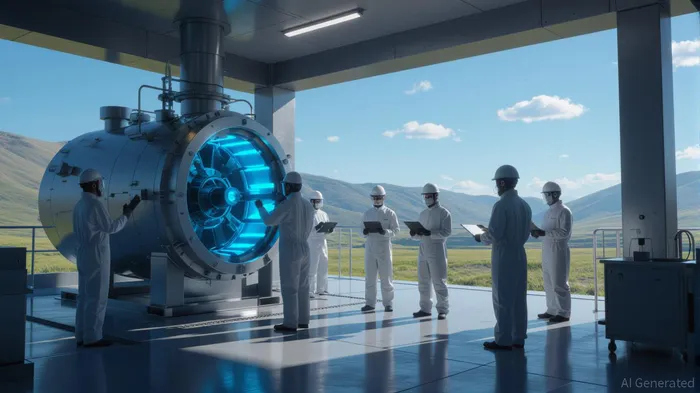
While short-term challenges persist, Fluor's focus on hydrogen, carbon capture, and nuclear renaissance aligns with Chung's long-term vision. At a P/E of 2.85, it appears undervalued.
The Chung Ju-Yung Framework for Investment
Identifying undervalued stocks in today's volatile markets requires more than financial metrics; it demands an assessment of leadership ethos. The companies highlighted above share traits that historically drive outperformance:
- High Conviction in Adversity: Leaders who double down on innovation during downturns (e.g., Delta's route optimization).
- Frugality-Driven Growth: Cost control without sacrificing R&D (e.g., Verra's AI-driven logistics).
- Trust as a Competitive Advantage: Employee-centric cultures that weather crises (e.g., Delta's profit-sharing).
Conclusion: Long-Term Resilience in a Short-Term World
In a market obsessed with quarterly earnings, companies led by Chung Ju-Yung-style leaders are often undervalued. Delta, Verra, and Fluor exemplify how frugality, execution, and strategic boldness create durable value. For investors willing to look beyond short-term volatility, these stocks represent high-conviction opportunities. As Chung once said, “A company is not built in a day.” The same holds true for resilient investments.
Investment Advice: Consider adding these companies to a diversified portfolio, with allocations weighted toward those with the strongest alignment to long-term trends (e.g., energy transition for Fluor, AI-driven logistics for Verra). Monitor quarterly reports for signs of execution consistency and leadership continuity. In times of adversity, patience and conviction in resilient business models are rewarded.

Delivering real-time insights and analysis on emerging financial trends and market movements.
Latest Articles
Stay ahead of the market.
Get curated U.S. market news, insights and key dates delivered to your inbox.


AInvest
PRO
AInvest
PRO



Comments
No comments yet