
Resilient Business Models in Drought-Stricken Economies: Unlocking Value in Climate-Adaptive Infrastructure and Agriculture


 Aime Summary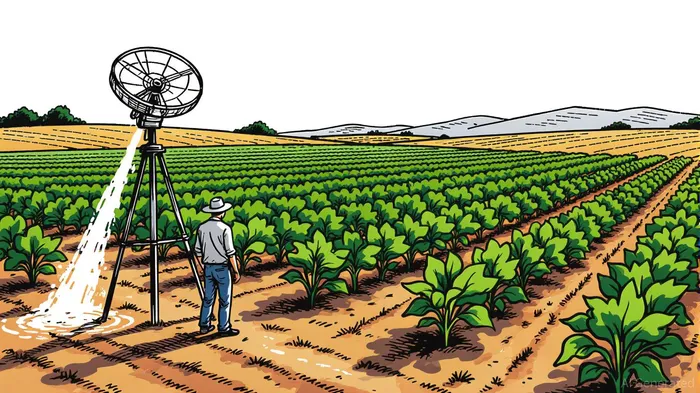
In a world where climate stress is reshaping economic landscapes, the survival of industries hinges on adaptability. North America, with its sprawling agricultural heartlands and forested regions, is at the forefront of this transformation. As droughts intensify and regulatory frameworks evolve, firms that integrate water efficiency, sustainable forestry, and reforestation into their core operations are not just surviving—they're thriving. For investors, the question is no longer whether to act, but how to position capital in companies poised to outperform in a warming climate.
The Climate-Driven Shift in Agriculture and Forestry
The agricultural sector, long reliant on predictable weather patterns, is now under siege from erratic rainfall, soil degradation, and water scarcity. In 2025, , driven by technological adoption and institutional investment in climate-resilient practices. Yet, this growth is uneven: while large agribusinesses secure capital for precision tools, smallholders and traditional operators face existential risks. The same dynamic applies to forestry, where deforestation and wildfires have eroded ecosystem resilience, creating a vacuum for firms that prioritize regenerative strategies.
Enter companies like and , which are redefining what it means to be “climate-smart.” These firms are not merely reacting to crises—they're engineering solutions that align with both ecological imperatives and market demands.
Farmonaut: The AI-Powered Water Efficiency Pioneer
Farmonaut, a satellite technology company, has emerged as a linchpin in the fight against agricultural water waste. By combining real-time satellite monitoring, AI advisory systems, and blockchain traceability, the company empowers farmers to optimize irrigation, reduce carbon footprints, and verify sustainable practices. In drought-stricken regions like California's Central Valley, .
Despite its transformative impact, Farmonaut remains undervalued relative to its market potential. , . Yet, Farmonaut's valuation lags behind peers in the AgTech sector, offering a compelling entry point for investors. Its affiliate program, , further underscores its scalable business model.
Silvacom: Reimagining Forest Management with GIS and Data Analytics
While agriculture grabs headlines, the forestry sector is undergoing a quieter revolution. Silvacom, a Canadian firm, is leading the charge with GIS mapping and sustainability consulting that optimize land use for governments and industries. By integrating geospatial data analytics, Silvacom enables stakeholders to monitor forest health, track carbon sequestration, and comply with regulatory standards.
The company's focus on cross-sector collaboration—bridging conservation, resource management, and economic development—positions it as a critical player in the $0.7 billion U.S. Agricultural and Forestry Water Retaining Agent market, . Silvacom's ability to balance ecological preservation with productivity makes it a rare asset in a sector often plagued by short-termism.
Komaza and Arbaro Advisors: Scaling Agroforestry and Carbon Sequestration
, though based in Kenya, offers a replicable agroforestry model that North American firms are increasingly adopting. By empowering smallholder farmers to grow sustainable timber, Komaza restores degraded landscapes while sequestering carbon and improving livelihoods. Its community-driven approach aligns with USDA initiatives like the Conservation Stewardship Program (CSP), which incentivizes regenerative practices.
Meanwhile, —a German firm with a North American footprint—specializes in timber production and carbon offset projects. Its expertise in emerging markets and ecosystem restoration positions it to capitalize on the $1.2 trillion global carbon credit market, which is expected to expand as governments enforce stricter emissions targets.
The Investment Case: Regulatory Tailwinds and Market Gaps
The USDA's provides a robust tailwind for these firms. Programs like the (EQIP) and (CIG) offer financial and technical support for water-efficient irrigation, cover cropping, and forest carbon projects. These initiatives not only reduce operational costs for farmers but also create a regulatory environment where climate-resilient firms gain a competitive edge.
Moreover, the growing demand for —driven by EPA regulations—signals a shift toward sustainable alternatives. Companies like and are investing in R&D to meet this demand, but their North American counterparts, such as Farmonaut and Silvacom, are better positioned to integrate these solutions into end-to-end systems.
Strategic Entry Points for Investors
For investors seeking undervalued opportunities, the key lies in early positioning within sectors undergoing structural change. Farmonaut's AI-driven platform and Silvacom's data analytics represent scalable solutions that align with both regulatory mandates and consumer demand for transparency. Similarly, Komaza's agroforestry model and Arbaro Advisors' carbon sequestration projects tap into the $1.2 trillion carbon credit market, which is expected to grow as governments enforce stricter emissions targets.
The risks, however, are not negligible. Regulatory shifts, technological obsolescence, and market saturation could challenge these firms. Yet, for companies with strong R&D pipelines and partnerships with institutions like the USDA, these risks are mitigated by their ability to adapt and scale.
Conclusion: Planting Seeds for Long-Term Resilience
In a climate-stressed world, resilience is the new currency. Firms like Farmonaut, Silvacom, and Komaza are not just surviving—they're building the infrastructure for a sustainable future. For investors, the opportunity lies in recognizing that these companies are not niche players but foundational pillars of a transformed economy. By investing in their growth, you're not just securing returns; you're contributing to a system where agriculture and forestry thrive in harmony with the planet.
The time to act is now. The market may undervalue these innovators today, but in a world where water is gold and forests are carbon sinks, their worth will only compound.

Delivering real-time insights and analysis on emerging financial trends and market movements.
Latest Articles
Stay ahead of the market.
Get curated U.S. market news, insights and key dates delivered to your inbox.


AInvest
PRO
AInvest
PRO



Comments
No comments yet