
The Resilience Playbook: How Adversity-Forged Founders Build Enduring Business Legacies
 Aime Summary
In an era of geopolitical uncertainty, inflationary pressures, and rapid technological disruption, the most enduring companies are those led by founders who have weathered adversity and built cultures of resilience. From Chung Ju-Yung's Hyundai to Elon Musk's TeslaTSLA--, founder-led enterprises have consistently demonstrated the ability to outperform during crises by prioritizing long-term vision, operational discipline, and stakeholder trust. For long-term value investors, identifying these companies—those with adversity-forged leadership and a playbook for navigating volatility—is not just prudent; it's essential.
The Chung Ju-Yung Legacy: Resilience as a Strategic Advantage
Chung Ju-Yung's Hyundai is a textbook case of founder-led resilience. During the 1997 Asian Financial Crisis, when competitors slashed costs by laying off workers, Chung retained employees and invested in lean operations and R&D. This decision preserved Hyundai's human capital and innovation pipeline, enabling the launch of globally successful models like the Sonata and Elantra in the early 2000s. A 2023 Purdue University study found that founder-led companies generate 31% more patents than their peers, underscoring the link between founder-driven innovation and long-term value creation.
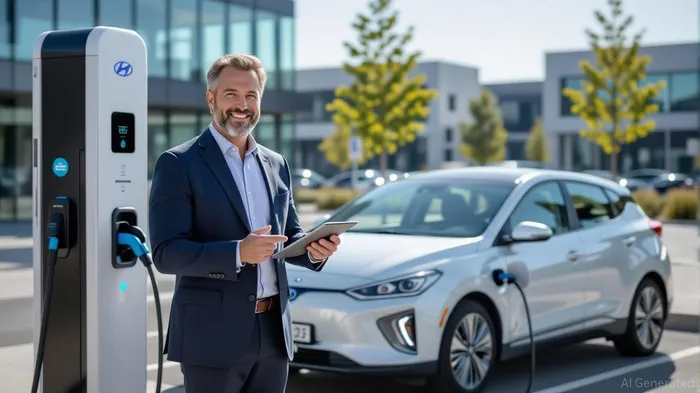
Hyundai's success was rooted in three pillars: relentless execution, strategic frugality, and people-centric trust. These principles remain relevant today. In 2025, Hyundai Motor Group is investing $21 billion into U.S. manufacturing through 2028 and aggressively pivoting to electric vehicles (EVs), mirroring the long-term strategies of modern founder-led giants like Tesla and MicrosoftMSFT--.
Modern Resilience: Founder-Led Companies in 2025
The traits that defined Chung Ju-Yung's success are now evident in a new generation of founder-led firms. Consider Verra Mobility (VRRM), led by Todd Pedersen, a former Vivint founder. In Q2 2025, Verra reported 6% year-over-year revenue growth, with 10.96% ROE and a 45% adjusted EBITDA margin. Despite these metrics, the stock trades at a 49.5% discount to its estimated fair value, reflecting the market's underappreciation of its resilience.
Verra's leadership, including newly appointed Executive Vice President Stacey Moser, has prioritized operational efficiency and strategic reinvention. The company's Commercial Services segment, which provides tolling and compliance solutions for fleets, grew revenue by 5% in Q2 2025, driven by expanding partnerships in North America and Europe. Meanwhile, its Government Solutions segment saw 10% growth, fueled by demand for smart mobility technologies.
Another standout is Associated Banc-Corp (ASB), a community bank led by James Rohr, who navigated the 2008 crisis by taking the bank private. In 2025, ASBASB-- trades at a 20% discount to its five-year price-to-book average, despite 12% annual deposit growth and a conservative debt structure. Its founder-led governance model—emphasizing low leverage, customer trust, and lean operations—has positioned it to thrive in a high-interest-rate environment.
The Resilience Premium: Quantifying Founder-Led Success
Founder-led companies are not just surviving—they're outperforming. A 2025 Oliver Wyman study found that such firms in emerging markets outperformed peers by 20% in ROA and ROE, driven by relational governance and trust-based leadership. For investors, this “resilience premium” can be measured through key indicators:
- R&D spending (≥5%): A proxy for long-term innovation.
- Free cash flow margins (15%+): A sign of operational efficiency.
- Employee retention rates: A reflection of culture and trust.
Tesla (TSLA), under Elon Musk, exemplifies this model. Despite recent volatility, Tesla's vertical integration and AI-driven production have allowed it to maintain 15%+ free cash flow margins. However, its 2025 governance structure—centered on Musk's $29 billion RSU package with no performance conditions—has drawn criticism for lacking accountability.
Actionable Investment Strategies
For long-term value investors, the playbook is clear: seek founder-led companies with adversity-shaped leadership, operational grit, and a track record of navigating downturns. Here are three actionable steps:
1. Focus on R&D and Free Cash Flow: Prioritize companies with R&D spending ≥5% and free cash flow margins ≥15%. Verra MobilityVRRM-- and ASB meet these criteria.
2. Assess Governance Structure: Look for founder-led firms with transparent, trust-based governance. Avoid those with opaque pay structures or weak board independence (e.g., Tesla's 2025 RSU package).
3. Monitor Resilience Metrics: Track metrics like employee retention, debt-to-EBITDA ratios, and recurring revenue streams. Hyundai's 95% recurring service revenue and 45% EBITDA margins make it a compelling case study.
Conclusion: The Future Belongs to Resilient Founders
The legacy of Chung Ju-Yung and other adversity-forged founders proves that resilience is not just a trait—it's a strategic advantage. In 2025, companies like Verra Mobility, Associated Banc-CorpASB--, and Hyundai Motor Group are replicating this playbook, combining operational discipline with long-term vision to navigate uncertainty. For investors, these firms represent not just undervalued opportunities but blueprints for enduring success in a volatile world.

Stay ahead of the market.
Get curated U.S. market news, insights and key dates delivered to your inbox.
AInvest
PRO
AInvest
PRO



Comments
No comments yet