
Resilience Infrastructure in Flood-Prone Regions: A Lucrative Frontier for Disaster Recovery Investments


 Aime Summary
The escalating frequency and severity of climate-related disasters are reshaping the investment landscape, with resilience infrastructure in flood-prone regions emerging as a critical growth sector. As global temperatures rise and extreme weather events become the new normal, the demand for flood damage restoration services and climate adaptation technologies is surging. This article examines the confluence of market dynamics, policy shifts, and technological innovation driving this transformation, offering actionable insights for investors seeking to capitalize on this expanding frontier.
Market Growth: A Climate-Driven Boom
The global disaster restoration services market, valued at $41.2 billion in 2023, is projected to grow at a compound annual growth rate (CAGR) of 5.7%,
reaching $75.8 billion by 2034. Flood damage restoration alone accounts for 41% of this demand, driven by the increasing frequency of hurricanes, wildfires, and floods linked to climate change. In the U.S., the restoration industry was valued at $7.1 billion in 2025, with flood-related property damage claims representing 27.6% of total property damage in 2022.
The U.S. market for disaster restoration services is expected to expand at a CAGR of 6.1%, hitting $8.4 billion by 2034.
This growth is further underscored by the financial toll of disasters: the U.S. experienced 28 billion-dollar climate events in 2023, with annual spending on disaster-related repairs averaging $23 billion from 2021 to 2023. The economic imperative to mitigate these costs is creating a fertile ground for innovation and investment.
Policy Shifts: Federal and State-Level Catalysts
Federal and state-level policies are playing a pivotal role in shaping the resilience infrastructure landscape. While
the Trump administration's cancellation of the BRIC program disrupted $3 billion in pre-disaster mitigation projects for fiscal years 2020–2023, states have stepped in to fill the gap. For instance, Florida allocated $150 million through its Resilient Florida Program, Virginia dedicated $67 million to community resilience projects, and
Connecticut established a Severe Weather Mitigation and Resiliency Advisory Council.
Legislative efforts like the Infrastructure Investment and Jobs Act (IIJA) and Inflation Reduction Act (IRA) are also fueling resilience investments.
These programs provide grants and technical assistance to enhance the resilience of transportation, energy, and water systems. Meanwhile,
the reauthorization of the National Flood Insurance Program in March 2025 ensures continuity for policyholders and supports pre-disaster mitigation efforts.
Technological Innovation: The New Frontier
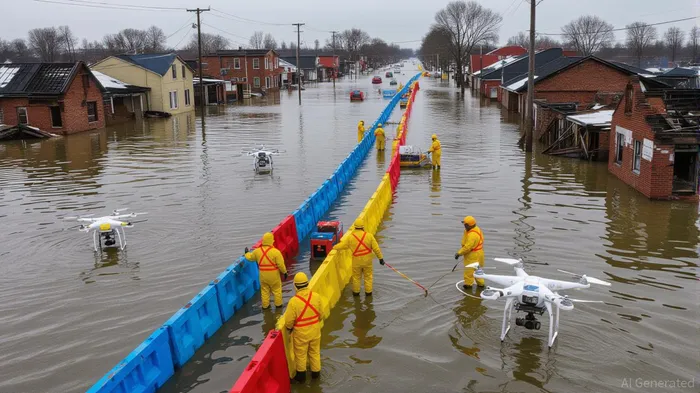 Technological advancements are revolutionizing flood damage restoration and climate adaptation.
AI-driven damage assessment tools, drones, and satellite imaging are streamlining disaster response, reducing recovery times, and minimizing secondary economic shocks. Startups like Zesty.ai and Skydio are leveraging these technologies to accelerate post-disaster assessments and infrastructure inspections.
Emerging companies are also gaining traction in the flood resilience space.
FloodBreak achieved a 281% three-year revenue increase, while international firms like Fathom and FloodMapp are entering the U.S. market to address gaps in flood risk data.
The McKinsey report estimates that climate resilience technologies could unlock a $1 trillion investment opportunity by 2030, as market actors increasingly price in climate risks.
Case Studies: Proven ROI and Scalability
The economic case for resilience investments is compelling.
A Johns Hopkins University study found that every $1 million invested in flood-resilient infrastructure creates approximately 40 jobs, with a $1 billion investment potentially generating 40,000 jobs. In Coastal Louisiana, 80% of subcontracts for flood infrastructure projects went to local businesses, highlighting localized economic benefits.
Pre-disaster mitigation also delivers significant cost savings.
The SmarterSafer Coalition reports that every $1 invested in mitigation saves up to $13 in recovery costs. These metrics underscore the shift from reactive post-disaster spending to proactive resilience-building-a trend that investors can capitalize on through public-private partnerships and technology-driven solutions.
Investment Opportunities: Where to Focus
For investors, the resilience infrastructure sector offers multiple entry points:
1.
Technology-driven restoration firms like Zesty.ai and Skydio are scaling AI and drone-based solutions to enhance disaster response efficiency.
2.
Passive flood protection systems such as flood barriers and water management systems are gaining traction.
3.
State-level resilience programs like those in Florida and Virginia are allocating significant funds for flood management, creating opportunities for infrastructure developers and consultants.
4.
Climate adaptation SaaS platforms such as ECOshifter and RIFFAI are leveraging digital tools to simulate adaptation strategies and monitor environmental risks.
Conclusion: A Resilient Future Requires Strategic Investment
The convergence of climate-driven market growth, policy support, and technological innovation is creating a robust ecosystem for resilience infrastructure in flood-prone regions. As disasters become more frequent and costly, the economic and social returns on pre-disaster investments are becoming undeniable. For investors, the key lies in aligning capital with scalable solutions that address both immediate recovery needs and long-term climate adaptation. The window to act is narrowing-but the opportunities are vast.

Stay ahead of the market.
Get curated U.S. market news, insights and key dates delivered to your inbox.


AInvest
PRO
AInvest
PRO



Comments
No comments yet