
The Resilience of U.S. Equities: How Record ETF Flows Signal Unwavering Investor Confidence Amid Turbulence
 Aime Summary
In 2025, the U.S. equity market has become a battleground of contrasting forces: macroeconomic headwinds, geopolitical tensions, and policy uncertainty on one side; and a surge in institutional and retail capital flowing into S&P 500 ETFs on the other. The data tells a compelling story of investor resilience, with year-to-date ETF inflows surpassing $500 billion by June—well above the $380 billion pace of 2024 and on track to eclipse the previous record of $1.12 trillion. This trend, driven by both retail and institutional players, underscores a growing conviction in the S&P 500's ability to weather volatility and deliver long-term returns.
A Tale of Two Investor Types
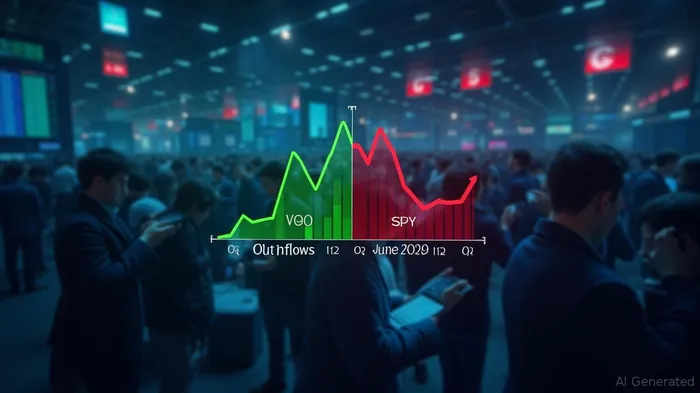
The divergence between institutional and retail flows has never been more pronounced. Retail investors, often characterized as “buy-the-dip” enthusiasts, have poured over $33 billion into retail-oriented S&P 500 ETFs like VOO (Vanguard S&P 500 ETF) and SPLG (SPDR Portfolio S&P 500 ETF) since March 2025. Even during the S&P 500's 26% decline in early 2025, these ETFs attracted record inflows, including $22 billion into SPLG in April alone. This behavior reflects a retail appetite for low-cost, broad-market exposure, with VOO's 0.03% expense ratio making it a favorite for passive investors.
In contrast, institutional flows have been more cautious. The SPDR S&P 500 ETF Trust (SPY) saw a staggering $26.9 billion in outflows in April 2025, despite its historical dominance. Similarly, the iShares Core S&P 500 ETF (IVV) has faced skepticism from large asset managers, who have shifted capital toward sectors like energy and defensive stocks. This institutional hesitancy may stem from macroeconomic concerns, including rising interest rates and the potential for a U.S. recession in 2026.
The Power of Retail Momentum
Retail-driven inflows have become a cornerstone of the S&P 500's momentum. JPMorganJPM-- estimates that retail investors added $270 billion to equities in the first half of 2025, with projections of $360 billion by year-end. This buying spree has offset institutional caution, particularly during periods of market stress. For instance, when reciprocal tariffs were announced in April, VOO and SPLG still attracted $11.1 billion and $22 billion in inflows, respectively.
This retail resilience is further amplified by the democratization of investing. Low-cost platforms, fractional shares, and social trading apps have enabled a new generation of investors to treat the S&P 500 as a “floor” for portfolio growth. The result? A self-reinforcing cycle where inflows drive index performance, which in turn attracts more capital—a dynamic reminiscent of the 2021 meme stock frenzy but with broader, more sustainable implications.
Institutional Caution and the Road Ahead
While retail optimism fuels the S&P 500's ascent, institutional investors remain wary of structural risks. The U.S. Federal Reserve's tightening cycle, a potential debt ceiling crisis, and global trade disputes have prompted large funds to reallocate toward defensive sectors and cash. For example, the iShares Core S&P 500 ETF (IVV) saw a $14.25 billion inflow in June 2025, but this came after months of outflows—a sign of strategic repositioning rather than outright bullishness.
This duality presents a unique investment opportunity. The S&P 500's low valuation (as of June 2025) and its status as a “flight-to-quality” asset in times of uncertainty make it a compelling long-term bet. However, investors should remain mindful of sector imbalances. For instance, tech-heavy ETFs like XLK (Semiconductor Select Sector SPDR Fund) have underperformed compared to the broader index, suggesting a rotation away from growth stocks.
Strategic Recommendations for Investors
- Diversify Across ETF Types: Investors should consider a mix of retail-friendly, low-cost ETFs (e.g., VOO) and institutional-grade options (e.g., IVV) to balance accessibility and liquidity.
- Monitor Sector Rotation: With institutional flows favoring energy and utilities, consider allocating a portion of your portfolio to sector-specific ETFs like XLE (Energy Select Sector SPDR Fund) or XLU (Utilities Select Sector SPDR Fund).
- Leverage Dollar-Cost Averaging: Given the S&P 500's volatility, consistent, periodic investments in broad-market ETFs can mitigate timing risks while capturing long-term growth.
- Stay Cautious on Tech Overexposure: While the S&P 500 includes tech giants, institutional caution around high-growth stocks suggests a potential underperformance in sectors like AI and semiconductors.
Conclusion: Confidence Amid Chaos
The record inflows into S&P 500 ETFs in 2025 are a testament to the index's enduring appeal. Despite macroeconomic turbulence, both retail and institutional investors are signaling their belief in the U.S. equity market's ability to adapt and thrive. For individual investors, this means a rare alignment of accessibility, affordability, and institutional validation. However, as always, prudence is key—leveraging the S&P 500's strength while hedging against sector-specific risks will be critical in navigating the uncertain landscape ahead.

Delivering concise, data-driven ETF insights every morning to keep you ahead of the market.
Latest Articles
Stay ahead of the market.
Get curated U.S. market news, insights and key dates delivered to your inbox.


AInvest
PRO
AInvest
PRO



Comments
No comments yet