
The Resilience of the U.S. Economy and Its Implications for Equity Markets
 Aime Summary
The U.S. economy continues to defy expectations, with robust employment data, resilient consumer spending, and a mixed but durable corporate earnings season reinforcing the case for equities as a strategic asset class. While global uncertainties—ranging from geopolitical tensions to trade policy shifts—loom large, the domestic labor market and consumer sector remain pillars of strength, offering tactical opportunities for investors.
Labor Market: A Foundation of Stability
June 2025's employment report underscored the labor market's resilience, with nonfarm payrolls rising by 147,000, slightly above expectations. This growth was driven by state government jobs (+73,000) and healthcare (+39,000), sectors insulated from the broader macroeconomic risks. The unemployment rate held steady at 4.1%, a level not seen since February 2025, and the labor force participation rate remained at 62.3%. These metrics suggest a labor market that, while cooling, is far from a crisis.
The durability of employment is critical for equity markets. A stable labor market supports consumer spending, which accounts for ~70% of U.S. GDP. Sectors like healthcare and education, which are beneficiaries of long-term demographic trends and policy-driven demand, offer defensive appeal. Investors may consider overweighting these areas, particularly as wage growth (up 3.7% year-over-year) provides a buffer against inflationary pressures.
Retail Sales: Consumer Resilience Amid Tariff Hikes
Retail sales data for June 2025 revealed a 0.6% monthly increase, reversing a 0.9% decline in May and surpassing expectations. Year-over-year, total retail sales grew by 3.9%, with core retail (excluding autos, gasoline, and food services) rising 0.5%. While tariff-driven price increases skewed some categories (e.g., electronics, furniture), sectors like auto dealerships (+1.2%), building materials (+0.9%), and food services (+0.6%) demonstrated strong volume growth.
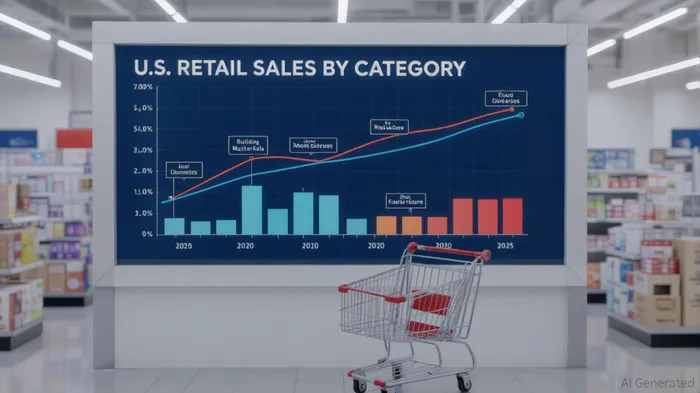
The consumer's ability to absorb tariffs and maintain spending is a tailwind for equities. Defensive sectors like utilities and consumer staples have held up, but the broader rebound in discretionary spending—particularly in travel and services—points to a shift in consumer priorities. Delta Airlines (ticker: DAL), for example, reported robust Q2 earnings, with premium cabin demand outpacing goods consumption. This trend suggests a reacceleration in services-driven growth, a sector that has historically outperformed during periods of high inflation and interest rates.
Earnings Season: Tech-Driven Resilience
The Q2 2025 earnings season, while modest (4.8% year-over-year S&P 500 growth), highlighted sectoral divergences. Technology and communication services led the charge, with AI-driven demand boosting companies like Micron TechnologyMU-- (ticker: MU), which reported a 30% earnings beat. Conversely, energy (ticker: XLE) and traditional retail (ticker: XRT) lagged, with the latter grappling with inventory overhang and weak consumer appetite for full-price goods.
The earnings data underscores the importance of aligning portfolios with long-term structural trends. AI, cloud computing, and productivity software remain high-conviction areas, while sectors facing margin compression—such as energy and retail—require cautious positioning. Notably, the S&P 500's earnings recovery post-April's tariff-related selloff (despite a 0.5% Q1 GDP contraction) suggests that corporate America is adapting to policy shocks, a bullish signal for equity valuations.
Tactical Opportunities and Risk Management
The interplay of strong employment, resilient consumer spending, and sectoral earnings growth creates a compelling case for risk assets. However, investors must remain cognizantCTSH-- of macroeconomic risks:
1. Interest Rates: The Federal Reserve's reluctance to cut rates (despite inflation easing) keeps borrowing costs elevated, dampening housing and business investment.
2. Trade Policy Uncertainty: While the 90-day tariff pause stabilized markets, the eventual implementation of “reciprocal tariffs” could reintroduce volatility.
3. Sectoral Divergence: Durable goods and interest-rate-sensitive sectors (e.g., autos, housing) face headwinds, while services and AI-driven tech remain resilient.
A tactical approach would involve:
- Overweighting AI and Services: Position in AI infrastructure (e.g., NVIDIANVDA--, AMD) and services (e.g., Delta, Expedia).
- Defensive Hedges: Allocate to healthcare (XLV) and utilities (XLU) for stability.
- Avoiding Tariff-Exposed Sectors: Underweight energy and traditional retail until policy clarity emerges.
Conclusion
The U.S. economy's resilience—anchored by a strong labor market, adaptable consumer base, and innovation-driven corporate earnings—provides a solid foundation for equities. While near-term risks persist, the data supports a long-term bullish case for risk assets, particularly in sectors aligned with structural growth trends. Investors who navigate sectoral divergences and maintain a disciplined approach to risk management will be well-positioned to capitalize on the evolving market dynamics.

Stay ahead of the market.
Get curated U.S. market news, insights and key dates delivered to your inbox.






Comments
No comments yet