
The Resilience of Earnings in Hard-Hit Sectors Amid Tariff Uncertainty
 Aime Summary
The global trade landscape has been reshaped by aggressive tariff policies since 2023, with the U.S. imposing IEEPA tariffs on China, Mexico, and Canada, and retaliatory measures from trade partners. These policies have disproportionately impacted sectors reliant on cross-border supply chains, including mining, agriculture, manufacturing, transportation, and wholesale trade. Yet, within this turbulence, a select group of companies has demonstrated operational discipline and execution prowess akin to Hyundai under Chung Ju-yung—prioritizing long-term vision, frugality, and innovation to outperform peers.
The Tariff-Driven Challenges
The mining sector, with a vulnerability score of 82.3, faces acute pressure due to its reliance on foreign commodities like rare earths from China and oil from Canada. Similarly, agriculture (79.3) and manufacturing (70.6) grapple with disrupted supply chains and retaliatory tariffs. Transportation and wholesale trade, while less directly exposed, are indirectly vulnerable through their dependence on energy and imported goods. The economic toll is stark: U.S. households face a $1,254 tax increase in 2025, and GDP is projected to contract by 0.9% before foreign retaliation.
Operational Discipline as a Competitive Edge
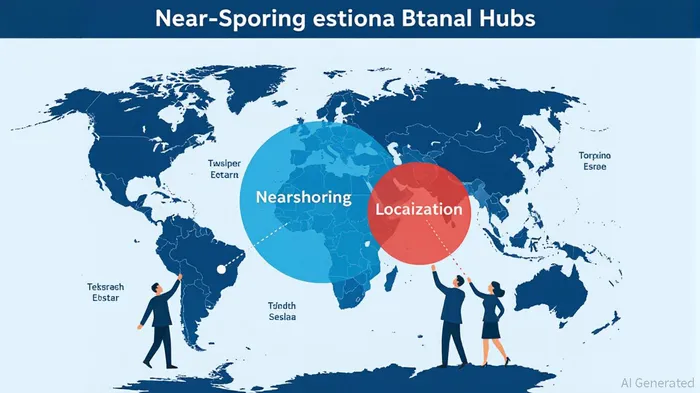
Companies that thrive in such environments share common traits: strategic localization, supply chain diversification, and AI-driven efficiency. These strategies mirror the principles of Chung Ju-Yung, who transformed Hyundai into a global powerhouse by emphasizing cost discipline, R&D investment, and regional production.
1. Xometry (NASDAQ: XMTR): AI-Powered Manufacturing Resilience
Xometry, a digital manufacturing platform, exemplifies frugality and innovation. In Q2 2025, it reported record revenue of $163 million and turned a $2.6 million EBITDA loss into a $3.9 million profit. By leveraging AI to optimize production workflows and reduce waste, XometryXMTR-- has scaled efficiently while maintaining profitability. Its "supplier + 1" strategy ensures redundancy in sourcing, mitigating risks from tariffs on Chinese components.
2. Hyundai Motor Group: Localization as a Tariff Shield
Hyundai's $21-billion investment in the Georgia Metaplant America underscores its commitment to localization. By producing 70% of U.S.-bound vehicles domestically by 2028, the company bypasses tariffs and insulates its supply chain from geopolitical shocks. This strategy mirrors Chung Ju-Yung's 1997 crisis-era playbook, where R&D investment and cost efficiency enabled survival during the Asian Financial Crisis.
3. Caterpillar (CAT): Reshoring and Digital Twins
Caterpillar has reshored critical manufacturing to the U.S. and Mexico, aligning with the Inflation Reduction Act's incentives. Its use of digital twins for supply chain modeling allows real-time adjustments to tariff-driven disruptions. Caterpillar's EBITDA margin of 15.2% in 2024 reflects its disciplined capital allocation and focus on high-margin, localized production.
4. Tesla (TSLA): Vertical Integration and Nearshoring
Tesla's Texas Gigafactory exemplifies nearshoring and vertical integration. By producing batteries and EVs domestically, TeslaTSLA-- avoids tariffs on Chinese components and reduces logistics costs. Its 2024 revenue of $96.8 billion, up 35% year-over-year, highlights the payoff of localized production and AI-driven efficiency.
The Role of Founder-Led Governance
Companies with founder-led governance, such as Constellation BrandsSTZ-- (STZ) and Berkshire Hathaway (BRK), prioritize long-term value creation. Constellation's 12% R&D-to-revenue ratio and conservative balance sheet enable it to navigate agricultural sector volatility. Berkshire Hathaway's focus on reinvestment in high-growth sectors (e.g., renewable energy) mirrors Chung's emphasis on strategic diversification.
Investment Implications
For investors, the key is to identify firms with:
- EBITDA efficiency above 15% (e.g., Xometry, Caterpillar).
- R&D-to-revenue ratios between 5–10% (e.g., Tesla, Constellation Brands).
- Founder-led governance (e.g., Berkshire Hathaway).
- Localization strategies (e.g., Hyundai, Tesla).
Conclusion
Tariff uncertainty is a double-edged sword: it disrupts but also rewards companies with operational discipline. By adopting strategies akin to Hyundai under Chung Ju-Yung—prioritizing localization, AI-driven efficiency, and frugality—firms in mining, agriculture, and manufacturing can transform volatility into competitive advantage. For investors, the path forward lies in backing these resilient leaders, whose earnings resilience will outpace sector averages in the years ahead.

Stay ahead of the market.
Get curated U.S. market news, insights and key dates delivered to your inbox.




Comments
No comments yet