
The Resilience of Core Equities in a Shifting Market: SPY ETF's Recent Surge and What It Means for Long-Term Investors


 Aime Summary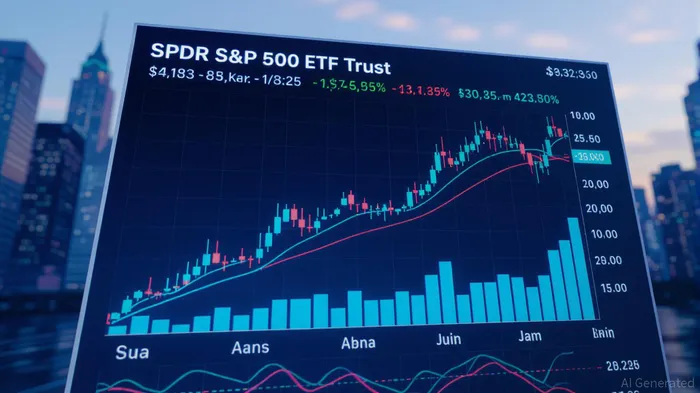
In an era defined by geopolitical uncertainty, AI-driven macroeconomic shifts, and the lingering shadow of Trump-era tariffs, the SPDR S&P 500 ETF Trust (SPY) has emerged as a beacon of stability. Despite a turbulent Q2 2025 marked by trade wars and inflationary pressures, SPY closed at $631.17 on August 5, 2025, reflecting a 1.52% daily gain and a 1.38% year-to-date rise. This performance underscores a critical question for investors: Can core equities still serve as a reliable anchor in a world increasingly dominated by volatility and algorithmic trading?
Structural Strength in a Fragmented Market
SPY's resilience stems from its structural advantages. With a market capitalization exceeding $570 billion and a 0.09% expense ratio, the ETF tracks the S&P 500's broad diversification across 11 sectors. Unlike the tech-driven rallies of 2023–2024, Q2 2025 saw industrials, utilities, and financials outperform, signaling a more balanced recovery. For instance, Johnson & Johnson's 5.8% revenue growth and Carnival Corporation's $6.3 billion quarterly earnings highlighted the strength of non-tech sectors. This diversification mitigates the risk of overreliance on a single industry, a critical factor as AI-driven productivity gains begin to permeate traditional sectors like manufacturing and energy.
Technical indicators further reinforce SPY's bullish trajectory. A golden cross occurred on June 27, 2025, as the 50-day moving average ($601.22) crossed above the 200-day ($585.47), historically signaling long-term growth. The RSI (64.37) and ADX (32.39) suggest a moderate uptrend, while the MACD's recent positive turn indicates momentum. These signals, combined with institutional buying around $615–$620, paint a picture of an ETF poised to test key resistance levels at $633–$645.
Navigating Macroeconomic Crosscurrents
The Federal Reserve's cautious stance has been a double-edged sword. With the federal funds rate held at 5.50% and only two projected rate cuts for 2025, liquidity constraints persist. However, the Fed's pivot from aggressive tightening to a “wait-and-see” approach has stabilized risk-on sentiment. A dovish surprise in August could push SPY toward $645, while a hawkish hold might cap gains at $633. Meanwhile, the U.S.–EU trade deal, which slashed tariffs to 15%, has injected optimism, with SPY hitting record highs shortly after the agreement.
Conversely, Trump's 35% tariffs on Canadian imports and proposed 25%–40% levies on other trade partners pose risks. These policies could inflate consumer prices and erode corporate margins, particularly for retail and industrial firms. Yet, the S&P 500's structural strength—bolstered by AI-driven productivity gains and a diversified earnings base—suggests that SPY is better positioned to weather these headwinds than sector-specific ETFs.
AI and the New Paradigm of Market Analysis
Artificial intelligence has revolutionized how investors interpret SPY's movements. Platforms like Tickeron use Financial Learning Models (FLMs) to analyze volume trends, macroeconomic data, and sentiment from social media. For example, Tickeron's AI accurately predicted SPY's rise to $610 following a bullish moving average crossover in May 2025. Such tools also identify support/resistance levels ($590 and $610, respectively) and generate real-time signals for swing traders.
The integration of AI extends beyond SPY. Tesla's $16.5 billion AI chip deal with Samsung and NVIDIA's 40% April 2025 surge illustrate how algorithmic insights are reshaping corporate valuations. For SPY, this means exposure to AI-driven growth across multiple sectors, from semiconductors to autonomous vehicles. Goldman SachsGS-- estimates AI could boost U.S. GDP by 2027, a tailwind for the S&P 500's long-term trajectory.
Strategic Rebalancing for Stability and Growth
For long-term investors, SPY offers a compelling case for rebalancing portfolios toward core equities. Its low expense ratio, dividend yield of 1.5%, and historical annualized return of 12.8% make it a cost-effective alternative to actively managed funds. Moreover, SPY's structural diversification provides a buffer against sector-specific downturns, a critical advantage in an AI-driven economy where volatility is the norm.
However, investors must remain vigilant. Short-term risks include seasonal weakness in August/September, overbought conditions (RSI at 64.37), and potential tariff-driven inflation. A hedging strategy—such as using inverse ETFs or put options—can mitigate downside risks if SPY breaks below $636.65. Conversely, those with a longer horizon should consider dollar-cost averaging into SPY, leveraging its projected 2026–2030 growth (averaging $662.95–$755.63) driven by AI, demographic shifts, and global trade normalization.
Conclusion: Core Equities as a Foundation
The SPY ETF's recent surge is not a fluke but a reflection of the S&P 500's enduring structural strength. In a market increasingly shaped by AI, geopolitical tensions, and macroeconomic uncertainty, core equities offer a rare combination of stability and growth potential. For investors seeking to navigate this complex landscape, SPY remains a cornerstone—providing broad exposure to innovation, diversification, and the resilience of America's largest corporations.
As always, consult a financial advisor to align these insights with your personal investment goals. The future of markets may be algorithmic, but the fundamentals of prudent portfolio management remain timeless.

Delivering real-time insights and analysis on emerging financial trends and market movements.
Latest Articles
Stay ahead of the market.
Get curated U.S. market news, insights and key dates delivered to your inbox.


AInvest
PRO
AInvest
PRO



Comments
No comments yet