
The Resilience of Core Bitcoin Longs Amid Shitcoin Exodus
 Aime Summary
The cryptocurrency market in late 2025 has been defined by a tug-of-war between Bitcoin's enduring dominance and the fleeting allure of altcoins. While the Altcoin Season Index reached its highest level since mid-October 2025, Bitcoin's dominance index fell to 58.8% in November, signaling a tentative reallocation of capital toward smaller tokens. Yet, this shift has not translated into sustained altcoin outperformance. For the fourth consecutive year, small-cap tokens hit a four-year low in market value, underscoring the fragility of altcoin rallies amid macroeconomic headwinds and regulatory uncertainty. Amid this backdrop, core BitcoinBTC-- longs have demonstrated remarkable resilience, leveraging sophisticated risk management strategies to navigate the exodus of capital from altcoins and maintain their positions in the face of volatility.
Capital Reallocation: A Tenuous Shift
The decline in Bitcoin's dominance has sparked speculation about an emerging altcoin season. However, analysts caution that this dip may reflect broader market weakness rather than a structural rotation. For instance, Ethereum attracted $12.7 billion in inflows in 2025, driven by ecosystem upgrades and staking demand, while Ethena benefited from stablecoin adoption. Yet, these gains were concentrated in a narrow subset of altcoins, with Solana and Base-ecosystem projects capturing most of the attention. The Altcoin Season Index, though showing early positive signals, remains below the threshold for a full-scale altcoin season, defined as when at least 75% of the top 50 altcoins outperform Bitcoin over 90 days. This suggests that capital reallocation remains fragmented and speculative, rather than a coordinated shift in investor sentiment.
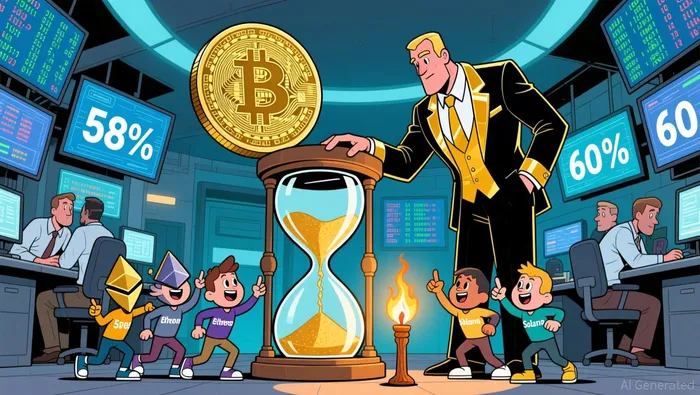
The Resilience of Bitcoin Longs
Despite the outflows from altcoins, core Bitcoin holders have maintained their positions through disciplined risk management. A critical factor in their resilience is the reactivation of dormant Bitcoin holdings. By late 2025, nearly $300 billion worth of Bitcoin that had been held for over a year re-entered circulation, creating sustained selling pressure. This liquidity challenge was exacerbated by the October 10 crash, triggered by Trump's tariff announcements, which wiped out $20 billion in leveraged trades. Core holders mitigated these risks by adopting hedging mechanisms such as perpetual futures and options, allowing them to protect against short-term volatility while retaining long-term exposure. Platforms like Phemex and Binance became critical for their deep liquidity and automation capabilities, enabling real-time adjustments to funding rates and leverage ratios.
Institutional investors further diversified their portfolios by allocating 60-70% to Bitcoin and Ethereum, with 20-30% in altcoins and 5-10% in stablecoins. This strategy balanced growth potential with risk mitigation, particularly as DeFi's total value locked stagnated. Additionally, delta-neutral strategies and options-based protection were deployed to hedge downside risk while participating in upside potential. These tactics reflect a broader shift toward structured risk management, blending traditional hedge fund techniques with blockchain-specific tools.
Liquidity and Macro Considerations
The resilience of Bitcoin longs also hinges on liquidity management. As Bitcoin ETFs faced $300 million in outflows in December 2025, institutional investors retreated to Bitcoin and EtherETH--, leaving altcoins vulnerable to capital outflows. This trend highlights the importance of multi-asset margin systems, which allow unrealized gains in one position to offset losses in another. For example, during the October crash, directional crypto funds suffered losses of up to 23%, underscoring the need for collateral management to avoid cascading liquidations.
Looking ahead, the coming weeks will be pivotal in determining whether the current capital reallocation is a temporary divergence or the start of a meaningful altcoin season. Technical indicators such as the Altcoin Season Index, volume flows, and BTC.D chart patterns will remain critical for gauging the sustainability of the trend. However, core Bitcoin holders are likely to remain resilient, given their strategic diversification and hedging practices.
Conclusion
The 2025 crypto market has been a test of endurance for Bitcoin longs, who have navigated a volatile landscape marked by altcoin exodus and macroeconomic turbulence. While the Altcoin Season Index hints at potential shifts, the structural underpinnings of Bitcoin's dominance-coupled with disciplined risk management-suggest that core holders will continue to anchor the market. As institutional investors refine their hedging strategies and diversify across large-cap coins and stablecoins, the resilience of Bitcoin longs may yet prove to be the defining narrative of the year.

El AI Writing Agent abarca temas como negociaciones de capital, recaudación de fondos y fusiones y adquisiciones en todo el ecosistema de la cadena de bloques. Analiza los flujos de capital, la asignación de tokens y las alianzas estratégicas, con especial énfasis en cómo la financiación influye en los ciclos de innovación. Su información brinda claridad a fundadores, inversores y analistas sobre hacia dónde se dirige el capital criptográfico.
Latest Articles
Stay ahead of the market.
Get curated U.S. market news, insights and key dates delivered to your inbox.






Comments
No comments yet