
The Resilience of Asian Markets Amid Global Trade Optimism
 Aime Summary
In the shadow of geopolitical tensions and economic uncertainties, Asian markets have shown remarkable resilience in 2025. A pivotal driver of this stability has been the landmark U.S.-Japan trade deal, finalized in July, which has reshaped investor sentiment and unlocked cross-border deal potential across the region. The agreement, which lowers U.S. tariffs on Japanese goods from 27.5% to 15%—and includes a $550 billion Japanese investment into U.S. industries—has sent ripples through global markets, offering a blueprint for how strategic trade frameworks can recalibrate economic expectations.
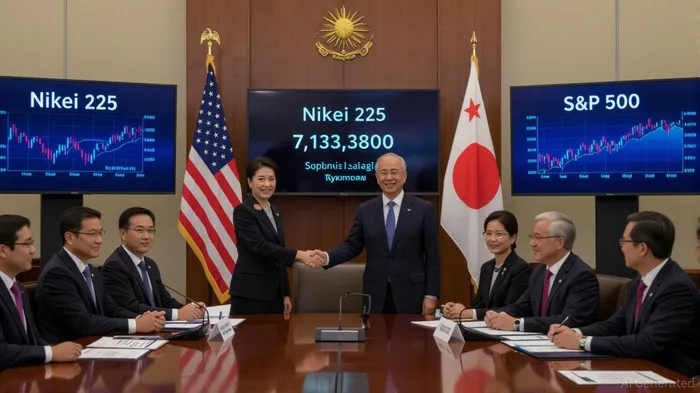
The immediate impact on Asian equities was stark. Japan's Topix and Nikkei 225 indices surged to record highs, with the Nikkei rising 1.09% in a single trading session. South Korea's Kospi followed suit, climbing 1.17%, while Australia's S&P/ASX 200 edged up 0.15%. Even China's Hang Seng Index, though flat, saw the yuan strengthen to 7.1444 against the dollar, its strongest level since November 2024. These movements reflect a broader shift in investor psychology: the trade deal has replaced fear of protectionism with cautious optimism about a more predictable global trading environment.
The U.S.-Japan pact has also catalyzed corporate activity. Japanese automakers, long wary of U.S. tariff threats, saw shares jump as the 15% tariff on automobiles and parts became the new benchmark. South Korean semiconductor giant SK Hynix, a key supplier to NvidiaNVDA--, reported a 69% year-on-year increase in operating profit, driven by demand for AI-related components. The company's stock surged 2.6% post-announcement, underscoring how trade clarity can unlock earnings potential.
The deal's implications extend beyond bilateral trade. By setting a precedent for tariff reductions and reciprocal investments, it has emboldened other Asian nations to accelerate their own U.S. trade negotiations. Indonesia, the Philippines, and Vietnam have already secured agreements, while Malaysia and Thailand are nearing finalization. South Korea's delegation has joined the talks, and India's timeline, though extended to September, remains a focal point for investors. This domino effect suggests that the U.S.-Japan framework could serve as a template for broader regional integration, reducing fragmentation in global supply chains.
However, the deal is not without its challenges. UBSUBS-- analysts caution that the 15% tariff, while lower than the 25% threat, could still depress Japan's exports by 0.4 percentage points annually. The Bank of Japan is expected to delay rate hikes until mid-2026, a sign that structural adjustments to trade policy may take time to materialize. For investors, this means balancing optimism with prudence, particularly in sectors like automotive and manufacturing, where margins remain sensitive to tariff fluctuations.

The U.S.-Japan deal has also reignited interest in cross-border partnerships. Japan's $550 billion investment into U.S. energy, semiconductors, and pharmaceuticals is expected to spur joint ventures and technology transfers. For example, Japanese firms like Tokyo Electron and Advantest are poised to benefit from U.S. demand for advanced semiconductor equipment. Similarly, U.S. agricultural producers stand to gain from Japan's 75% increase in rice imports and expanded quotas for soybeans and corn. These synergies highlight how trade agreements can evolve into platforms for innovation, not just commodity exchange.
For investors, the key takeaway is to focus on sectors that benefit from both the deal's immediate terms and its long-term implications. The semiconductor and automotive industries are obvious candidates, but energy and pharmaceuticals also warrant attention. The Alaskan LNG offtake agreement, for instance, could boost U.S. energy exporters while enhancing Japan's energy security. Meanwhile, Japan's investment in U.S. critical minerals—such as lithium and rare earths—aligns with global decarbonization trends, offering growth opportunities in the clean energy transition.
In conclusion, the U.S.-Japan trade deal has proven to be more than a tactical win for Tokyo; it has redefined the contours of global trade and investment. For Asian markets, the deal has provided a much-needed anchor of stability, fostering a climate where cross-border deals can flourish. While risks remain, the resilience of these markets—driven by strategic alignment and investor confidence—suggests that the region is well-positioned to navigate the next phase of globalization. As the dust settles on this historic agreement, investors would do well to focus on the sectors and geographies best positioned to capitalize on the new economic order.

Stay ahead of the market.
Get curated U.S. market news, insights and key dates delivered to your inbox.






Comments
No comments yet