
Resilience in Adversity: Lessons from Chung Ju-Yung and the Case for Contrarian Industrial Plays
 Aime Summary
In the annals of industrial history, few figures embody the fusion of resilience, operational discipline, and long-term vision as profoundly as Chung Ju-Yung. Rising from a rural Korean village to build Hyundai into a global industrial empire, Chung's legacy—marked by relentless execution, frugality, and trust in human capital—offers timeless lessons for investors seeking undervalued, founder-driven firms in economically resilient sectors like construction, shipbuilding, and infrastructure. Today, as markets grapple with volatility and shifting demand, the principles that defined Chung's success remain a compass for identifying contrarian opportunities.
The Chung Ju-Yung Model: Resilience as a Strategic Advantage
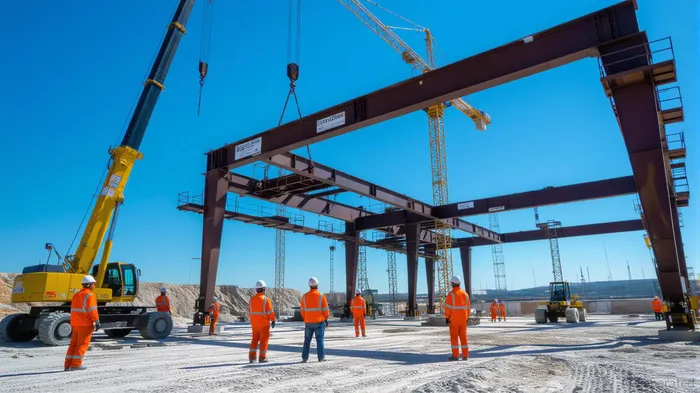
Chung's rise was not merely a story of ambition but of strategic reinvention. In the 1960s, he invested heavily in advanced construction equipment, a bold move that positioned Hyundai to dominate South Korea's post-war rebuilding. His philosophy of “relentless execution” prioritized operational efficiency, while his frugality—reinvesting profits into innovation rather than shareholder payouts—created a compounding effect. This model is now echoed in modern industrial firms that balance cost discipline with long-term reinvestment.
Consider Fluor Corporation (FLR), a leader in engineering and construction. Fluor's recent pivot to NuScale Power's small modular reactor (SMR) technology mirrors Chung's 1960s bet on heavy machinery. By aligning with the global energy transition, FluorFLR-- is positioning itself for decades of demand in decarbonization projects. Despite trading at a 13% discount to its estimated fair value of $60, Fluor's operational discipline—evidenced by its lean project management and strategic capital allocation—suggests undervaluation.
Frugality as a Catalyst for Innovation
Chung's mantra of frugality was not about austerity but about channeling resources into innovation and human capital. This ethos is alive in Verra Mobility (VRRM), led by Todd Pedersen, who famously used a beat-up truck during his early career. Verra Mobility's 46.77% annual earnings growth projection stems from its frugality-driven expansion into smart parking solutions and government contracts. At $25.01 (vs. a fair value of $48.35), the stock appears significantly undervalued. Pedersen's ability to scale operations while maintaining cost discipline reflects Chung's belief that constraints breed creativity.
People-Centric Leadership: The Human Capital Moat
Chung's success hinged on his trust in employees, a principle that built Hyundai's “people-centric” culture. This is mirrored in Associated Banc-Corp (ASB), a community-driven bank supporting infrastructure development. ASB's 3.83% dividend yield and 40.5% projected earnings growth underscore its founder-led focus on employee retention and stakeholder trust. Trading at $23.99—49.5% below its fair value—ASB exemplifies how frugality and community alignment can create durable competitive advantages.
Contrarian Plays: The Resilience Premium
The 2023 McKinsey study on resilient leadership reveals a 23% outperformance in shareholder returns over five years for firms led by visionary founders. This “resilience premium” is particularly relevant in 2025, as AI disruption and climate risks demand leaders who can adapt. Constellation Brands (STZ), for instance, has navigated U.S. tariffs by pivoting to localized production and AI-driven inventory management, reducing costs by 15%. Trading at a 30% discount to fair value, STZ's agility in a fragmented market mirrors Chung's crisis-era strategies.
Investment Thesis: Building a Resilient Portfolio
For investors, the key is to identify founder-led firms that prioritize reinvestment in innovation, operational efficiency, and stakeholder alignment. These companies, like Hyundai in the 1960s, are not merely surviving—they are redefining their industries. Fluor's energy transition bets, Verra Mobility's frugality-driven growth, and ASB's community-centric model all exemplify this ethos.
Conclusion: The Next Hyundai Awaits
Chung Ju-Yung's legacy is a testament to the power of resilience in adversity. Today's industrial landscape, shaped by decarbonization, automation, and geopolitical shifts, demands leaders who can turn challenges into opportunities. By investing in founder-driven firms with durable competitive advantages—those that mirror Chung's principles of innovation, frugality, and trust—investors can capture the resilience premium and build portfolios that thrive in both stable and volatile markets. The next Hyundai is already emerging; the question is whether investors are ready to recognize it.

Stay ahead of the market.
Get curated U.S. market news, insights and key dates delivered to your inbox.
AInvest
PRO
AInvest
PRO



Comments
No comments yet