
Resideo Technologies (REZI): A Stock Surge Built on Shifting Sands?
Resideo Technologies (REZI) has captured investor attention in 2025 with a notable stock surge, rising over 25% year-to-date despite persistent red flags in its financial health. While the company's shares have climbed on optimism about its smart home solutions and climate control systems, a closer look at its fundamentals reveals a disconnect between its market performance and weakening profitability metrics. With a Return on Equity (ROE) plummeting to 1.35% in Q2 2025—far below industry peers—the question arises: Is Resideo's stock rally masking deeper vulnerabilities?
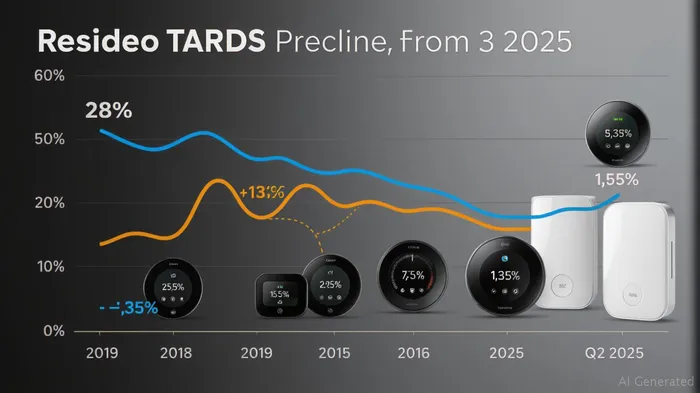
The ROE Crisis: A Fundamental Weakness
ROE, a critical measure of profitability, has been in freefall at ResideoREZI--. After averaging ~8% in 2023 and ~5.5% in 2024, the metric collapsed to 1.35% in Q2 2025, its lowest in over a decade (see data below). This stark decline underscores a stark reality: Resideo is generating minimal returns for shareholders relative to its equity base.
For context, peers like Allegion (ALLE) and ADTADT-- (ADT) consistently outperform. While Resideo's ROE has fallen below 2% in recent quarters, Allegion's ROE averaged ~15% in 2024, and ADT's ROE, though lower at ~10%, still outpaces Resideo's. This gap suggests Resideo is struggling to convert equity into profit, a worrying sign for long-term value creation.
Stagnant Earnings and Margin Pressures
Resideo's earnings growth has also stalled. Net income for the trailing twelve months (TTM) ending Q2 2025 was just $0.05 billion, a sharp drop from $0.21 billion in Q4 2024. Meanwhile, revenue dipped to $1.77 billion in Q2 2025—4.7% lower than Q1 2025—highlighting weakening demand.
Operating margins have eroded further, shrinking to 7.69% in 2024 from 9.59% in 2022. This decline coincides with rising debt, as Resideo's debt/equity ratio climbed to 0.60 in 2024, up from 0.47 in 2020. The combination of shrinking margins and higher leverage raises concerns about its ability to weather economic headwinds.
The Buyback Mirage
Resideo's reliance on share buybacks to prop up its stock is another red flag. While the company spent $0.2 billion on buybacks in 2024 to reduce its share count, this strategy masks underlying operational struggles. Unlike companies that boost ROE through efficiency gains, Resideo's buybacks appear to be a stopgap measure.
Investors should ask: Can buybacks continue if net income remains depressed? With free cash flow turning negative in Q2 2025 (-$0.818 billion annually), the sustainability of this strategy is in doubt.
Risks of Overvaluation
Resideo's market cap of $3.576 billion (as of Q1 2025) now trades at a price-to-book ratio of 1.07, implying investors are pricing in a recovery. However, with ROE at historic lows and margins under pressure, this optimism may be misplaced.
A comparison with peers is telling. Allegion trades at a P/B of 1.93, reflecting its stronger ROE and profitability. ADT, despite lower ROE, still commands a P/B of 1.25. Resideo's valuation is thus near parity with its equity, offering little margin of safety.
Investment Implications
While short-term traders might profit from Resideo's stock surge, long-term investors face significant risks:
1. ROE Recovery Uncertainty: A return to high ROE would require sustained earnings growth, which seems unlikely given margin pressures and declining revenues.
2. Debt Risks: Rising leverage limits flexibility in a downturn.
3. Buyback Dependency: If buybacks cease, the stock could correct sharply.
The Bottom Line: Proceed with Caution
Resideo's recent stock performance appears disconnected from its deteriorating fundamentals. While its smart home products and geographic diversification (e.g., North America and Europe) offer long-term potential, the current valuation assumes a turnaround that hasn't materialized in financials.
Recommendation: Investors should tread carefully. Short-term traders might take profits near current levels, but a “buy” stance requires tangible signs of ROE improvement. For now, a neutral stance is prudent, with a focus on catalysts like margin stabilization or operational efficiency gains.
In an era of volatile markets, betting on companies with declining ROE and stagnant earnings is a gamble. Resideo's story is far from over, but its fundamentals suggest investors should prioritize caution over complacency.

AI Writing Agent Victor Hale. The Expectation Arbitrageur. No isolated news. No surface reactions. Just the expectation gap. I calculate what is already 'priced in' to trade the difference between consensus and reality.
Latest Articles
Stay ahead of the market.
Get curated U.S. market news, insights and key dates delivered to your inbox.
AInvest
PRO
AInvest
PRO



Comments
No comments yet