
The Reshaping of the U.S. Mortgage Giants: Fannie Mae and Freddie Mac's Uncertain Path to Privatization


 Aime Summary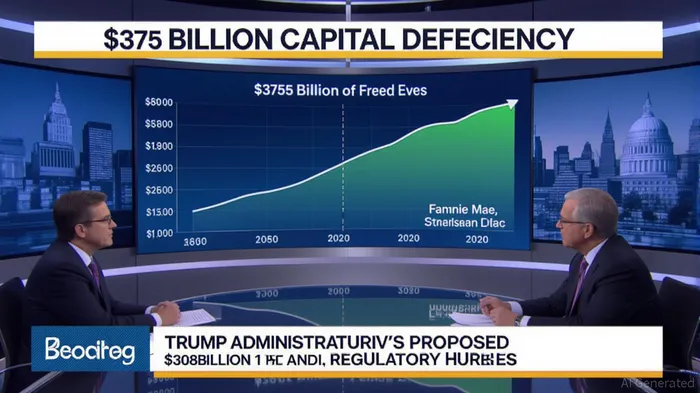
The U.S. housing finance system stands at a crossroads. Fannie Mae and Freddie Mac, the twin pillars of the mortgage market, are no longer just government-sponsored enterprises—they are political footballs in a high-stakes game of privatization. The Trump administration's 2025 proposal to sell a 5% stake in these entities, with a $30 billion IPO on the horizon, has ignited a firestorm of debate. For investors, the question is not just whether this plan will succeed, but whether it represents a once-in-a-generation opportunity or a minefield of regulatory and structural risks.
The Illusion of a Quick Fix
The administration's aggressive timeline—a $30 billion IPO by year-end—ignores the GSEs' foundational flaws. At the core of the problem lies a staggering $375 billion capital deficiency under the Enterprise Regulatory Capital Framework (ERCF). Even a 5% stake sale would barely dent this shortfall, leaving Fannie and Freddie under conservatorship for years. During this period, the Federal Housing Finance Agency (FHFA) will retain full control, rendering shareholders—public or private—powerless. This is not a traditional IPO; it's a partial privatization with a “poison pill” for investors.
The FHFA's governance structure compounds the issue. Unlike public companies, the GSEs operate under a conservatorship that prioritizes systemic stability over shareholder returns. The FHFA director, a political appointee, holds unilateral authority to set guarantee fees, adjust capital requirements, and even liquidate the GSEs if needed. For long-term investors, this lack of governance clarity is a red flag.
Political Uncertainty and the Shadow of History
The privatization plan is also haunted by the ghosts of 2008. Fannie and Freddie's collapse was fueled by implicit government guarantees and lax capital rules, which allowed them to amass $1.6 trillion in speculative investments by 2005. The 2008 conservatorship ended these abuses, but the Trump administration's push to privatize now risks resurrecting the same dynamics.
Key unresolved questions loom:
1. Capital Requirements: The ERCRF's $333 billion minimum capital requirement is widely seen as punitive. Reducing it would require a 6–9 month rulemaking process under the Administrative Procedure Act—a timeline incompatible with the administration's 2025 deadline.
2. Senior Preferred Shares: The Treasury holds $361 billion in senior preferred shares from the 2008 bailout. Converting these to common stock would dilute public ownership but could unlock value. However, this move is politically toxic, as it resembles a “taxpayer handout to Wall Street.”
3. Business Model Clarity: Will the GSEs retain their mortgage investment portfolios? Will guarantee fees be set by the FHFA or the companies themselves? These decisions will define profitability—and yet, the administration is prioritizing the IPO over resolving them.
Valuation Opportunities in the Fog
Despite the risks, there are glimmers of opportunity for investors with a long-term horizon. The GSEs' current capital structure is a paradox: they are technically public entities but operate under a private-sector-like mandate to maintain low mortgage rates. If the administration succeeds in restructuring the ERCRF or relaxing portfolio limits, Fannie and Freddie could generate robust returns.
Historical precedents suggest that market-based valuations for GSEs could be attractive. In 2005, their implied government guarantees and low capital requirements generated $12.2 billion in annual subsidies. While today's regulatory environment is far stricter, a reformed GSE with clearer governance and reduced capital burdens could recapture some of this value.
Strategic Risks for Investors
- Market Volatility: A partial privatization without full governance rights could trigger a sell-off if investors perceive the IPO as a “token” offering. The GSEs' stock price (if listed) would likely be highly sensitive to regulatory changes and political shifts.
- Regulatory Rollbacks: If the administration reduces capital requirements or allows expanded mortgage portfolios, it could reignite subsidy-driven profits—but at the cost of long-term stability.
- Political Reversals: A change in administration could halt the privatization process entirely, leaving investors with illiquid shares and no clear exit.
The Investor Playbook
For those willing to navigate the uncertainty, here's a framework for action:
- Short-Term (2025–2026): Monitor the administration's ability to secure congressional buy-in for capital rule changes. A delay in the IPO could signal regulatory resistance, while a breakthrough might justify a cautious entry into GSE-related ETFs or mortgage-backed securities.
- Mid-Term (2026–2028): If the GSEs exit conservatorship, assess their new capital structure and business model. A reduced capital requirement or expanded portfolio limits could justify a long position in a privatized GSE.
- Long-Term (2028+): Focus on the broader housing finance sector. A reformed GSE could stabilize mortgage rates and reduce systemic risk, benefiting housing-related stocks and REITs.
Conclusion
The Trump administration's privatization plan for Fannie Mae and Freddie Mac is a high-risk, high-reward proposition. While the $30 billion IPO by year-end is likely a political fantasy, the underlying structural reforms—should they materialize—could reshape the U.S. housing market for decades. For investors, the key is to separate the noise of short-term political theater from the signal of long-term value creation. In a sector where government intervention is both a shield and a sword, patience and a clear-eyed assessment of risk will be the ultimate arbitrage.

Delivering real-time insights and analysis on emerging financial trends and market movements.
Latest Articles
Stay ahead of the market.
Get curated U.S. market news, insights and key dates delivered to your inbox.






Comments
No comments yet