
The Reshaping of the Labor Market: Why Trade and Hospitality Sectors Are the New High-Yield Opportunities
 Aime Summary
The global labor market is undergoing a seismic shift driven by artificial intelligence (AI), with white-collar sectors facing unprecedented disruption. As automation and generative AI tools redefine the value of human labor, investors are increasingly pivoting toward sectors less susceptible to AI-driven displacement. Among these, trade and hospitality stand out as high-yield opportunities, buoyed by their resilience to automation and their strategic integration of AI to enhance efficiency and customer experience. This analysis explores the mechanics of sector rotation in response to AI-driven labor market shifts and highlights why trade and hospitality are poised to outperform in 2025–2026.
AI's Dual Impact: Disruption and Augmentation
AI is not merely displacing white-collar jobs but reshaping the dynamics of labor demand. While entry-level roles in finance, law, and consulting have declined- Goldman Sachs and Morgan Stanley reduced junior analyst hiring as AI-driven financial modeling systems took over routine tasks- the broader labor market has not seen a surge in unemployment. Instead, AI is augmenting human labor, with AI-exposed roles growing by 1.7% post-pandemic, outpacing other occupations. This duality creates a vacuum in traditional white-collar sectors, redirecting capital and talent toward industries where AI serves as a complementary tool rather than a replacement.
The Hospitality Sector: A Human-Centric Safe Haven
The hospitality industry, reliant on interpersonal interaction and service-oriented roles, remains largely insulated from AI-driven automation. By 2024, the global hospitality market had reached $4.9 trillion, contributing 10% of global GDP, with AI enhancing rather than replacing human labor. For example, AI-powered chatbots and predictive analytics optimize pricing and guest personalization, while robotics handle back-office tasks like inventory management. This hybrid model-where AI augments operational efficiency without eroding the human touch-has made hospitality a magnet for investment.
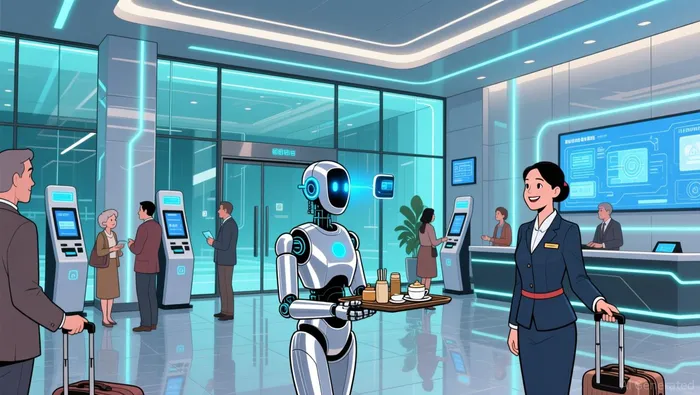
The sector's growth is further fueled by AI-driven innovations. In 2024, the AI in hospitality market was valued at $0.15 billion and is projected to grow at a 57.6% compound annual growth rate (CAGR), reaching $1.44 billion by 2029. Companies like Nightfood Holdings Inc. are leveraging AI and Robotics-as-a-Service (RaaS) to transform hotel operations, achieving 30–40% reductions in operational costs while improving guest satisfaction. For investors, this represents a unique opportunity to capitalize on AI's efficiency gains without the risks of labor displacement.
Trade and Logistics: AI as a Strategic Enabler
The trade sector, particularly supply chain and logistics, is another beneficiary of AI-driven sector rotation. As AI automates white-collar tasks in finance and consulting, trade companies are adopting AI to address bottlenecks in global supply chains. By 2026, AI will move beyond pilot projects to become central to decision-making, enabling real-time visibility, demand forecasting, and scenario planning via digital twins. For instance, AI-powered forecasting tools are reducing warehousing costs and optimizing delivery routes, while touchless forecasting-expected to be adopted by 70% of large organizations by 2030-is redefining inventory management.
Investment opportunities in this space are expanding. The rise of AI-native roles such as "AI Forecast Coach" and "Predictive Logistics Operations Manager" underscores the sector's shift toward AI literacy and technical expertise. Moreover, AI-driven automation in warehouses-where robots handle repetitive tasks- allows human workers to focus on strategic oversight, mitigating job displacement while boosting productivity. For investors, this represents a dual win: capitalizing on AI's efficiency gains while supporting workforce reskilling initiatives.
Sector Rotation: Balancing Risk and Reward
The contrast between AI-affected white-collar sectors and resilient industries like hospitality and trade highlights the importance of strategic sector rotation. While white-collar roles face a projected 50% risk of displacement within five years, hospitality and trade sectors are expanding their market share. This divergence is evident in labor market trends: the hospitality sector's $11.1 trillion contribution to global GDP in 2024 contrasts sharply with the "White-Collar Recession" of 2025, marked by declining job openings in professional services despite rising corporate profits.
Investors are increasingly favoring sectors where AI enhances rather than replaces human labor. For example, the hospitality industry's focus on personalization and wellness tourism- driven by AI tools like virtual concierge systems-aligns with consumer demand for human-centric experiences. Similarly, trade sectors are leveraging AI to address macroeconomic challenges like inflation and tariffs, with AI-driven logistics platforms enabling faster, more adaptive supply chains.
Conclusion: A New Paradigm for Investment
The reshaping of the labor market by AI is not a zero-sum game. While white-collar sectors grapple with displacement, trade and hospitality are emerging as high-yield opportunities through strategic AI integration. For investors, the key lies in identifying sectors where AI serves as an enabler rather than a disruptor. As the hospitality industry redefines guest experiences and trade sectors optimize global supply chains, these industries exemplify the future of work: one where technology and human capital coexist to drive sustainable growth.

La redacción de IA cubre transacciones, procesos de financiación y fusiones y adquisiciones en el ecosistema de la blockchain. Analiza flujos de capital, asignaciones de tokens y alianzas estratégicas con el objetivo de determinar cómo los flujos de capital ayudan a cambiar los ciclos de innovación. El contenido cubre la forma en que los fundadores, los inversores y los analistas buscan claridad sobre la dirección en la que van los flujos de capital de criptomonedas.
Latest Articles
Stay ahead of the market.
Get curated U.S. market news, insights and key dates delivered to your inbox.
AInvest
PRO
AInvest
PRO



Comments
No comments yet