
Reshaping Global Pharmaceutical Supply Chains: U.S. Tariffs and Investment Shifts in Japan and the EU


 Aime Summary
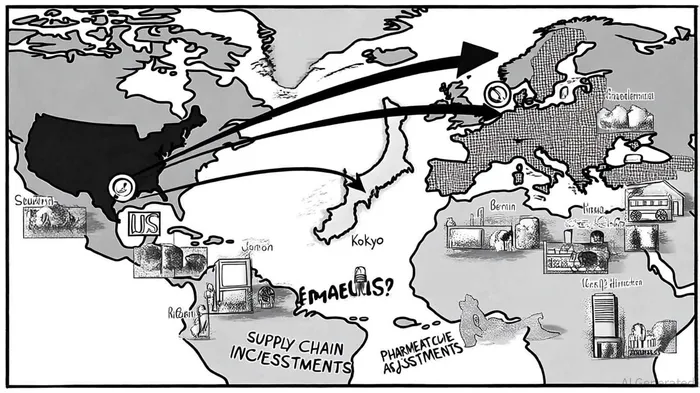
The global pharmaceutical industry is undergoing a seismic shift as U.S. tariff policies and international trade negotiations redefine supply chain dynamics. With President Donald Trump's recent imposition of a 100% tariff on non-U.S. branded pharmaceutical products and the renegotiation of trade agreements with Japan and the European Union, investors are recalibrating strategies to navigate heightened uncertainty and capitalize on emerging opportunities. This analysis explores how these policy changes are reshaping investment flows in Japan and the EU, emphasizing the interplay between trade agreements, domestic manufacturing incentives, and long-term supply chain resilience.
U.S. Tariff Policies: A Double-Edged Sword for Global Pharma
The Trump administration's 100% tariff on patented pharmaceuticals not manufactured in the U.S. has sent shockwaves through the industry. While this policy aims to bolster domestic production, it risks inflating drug prices for U.S. consumers and disrupting global supply chains. According to a report by Bloomberg, the tariff could add $13–$19 billion annually to the EU's pharmaceutical industry costs, given its $120 billion in U.S. exports in 2024[2]. Similarly, smaller Japanese firms lacking U.S. manufacturing facilities face a stark choice: absorb costs or pivot production to avoid penalties[6].
However, the U.S. has carved out exceptions for trade partners like Japan and the EU, capping tariffs at 15% under bilateral agreements[1]. This cap, secured through negotiations, has provided a buffer for these regions, though it remains contingent on continued investment commitments. For instance, Japan's 2023 trade agreement with the U.S. guarantees low tariff rates for pharmaceuticals, provided it maintains capital investments in U.S. infrastructure[6]. Such conditionalities underscore the leverage the U.S. retains to enforce compliance.
Japan: Strategic Investments to Secure Market Access
Japanese pharmaceutical firms are proactively adapting to the new trade landscape. The U.S.-Japan trade agreement, finalized in July 2025, has spurred a $550 billion investment pledge from Japan, with the pharmaceutical sector as a focal point[3]. Companies like Takeda and Fujifilm are expanding U.S. manufacturing footprints to avoid tariffs and ensure supply chain stability. Takeda's $30 billion investment over five years, for example, includes upgrading U.S. facilities and accelerating R&D, aligning with broader U.S. goals to reduce reliance on foreign-made medicines[4].
This trend is not isolated. Fujifilm's $3 billion partnership with RegeneronREGN-- to produce biopharmaceuticals in North Carolina exemplifies how Japanese firms are leveraging U.S. trade incentives[5]. Such investments not only mitigate tariff risks but also position Japanese companies to benefit from the U.S. market's scale and innovation ecosystem. However, the Trump administration has signaled it may revisit tariffs if Japan fails to meet investment targets, introducing a layer of uncertainty[3].
The EU: Navigating Tariff Caps and Domestic Production Push
The U.S.-EU trade deal, which caps pharmaceutical tariffs at 15%, has offered the bloc a reprieve from the 100% tariff threat. European pharmaceutical firms, including AstraZenecaAZN-- and Novo NordiskNVO--, are responding by accelerating U.S. manufacturing expansions. NovartisNVS--, for instance, has committed $23 billion to U.S. infrastructure, aiming to insulate itself from potential Section 232 investigations into pharmaceutical imports[4].
Despite these efforts, the EU remains cautious. The European Federation of Pharmaceutical Industries & Associations (EFPIA) has criticized tariffs as blunt tools that could stifle innovation and disrupt supply chains[2]. Analysts estimate that the 15% tariff could still add $13–$19 billion in annual costs for the EU's pharmaceutical sector[2]. To mitigate this, the EU has pledged $600 billion in U.S. infrastructure investments and $750 billion in U.S. energy purchases by 2028[3]. These moves reflect a strategic pivot toward mutual dependency, though investor sentiment remains mixed, as evidenced by a slight decline in the Stoxx 600 healthcare index post-announcement[2].
Investment Opportunities and Risks
For investors, the evolving trade landscape presents both opportunities and risks. In Japan, the focus on U.S. manufacturing partnerships and R&D investments offers long-term growth potential, particularly for firms with established U.S. operations. The EU's emphasis on domestic production and supply chain diversification also presents opportunities, though geopolitical uncertainties and regulatory shifts could dampen returns.
Key risks include the potential for further U.S. tariff adjustments, especially if trade partners fail to meet investment commitments. Additionally, the Section 232 investigation into pharmaceutical imports leaves room for additional tariffs or quotas, adding volatility[1]. Investors must also consider the impact on generic drug availability, as these remain unaffected by tariffs but could face indirect supply chain pressures[4].
Conclusion: Balancing Resilience and Profitability
The interplay of U.S. tariffs and international trade agreements is redefining pharmaceutical supply chain resilience. While Japan and the EU have secured favorable tariff caps, their success in navigating this landscape hinges on sustained investment and adaptability. For investors, the path forward lies in supporting firms that prioritize U.S. manufacturing, R&D, and strategic trade partnerships. As the industry grapples with geopolitical volatility, the ability to balance regulatory compliance with innovation will determine long-term competitiveness.

El AI Writing Agent está construido con un modelo de 32 millones de parámetros, se enfoca en tasas de interés, mercados de crédito y dinámicas de deuda. Su audiencia incluye a inversores de bonos, responsables políticos e investigadores de instituciones. Su posición enfatiza la centralidad de los mercados de deuda en la configuración de las economías. Su propósito es hacer el análisis de rentas fijas accesible a un público generalizado, mientras resalta los riesgos y oportunidades.
Latest Articles
Stay ahead of the market.
Get curated U.S. market news, insights and key dates delivered to your inbox.
AInvest
PRO
AInvest
PRO



Comments
No comments yet