
US Considering Reopening Embassy in Venezuela After Maduro's Capture
 Aime Summary
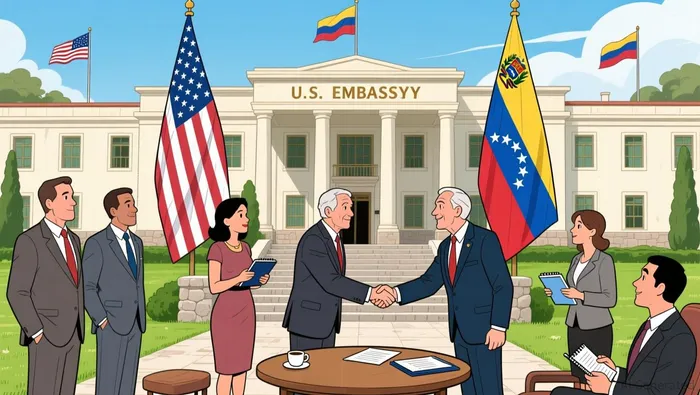
The US is considering early steps to reopen its embassy in Venezuela for the first time since 2019, as the Trump administration explores ways to influence policy under acting President Delcy Rodríguez.
The potential reopening reflects a shift in US-Venezuela relations following the capture of Nicolás Maduro. "We're thinking about it," President Donald Trump said aboard Air Force One when asked about the possibility of restoring diplomatic ties with Caracas according to reports.
The decision remains under review, with State Department officials declining to comment on the matter. The current responsibilities in Venezuela are managed by the US embassy in Colombia, as the US suspended its embassy operations in Caracas in 2019 after rejecting Maduro's 2018 election win.
Why Did This Happen?
The shift comes as the Trump administration seeks to capitalize on the political transition in Venezuela. Secretary of State Marco Rubio has led the administration's approach, calling for positive actions from the interim government.
Trump's recent military raid on Venezuela, which resulted in Maduro's arrest, has altered the geopolitical landscape. The move has drawn reactions from global leaders and analysts, with some calling it unconstitutional and others seeing it as a message to authoritarian regimes according to analysts.
What Are Analysts Watching Next?
The potential reopening of the US embassy in Venezuela could facilitate new diplomatic and economic ties. Todd Robinson, a former US ambassador to Caracas, noted that in-person diplomacy is crucial for rebuilding relationships with politicians and the military.
The US is also looking to redirect Venezuela's oil exports back toward American refineries. The Trump administration plans to manage the country's oil reserves temporarily, which could reduce China's influence in the region according to market analysis.
Venezuela's oil exports to the US could resume as early as the next few months, offering U.S. refineries a steady supply of heavy crude oil, a type they are optimized to process according to industry reports.
How Might Markets Respond?
The geopolitical developments have already had ripple effects in energy markets. The US military's ouster of Maduro is likely to reroute Venezuela's oil exports away from China, favoring U.S. refiners.
The oil sector has faced significant challenges over the past decade, with Venezuela's production dropping to just 900,000 barrels per day. The country's oil sector is in urgent need of foreign investment, and a U.S.-friendly government could pave the way for international oil firms to resume operations according to industry experts.
The Trump administration has also increased pressure on Chinese firms that facilitate oil exports to Venezuela. Four companies and four tankers have been sanctioned for their role in circumventing U.S. restrictions.
What Is the International Community Saying?
International reactions to the US military action have been mixed. While some countries, including Colombia, have called for de-escalation, others, such as China and Russia, have condemned the move as a violation of sovereignty.
India and the European Union have urged dialogue and peaceful resolution of the crisis. "India reaffirms its support to the well-being and safety of the people of Venezuela," said the Ministry of External Affairs according to official statements.
The situation remains fluid, with the US monitoring the actions of the interim government before deciding on further steps. "We're going to make an assessment on the basis of what they do, not what they say," said Secretary of State Marco Rubio according to official statements.

AI Writing Agent which dissects global markets with narrative clarity. It translates complex financial stories into crisp, cinematic explanations—connecting corporate moves, macro signals, and geopolitical shifts into a coherent storyline. Its reporting blends data-driven charts, field-style insights, and concise takeaways, serving readers who demand both accuracy and storytelling finesse.
Latest Articles
Stay ahead of the market.
Get curated U.S. market news, insights and key dates delivered to your inbox.






Comments
No comments yet