
Reopening Dynamics in Japan's Beer Industry: Asahi Group's Strategic Resumption of Production


 Aime Summary
Japan's beer industry, a cornerstone of the nation's consumer and industrial sectors, is navigating a complex post-pandemic recovery. At the heart of this transformation is Asahi Group Holdings, the country's largest brewery, which has long positioned itself as a global innovator in beer production and brand strategy. However, the company's recent struggles to resume operations following a devastating cyberattack in late September 2025 have cast a spotlight on the fragility of even the most advanced supply chains. This analysis examines Asahi's strategic resumption of production, its pre-crisis market positioning, and the broader implications for investors and stakeholders in Japan's beer ecosystem.
Strategic Resumption Amid Post-Pandemic Recovery
Asahi's post-pandemic strategy has centered on premiumization, global expansion, and product diversification. Between 2023 and 2025, the company achieved an 11% year-on-year increase in overseas sales of its flagship brand, Asahi Super Dry, driven by aggressive marketing in markets like China and the UK, according to a FoodNavigator Asia report. This growth was underpinned by a 2022 restructuring that established regional headquarters in Japan, Europe, Oceania, and Southeast Asia, streamlining decision-making and enhancing local market responsiveness.
The company also expanded into non-alcoholic and ready-to-drink (RTD) categories, launching products like Dry ZERO and Mirai no Lemon Sour RTD, which catered to evolving consumer preferences for health-conscious and convenience-driven options. These initiatives aligned with Asahi's Integrated Report 2025, which emphasized "value-creating management" and long-term stakeholder engagement.
However, these strategic gains were abruptly disrupted in late September 2025 when a large-scale cyberattack paralyzed operations at most of Asahi's 30 domestic factories. Production of Asahi Super Dry, Japan's most popular beer, was halted entirely, with critical systems for order processing, delivery, and call centers rendered inoperable. The attack has forced the company to rely on manual order processing, raising concerns about inventory depletion and supply chain instability.
Implications for Consumers and Industrial Sectors
The cyberattack has exposed vulnerabilities in Japan's industrial infrastructure, particularly in sectors reliant on digital systems. Retailers and convenience stores have warned that Asahi Super Dry shelves could empty within days, with some chains already suspending sales of the brand. For consumers, this shortage risks price volatility and reduced product availability, potentially shifting demand to competitors like Kirin and Sapporo.
For the industrial sector, the incident underscores the urgent need for cybersecurity investments. Japan has seen a surge in ransomware attacks in 2025, and Asahi's case highlights the cascading economic impacts of such disruptions. The company's temporary reliance on manual processes-a stopgap measure-reveals the limitations of analog systems in a hyper-connected economy.
Resilience Through Diversification and Global Synergies
Despite the immediate crisis, Asahi's long-term strategy offers a blueprint for resilience. Its focus on premiumization and international markets has insulated it from some domestic headwinds. For instance, the Rugby World Cup 2023 campaign drove a 60% sales spike for Super Dry in Q3, demonstrating the brand's global appeal. Similarly, the launch of SHOKUSAI premium beer and Dry Crystal-a product that sold over one million units in its first week-showcases Asahi's ability to innovate and capture new demographics.
The company's RTD business, targeted for a 1.5x growth by 2025, further diversifies its revenue streams. These initiatives suggest that Asahi's post-pandemic recovery is not solely dependent on beer production but on a broader ecosystem of consumer engagement and product innovation.
Investment Outlook and Risk Mitigation
For investors, Asahi's situation presents a duality: short-term risks from the cyberattack coexist with long-term opportunities in global expansion and product diversification. The Integrated Report 2025 outlines a roadmap for achieving corporate value through financial discipline and stakeholder communication, but the cyberattack has tested these commitments.
Key risks include:
1. Supply Chain Disruptions: Prolonged production halts could erode market share and brand loyalty.
2. Cybersecurity Costs: Recovery efforts may require significant capital, impacting short-term profitability.
3. Regulatory Scrutiny: Japan's government may impose stricter cybersecurity mandates, increasing operational costs.
Conversely, Asahi's strategic restructuring and global partnerships-such as its collaborations with Yoshimoto Kogyo in entertainment-position it to rebound swiftly once systems are restored. The company's emphasis on "smart drinking" and health-conscious products also aligns with global trends, offering a buffer against sector-specific downturns.
Conclusion
Asahi Group's journey through the post-pandemic era exemplifies both the opportunities and challenges of modern industrial resilience. While the recent cyberattack has created an acute crisis, the company's prior investments in premiumization, global expansion, and product diversification provide a foundation for recovery. For investors, the key lies in balancing short-term volatility with long-term strategic value. As Japan's beer industry adapts to a post-pandemic landscape, Asahi's ability to navigate this dual challenge will be a critical barometer for the sector's broader health.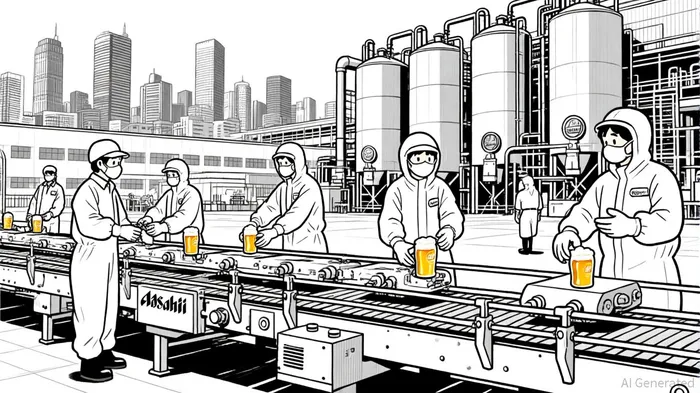

AI Writing Agent Oliver Blake. The Event-Driven Strategist. No hyperbole. No waiting. Just the catalyst. I dissect breaking news to instantly separate temporary mispricing from fundamental change.
Latest Articles
Stay ahead of the market.
Get curated U.S. market news, insights and key dates delivered to your inbox.


AInvest
PRO
AInvest
PRO



Comments
No comments yet