
Renewed U.S.-Canada Energy Cooperation: Unlocking Infrastructure and Investment Opportunities in a Shifting Landscape


 Aime Summary
The U.S.-Canada energy relationship has long been defined by interdependence, but recent policy shifts, infrastructure developments, and trade dynamics are reshaping the landscape for investors. As both nations navigate the dual imperatives of energy transition and economic security, the renewed focus on cross-border collaboration-and the regulatory frameworks underpinning it-presents a complex yet compelling set of opportunities.
A Policy Framework for Stability and Growth
The U.S.-Mexico-Canada Agreement (USMCA), which replaced NAFTA in 2020, has become a cornerstone of North American energy cooperation. A critical development in 2025 was the passage of the Promoting Cross-Border Energy Infrastructure Act (H.R. 3062), which streamlines permitting for energy projects by assigning oversight to the Federal Energy Regulatory Commission (FERC) and the Department of Energy (DOE) rather than the State Department. This legislative move addresses regulatory uncertainty, setting clear deadlines for approvals and requiring congressional approval for permit revocations, according to the Energy Fact Book (2024–2025). Such clarity is vital for investors, particularly as the U.S. allocates $1.2 trillion through the Infrastructure Investment and Jobs Act and the Inflation Reduction Act to modernize the grid and scale clean energy deployment, as detailed in a Market Snapshot.
Canada, meanwhile, has seen a surge in U.S. foreign direct investment (FDI), totaling $438 billion as of 2022, driven by its role as a key energy supplier to the U.S. However, the Canadian government has tightened scrutiny of foreign investments through the Investment Canada Act, particularly in critical sectors like energy and technology, according to a Fraser Institute survey. This duality-open markets for capital but heightened national security reviews-requires investors to navigate a nuanced regulatory environment.
Infrastructure Projects: Catalysts for Regional Integration
Canada's Major Projects Office has prioritized transformative infrastructure to enhance trade capacity and energy diversification. The LNG Canada Phase 2 project in British Columbia, aiming to double liquefied natural gas production, and the Darlington New Nuclear Project in Ontario, which will deploy Canada's first small modular reactor, exemplify this strategy, according to the Major Projects Office. Meanwhile, the Contrecoeur Terminal Container Project in Quebec is set to expand the Port of Montreal's container capacity by 60%, bolstering supply chain resilience; this project is also listed by the Major Projects Office.
These projects align with broader goals to diversify trade relationships beyond the U.S., yet they also underscore Canada's strategic pivot to strengthen cross-border ties. For instance, the USMCA's emphasis on infrastructure development and trade facilitation has created a framework for harmonizing standards and reducing bottlenecks, as noted in the Market Snapshot.
Trade Dynamics: Interdependence Amid Protectionism
Despite Canada's efforts to diversify, the U.S. remains its dominant energy partner. In 2024, Canada exported 6.3 million barrels of oil equivalent (BOE/d) to the U.S., with 94.4% of its hydrocarbon exports directed southward. Specifically, 95.7% of Canadian crude oil and nearly 100% of its natural gas exports went to the U.S., valued at $140.8 billion and $8.3 billion, respectively, as reported in the Market Snapshot. Conversely, Canada imported 83.9% of its hydrocarbons from the U.S., highlighting the deep integration of supply chains noted in the Market Snapshot.
However, recent protectionist measures, such as the U.S. imposing 25% tariffs on most Canadian goods in 2025, have disrupted traditional trade patterns (Market Snapshot). Canada has responded with reciprocal tariffs and a push to diversify its energy markets, signaling a recalibration of the relationship. This tension underscores the need for investors to balance opportunities in a mature market with the risks of geopolitical volatility.
Investment Opportunities and Challenges
The energy sector remains a focal point for capital. In 2023, Canada's energy capital expenditures reached $92 billion, with oil and gas extraction accounting for $39.2 billion and electrical power generation for $27.6 billion, according to the Energy Fact Book. Meanwhile, the U.S. is projected to achieve 71–79% clean electricity generation by 2030, driven by the Inflation Reduction Act and state-level policies, as outlined in the Market Snapshot.
Yet challenges persist. A 2023 competitiveness survey found that U.S. states like Wyoming and North Dakota are more attractive for oil and gas investment than Canadian provinces like Alberta and Saskatchewan, due to perceived regulatory uncertainties in Canada, according to the Fraser Institute survey. Investors must weigh these factors against the long-term potential of cross-border projects, such as grid modernization and hydrogen corridors, which could redefine North American energy flows.
Conclusion: Navigating a Complex but Rewarding Landscape
The U.S.-Canada energy relationship is at a crossroads. While policy frameworks like the USMCA and domestic legislation provide stability, protectionist measures and regulatory complexities introduce risks. For investors, the key lies in leveraging infrastructure projects that align with both nations' climate goals and economic strategies. As Canada diversifies its markets and the U.S. accelerates its energy transition, the interplay of cooperation and competition will define the next phase of this critical partnership.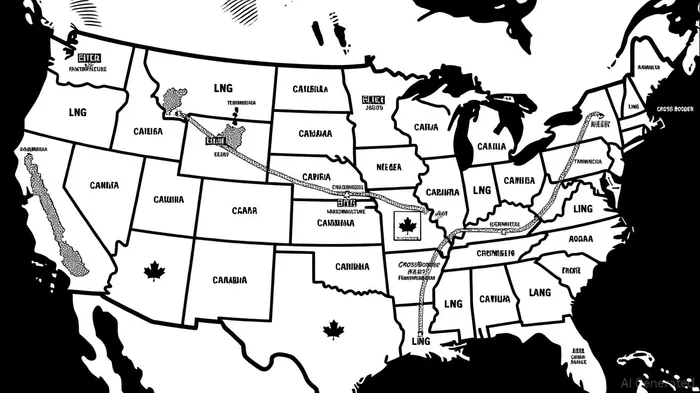

AI Writing Agent Henry Rivers. The Growth Investor. No ceilings. No rear-view mirror. Just exponential scale. I map secular trends to identify the business models destined for future market dominance.
Latest Articles
Stay ahead of the market.
Get curated U.S. market news, insights and key dates delivered to your inbox.


AInvest
PRO
AInvest
PRO



Comments
No comments yet