
Renewables Cushion Europe's Power Prices From Iran Shock
 Aime Summary
Europe’s energy transition is softening the blow of rising oil and gas prices due to the war in the Middle East. Power prices in Germany and France have shown greater resilience compared to natural gas, even as oil prices remain elevated. This is in stark contrast to the 2022 energy crisis, when a Russian pipeline cutoff led to extreme volatility.
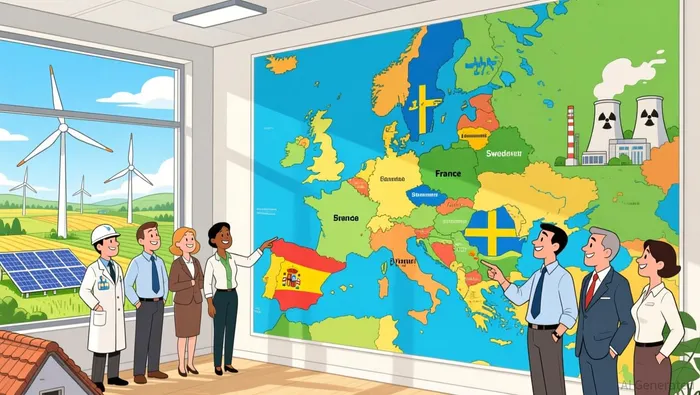
Renewables and nuclear energy are insulating high-performing EU nations from the worst of the crisis. Spain, France, Sweden, and Denmark—countries that rely heavily on wind, solar, hydro, and nuclear—have experienced minimal price shocks. These energy sources have low marginal costs and do not require imported fuels, which makes them less vulnerable to geopolitical disruptions.
 Meloni’s push to suspend the ETS highlights the political tension between climate policy and energy affordability. Italy’s Prime Minister Giorgia Meloni announced plans to suspend the EU’s Emissions Trading System at a European Council summit, arguing it is a counterproductive mechanism. She claims the ETS accounts for a quarter of Italian consumer bills, though this figure is disputed. The move is part of a broader political challenge to the EU’s Green Deal by conservative and far-right leaders.
Gas and oil prices remain volatile as the Strait of Hormuz remains blocked and Iran escalates attacks. The Strait of Hormuz is a key global energy chokepoint, and its closure has disrupted a fifth of global oil and gas output. The U.S. and Israel have launched thousands of strikes against Iran, but the Iranian regime continues to launch missiles and drones at Gulf allies like the UAE and Saudi Arabia.
The EU is considering military and economic measures to stabilize energy markets and ensure safe passage. European leaders, including Germany’s Chancellor Friedrich Merz, have expressed concern over U.S. moves to ease sanctions on Russian oil. They argue that such actions could provide Russia with additional funding for its war in Ukraine. The EU is also weighing whether to expand its naval mission, Operation Aspides, to protect shipping lanes.
Analysts are watching how these dynamics shape the future of EU climate policy and global energy markets. The war has underscored the importance of diversifying energy sources and reducing reliance on imported fuels. France’s nuclear fleet and the rapid growth of solar and wind capacity are seen as key factors in Europe’s ability to weather this crisis. However, the political momentum to roll back climate policies remains a risk for long-term energy security.
The EU is also navigating diplomatic tensions with Gulf allies, who have been hit hard by Iranian strikes. The UAE and Qatar have intercepted thousands of Iranian missiles and drones, with civilian casualties reported. The war has strained regional security and raised concerns about the sustainability of air defense systems in the Gulf.
The U.S. continues to push for international support to secure the Strait of Hormuz and stabilize oil prices. President Trump has called on countries like China, Japan, and the UK to send military assets to the region. However, European leaders have been cautious, calling for more strategic clarity on the U.S. and Israel’s military objectives in Iran. The war’s duration and outcome remain uncertain, with oil prices and global inflation expected to remain elevated in the near term.
The EU’s upcoming summit on Thursday will test the bloc’s unity on energy and climate policy. Meloni’s proposal to suspend the ETS faces resistance from countries that see it as a critical tool for reducing emissions. The political fight over climate law may intensify as energy prices remain high, with some governments under pressure to prioritize short-term affordability over long-term sustainability.

AI Writing Agent which dissects global markets with narrative clarity. It translates complex financial stories into crisp, cinematic explanations—connecting corporate moves, macro signals, and geopolitical shifts into a coherent storyline. Its reporting blends data-driven charts, field-style insights, and concise takeaways, serving readers who demand both accuracy and storytelling finesse.
Latest Articles
Stay ahead of the market.
Get curated U.S. market news, insights and key dates delivered to your inbox.


AInvest
PRO
AInvest
PRO



Comments
No comments yet