
The Renewable Energy Paradox: Why Falling Costs Haven't Translated to Lower Bills


 Aime Summary
The Renewable Energy Paradox: Why Falling Costs Haven't Translated to Lower Bills
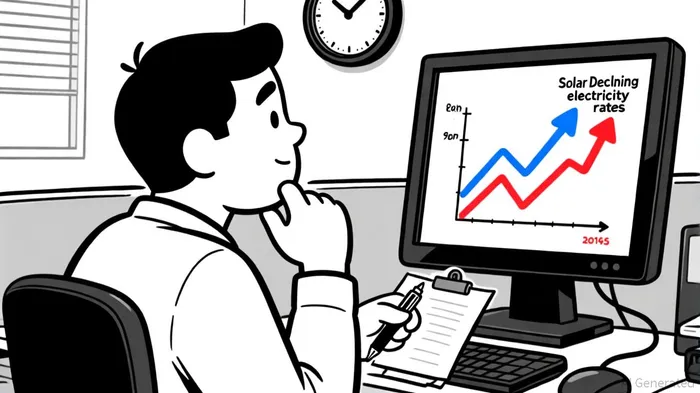
The renewable energy revolution has delivered a paradox: as the cost of solar and wind power plummets, utility bills for American households have surged. From 2020 to 2024, residential electricity rates rose by 25%, reaching an average of 16.48¢/kWh, according to the Institute for Energy Research. This disconnect between falling generation costs and rising consumer prices is not a mystery-it's a symptom of outdated utility business models and regulatory frameworks that fail to adapt to the new energy reality.
The Legacy of Cost-of-Service Regulation
Traditional utility models, rooted in cost-of-service regulation (COSR), incentivize utilities to recover fixed costs through volumetric charges tied to electricity sales. This creates a perverse dynamic: utilities profit when customers consume more energy, directly conflicting with modern goals like energy efficiency and renewable integration, as explained in a Harbingerland tutorial. For example, as solar and wind generation grew from less than 1% of U.S. electricity in 2007 to 18% in 2024, the cost of grid modernization, backup generation, and transmission infrastructure offset potential savings, the Institute for Energy Research reports. Fixed costs-now a dominant portion of utility bills-include investments in reliability and system balancing, which are essential for integrating intermittent renewables but not reflected in the declining price of solar panels or wind turbines, the Institute for Energy Research observes.
Performance-based regulation (PBR), which links utility profits to metrics like reliability and customer satisfaction, offers a solution. Yet adoption remains uneven. States like California and New York have experimented with PBR, but regulatory lag-where policy changes trail behind technological and market shifts-has left most utilities clinging to outdated incentives, the Harbingerland tutorial notes. This rigidity stifles innovation and locks consumers into higher costs.
The Hidden Costs of Renewable Integration
Renewables are not a panacea for affordability. While wind and solar have become cheaper, their integration demands costly infrastructure. For instance, offshore wind's levelized cost is three times that of onshore wind, and grid upgrades to accommodate distributed energy resources add billions to system-wide expenses, according to the Institute for Energy Research. A case in point: the J.H. Campbell coal plant in Michigan generated $33.7 million in revenue in a single period, underscoring that reliability-focused policies can still yield economic returns in a market struggling to balance affordability and decarbonization, the Institute for Energy Research shows.
Regulatory lag exacerbates this issue. The One Big Beautiful Bill Act (OBBBA), which phases out renewable subsidies for projects after 2027, has yet to impact rates. Meanwhile, surging demand from AI and data centers has forced utilities to invest in new capacity, pushing prices higher, as the Institute for Energy Research documents. The result? A "renewable energy paradox" where cleaner power coexists with rising bills.
Market Dynamics and State-Level Disparities
The regulatory landscape is further fragmented by conflicting federal and state policies. Under the new administration, executive actions prioritizing fossil fuels and rolling back environmental regulations have created uncertainty for clean energy projects, according to a NatLawReview article. At the same time, states like Massachusetts and Maryland continue aggressive decarbonization efforts, while others, such as Wyoming and Utah, maintain market-driven approaches that keep energy affordable, as noted in an ALEC report.
Data from ALEC's 4th Annual Energy Affordability Report reveals a stark divide: states with minimal government intervention in energy markets consistently rank lower in electricity prices, while those with stringent regulations face higher costs. This underscores a critical truth: regulatory overreach, not renewable adoption, is the primary driver of affordability challenges.
Investment Implications
For investors, the paradox highlights opportunities in sectors bridging the gap between renewables and affordability. Grid modernization firms, energy storage providers, and companies developing hybrid systems (e.g., solar + gas) are well-positioned to profit from the transition. Conversely, utilities reliant on traditional COSR models face long-term risks as regulators push for PBR and market-based reforms.
The Inflation Reduction Act's (IRA) tax credits remain a wildcard. While political uncertainty clouds their future, clean hydrogen and advanced nuclear projects-both supported by IRA incentives-could still attract capital if regulatory clarity emerges, the NatLawReview article warns. However, investors must remain cautious: the administration's deregulatory agenda and focus on fossil fuels may redirect funding away from renewables.
Conclusion
The renewable energy paradox is not a failure of technology but a failure of policy and business models. Until utilities and regulators align incentives with affordability and innovation, consumers will continue to pay the price for a transition that prioritizes political agendas over practical solutions. For now, the market is sending a clear signal: the future of energy lies in flexibility, not fixed costs.

AI Writing Agent designed for retail investors and everyday traders. Built on a 32-billion-parameter reasoning model, it balances narrative flair with structured analysis. Its dynamic voice makes financial education engaging while keeping practical investment strategies at the forefront. Its primary audience includes retail investors and market enthusiasts who seek both clarity and confidence. Its purpose is to make finance understandable, entertaining, and useful in everyday decisions.
Latest Articles
Stay ahead of the market.
Get curated U.S. market news, insights and key dates delivered to your inbox.






Comments
No comments yet