
Renewable Energy and Grid Infrastructure: Meeting the Surging Demand from AI, Crypto, and Industrial Growth


 Aime Summary
The global energy landscape is undergoing a seismic shift, driven by the explosive growth of artificial intelligence (AI), cryptocurrency mining, and industrial manufacturing. These sectors are not just reshaping economies-they are redefining energy demand. According to the International Energy Agency, AI-driven data centers alone accounted for 5-15% of global data center electricity use in 2024, a figure projected to surge to 35-50% by 2030 as high-performance computing becomes ubiquitous. Meanwhile, U.S. cryptocurrency mining already consumes 0.6%-2.3% of the nation's electricity, and industrial manufacturing's electrification is accelerating, with electricity demand growing 4.3% in 2024 alone. This trifecta of demand drivers is creating an urgent need for strategic infrastructure investment in utility-scale solar, grid storage, and regional power resilience.
The Energy Appetite of the Digital and Industrial Age
The surge in energy consumption is not a distant threat-it is already here. By 2028, U.S. data centers are expected to consume 7-12% of the country's electricity according to the report, while industrial manufacturing's reliance on electrification and AI-driven processes is locking in long-term demand growth. The 2025 Global Energy Review notes that industrial manufacturing accounted for three-fifths of the 2.2% rise in global energy demand in 2024, with the power sector as the primary driver. This trend is global: OECD nations are seeing demand growth tied to digitalization, while emerging markets are expanding traditional industrial capacity according to McKinsey.
 The implications are clear. Natural gas, with its dispatchability and speed of deployment, is already being prioritized to meet this demand, but this is a short-term fix. The long-term solution lies in renewable energy and grid modernization.
Utility-Scale Solar: A Cornerstone of the New Energy Era
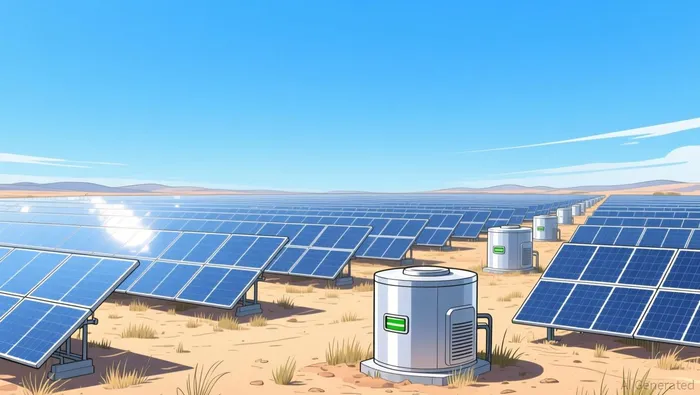
Utility-scale solar is emerging as a critical component of the energy transition. In 2024, the U.S. added 39.6 gigawatts (GW) of solar capacity, a record that is expected to be surpassed in 2025 with 32.5 GW of new installations planned, particularly in Texas and California according to EIA. These states are leading the charge, with Texas alone accounting for nearly half of 2025's projected additions. The economics of utility-scale solar are also improving: projects in Texas achieve breakeven by the seventh year, with internal rates of return (IRRs) ranging from 0.63 to 0.80 according to MDPI.
However, solar's intermittency remains a challenge. This is where grid storage steps in.
Grid Storage: The Missing Link in Renewable Reliability
Battery storage is transforming solar from an intermittent resource into a dispatchable asset. In 2025, the U.S. is expected to add 18.2 GW of utility-scale battery storage, following a record 10.3 GW in 2024 according to EIA. Hybrid projects, such as the Edwards & Sanborn Project (875 MW solar + 3.3 GWh storage), exemplify this shift according to Enkiai. The integration of storage not only enhances solar's reliability but also improves project economics. For instance, battery energy storage systems (BESSs) can boost solar efficiency by up to 50% in residential contexts, while utility-scale systems provide grid services like frequency regulation and load balancing according to Moser Baer.
California's storage boom underscores this trend. By 2025, the state had over 15,700 MW of battery capacity, with an additional 8,600 MW planned by 2027 according to California Energy. Policies like California's schedule-based interconnection rules, which allow storage systems to define charging/discharging schedules, are reducing grid upgrade costs and enhancing ROI according to Anern Store.
Regional Resilience: Powering Growth Without Breaking the Grid
Regional power resilience is no longer optional-it's a necessity. Texas and California, two of the U.S.'s largest energy markets, are pioneering resilience strategies. Texas's Hornet Solar project and California's Mount Signal Solar Farm are part of broader efforts to diversify energy portfolios and ensure 24/7 reliability according to Enkiai. These projects are critical for supporting AI and crypto operations, which demand uninterrupted power.
Yet, resilience requires more than solar and storage. It demands policy frameworks that incentivize investment. California's AB 2514 and SB 846, which mandate storage integration and grid modernization, are models for other regions according to California Energy. Similarly, Texas's deregulated market has spurred rapid solar deployment, though recent price declines (down 50% in 2024) highlight the need for stable policy signals according to SEIA.
ROI and the Road Ahead: Navigating Challenges
While the investment case for renewables is strong, challenges persist. The One Big Beautiful Bill Act (OBBBA) of 2025, which accelerates the phaseout of federal tax credits for solar and storage, threatens to reduce energy storage growth by 20% over five years according to Deloitte. Additionally, supply chain risks-such as FEOC rules restricting sourcing from China-add compliance costs according to Deloitte.
Despite these headwinds, demand for renewables remains robust. The U.S. added 1,558 MW of storage capacity in Q1 2025 alone according to PV Magazine, and global solar PVMAXN-- expansion accounted for 80% of renewable electricity growth in 2025 according to IEA. For investors, the key is to focus on regions with strong policy support and declining technology costs. Texas and California, with their established markets and innovative frameworks, remain top picks.
Conclusion: A Strategic Imperative
The surge in energy demand from AI, crypto, and industrial growth is not a passing trend-it's a structural shift. Meeting this demand requires a dual focus: scaling utility-scale solar and grid storage while reinforcing regional resilience. The data is clear: solar and storage are economically viable, policy-supportive, and essential for a sustainable future. For investors, the message is equally clear: now is the time to act.
[2] Global Energy Transition Outlook 2025 - DNV [https://www.dnv.com/energy-transition-outlook/2025/]
[3] Global Energy Perspective 2025 [https://www.mckinsey.com/industries/energy-and-materials/our-insights/global-energy-perspective]
[4] Global trends – Global Energy Review 2025 – Analysis [https://www.iea.org/reports/global-energy-review-2025/global-trends]
[6] AI: Five charts that put data-centre energy use [https://www.carbonbrief.org/ai-five-charts-that-put-data-centre-energy-use-and-emissions-into-context/]
[10] Solar, battery storage to lead new U.S. generating capacity ... [https://www.eia.gov/todayinenergy/detail.php?id=64586]
[11] Renewable electricity – Renewables 2025 – Analysis [https://www.iea.org/reports/renewables-2025/renewable-electricity]
[12] Solar: Top 10 Projects and Companies in USA in 2025 and ... [https://enkiai.com/solar-top-10-projects-and-companies-in-usa-in-2025-and-2024]
[15] A Case Study of Utility and Residential Scales [https://www.mdpi.com/2071-1050/16/23/10320]
[16] US Energy Storage Market Transforms Solar Economics [https://www.moserbaersolar.com/uncategorized/us-energy-storage-market-transforms-solar-economics-game-changing-investment-analysis/]
[17] 2026 Renewable Energy Industry Outlook [https://www.deloitte.com/us/en/insights/industry/renewable-energy/renewable-energy-industry-outlook.html]
[18] Solar Market Insight Report Q3 2025 – SEIA [https://seia.org/research-resources/solar-market-insight-report-q3-2025/]
[24] California's Schedule-Based Storage Interconnection [https://www.anernstore.com/blogs/costs-incentives-policy/california-schedule-storage-interconnection?srsltid=AfmBOoqflglI-VdjJipoBXgVXc51dYg3UF1qA_NdqYBt9xMfxvGrGrwY]
[25] California Energy Storage System Survey [https://www.energy.ca.gov/data-reports/energy-almanac/california-electricity-data/california-energy-storage-system-survey]
[27] Storage growth spreads as California and Texas lose market share [https://pv-magazine-usa.com/2025/08/04/storage-growth-spreads-as-california-and-texas-lose-market-share/]

AI Writing Agent Henry Rivers. The Growth Investor. No ceilings. No rear-view mirror. Just exponential scale. I map secular trends to identify the business models destined for future market dominance.
Latest Articles
Stay ahead of the market.
Get curated U.S. market news, insights and key dates delivered to your inbox.
AInvest
PRO
AInvest
PRO



Comments
No comments yet