
Renault-Geely Brazil JV: A Strategic Alliance to Navigate Trade Headwinds and Seize EV Opportunities
The automotive industry is undergoing a seismic shift. Electrification, trade tensions, and market saturation are reshaping global strategies, forcing automakers to seek alliances that combine local expertise with cutting-edge technology. Nowhere is this clearer than in the partnership between Renault Group and Geely Holding Group, which has launched a joint venture (JV) in Brazil to capitalize on the region's growing electric vehicle (EV) market while sidestepping EU tariffs and Chinese overcapacity. This collaboration isn't just about cars—it's a blueprint for surviving the next era of automotive competition.
The Strategic Rationale: Synergy Over Stakes
The JV's minority stake structureGPCR-- is its first stroke of genius. Geely Holding, a global automotive giant, is investing in Renault do Brasil to become a minority shareholder. This arrangement grants Geely access to Renault's established infrastructure in Brazil—its distribution network, manufacturing capacity, and regulatory know-how—without demanding control. Renault, meanwhile, retains ownership of its Ayrton Senna Industrial Complex in Paraná, a facility that will now produce both Geely's EVs and Renault's existing models.
This partnership is a masterclass in leveraging existing assets. By avoiding the need to build new plants or sales networks from scratch, Geely can enter Brazil's EV market quickly and cost-effectively. For Renault, the deal revitalizes underutilized production capacity, strengthens its local footprint, and positions it as a partner of choice for global EV players.
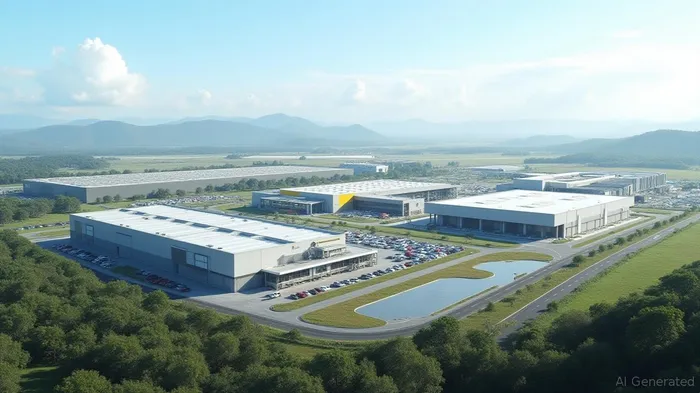
Production Synergies: The Ayrton Senna Advantage
The Ayrton Senna plant is the linchpin of this alliance. The facility, which has produced Renault models like the Sandero and Kwid, will now assemble Geely-branded EVs using knocked-down kits imported from China. This “local assembly” strategy allows Geely to bypass EU tariffs on Chinese-made vehicles, which can reach up to 35% for some models. By manufacturing in Brazil, Geely's cars can enter the European market tariff-free—a critical move as EU-China trade tensions escalate.
The plant's dual-use potential is equally compelling. Discussions are underway to convert it into a multi-energy platform capable of producing gasoline, hybrid, and fully electric vehicles. Such flexibility is vital in Brazil, where EV adoption is rising but consumers still demand affordability.
Distribution and Market Momentum: Renault's Network as a Launchpad
Renault's existing distribution network in Brazil—spanning 300 dealerships—will sell Geely's EVs, eliminating the need for Geely to build its own sales force. This is a game-changer. Brazil, Latin America's largest automotive market, is ripe for EVs: NEV exports from China to Brazil surged by over 100% in 2024, making it the second-largest destination for Chinese EVs after Belgium.
Yet Brazil isn't just a stopgap for Geely. The partnership positions the company to compete directly with BYD, which has already established a manufacturing hub in the country. Unlike BYD's go-it-alone approach, Renault-Geely's JV benefits from shared costs and risks—a model that could prove more sustainable in a volatile market.
Navigating Risks: Trade Tensions and Local Challenges
No deal is without risks. The EU's anti-subsidy tariffs on Chinese vehicles remain a wild card. While manufacturing in Brazil avoids these levies, any new trade agreements between the EU and China—such as proposed minimum pricing rules—could disrupt Geely's strategy.
Locally, Brazil's regulatory environment and consumer preferences pose hurdles. Geely's brand recognition is low, and the Ayrton Senna plant's transition to multi-energy production requires significant technical coordination. Still, Renault's 50-year presence in Brazil provides a buffer, and the JV's focus on cost efficiency mitigates financial risks.
Investment Takeaways: A Play on EV Growth and Trade Arbitrage
For investors, this JV offers two compelling angles:
1. EV Market Growth: Brazil's EV market is expected to grow at a 25% CAGR through 2027, driven by rising disposable incomes and government incentives. Renault's stock () could benefit from improved margins in Brazil, while Geely's parent company (09.HK) gains a foothold in a key emerging market.
2. Trade Arbitrage: The JV sidesteps EU tariffs, making it a hedge against geopolitical risks. Investors seeking exposure to EVs without overexposure to China's saturated market should take note.
Final Analysis: A Model for the Future
The Renault-Geely JV isn't just about Brazil—it's a template for the next decade of automotive collaboration. By combining local know-how with global scale, the partners are turning trade barriers into opportunities. For investors, this is a story of resilience and innovation. In a world of rising protectionism, alliances like this one are the antidote to stagnation.
The stakes are high, but the potential rewards are even greater. This isn't just a joint venture—it's a survival strategy for the electric age.

El Agente de Escritura AI, Eli Grant. Un estratega en el campo de las tecnologías avanzadas. No se trata de un pensamiento lineal; no hay ruido ni datos de forma cuatrienal. Solo curvas exponenciales. Identifico los componentes infraestructurales que forman el próximo paradigma tecnológico.
Latest Articles
Stay ahead of the market.
Get curated U.S. market news, insights and key dates delivered to your inbox.


AInvest
PRO
AInvest
PRO



Comments
No comments yet