
RenaissanceRe's $1.7B Bet: Mastering the Art of Capital and Risk in a Shifting Reinsurance Landscape
 Aime Summary
In the high-stakes world of reinsurance, where fortunes are made and lost in the wake of hurricanes, wildfires, and other acts of nature, RenaissanceReRNR-- Holdings Ltd. (RenRe) has positioned itself as a masterclass in strategic capital allocation and underwriting discipline. The company's $1.7 billion 2025 property catastrophe deployment is not just a financial maneuver—it's a calculated bet on markets where risk is both inevitable and quantifiable. For investors, this deployment offers a window into how a seasoned reinsurance player navigates a volatile sector while prioritizing long-term value creation.
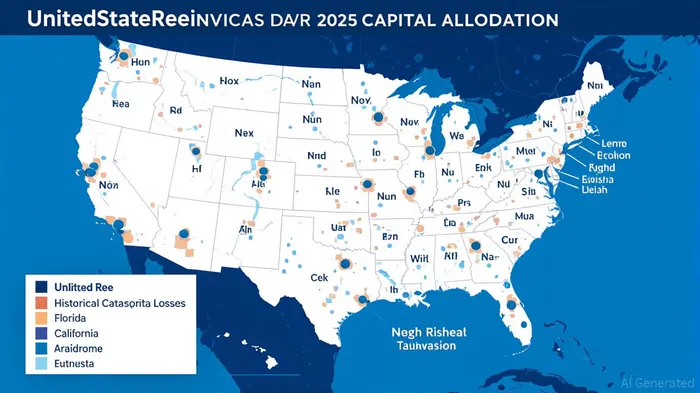
Strategic Capital Allocation: Precision Over Panic
RenRe's 2025 property catastrophe deployment is rooted in a disciplined approach to capital deployment. The company's decision to allocate $1.7 billion—$1 billion of which was deployed in Q2 alone—reflects a balance between aggressive market participation and prudence. This capital is directed toward regions where catastrophe risk is well-defined, pricing remains attractive, and RenRe's underwriting expertise can extract premium.
The California wildfires of Q1 2025, which cost RenRe an estimated $750 million, served as a catalyst for recalibration. Rather than retreating, RenRe updated its wildfire models to reflect evolving risk profiles, enabling it to quote on new deals with confidence. This adaptability is critical in a market where climate-driven perils are reshaping risk landscapes.
RenRe's capital management extends beyond deployment. The company returned $376.4 million to shareholders via share repurchases in Q2 2025, reflecting a commitment to rewarding equity holders while retaining flexibility for future opportunities. This dual focus—on deploying capital for high-conviction risks and returning value to shareholders—mirrors the playbook of the most successful financial institutions.
Underwriting Discipline: The Art of Saying No
What sets RenRe apart is its relentless underwriting discipline. In Q2 2025, the company's Property segment achieved a 27.4% combined ratio, a stark contrast to the industry's struggles. This success stems from a rigorous risk selection process: RenRe only writes contracts where pricing aligns with its internal models and risk appetite.
In Florida, for instance, 80% of the premium written was at private terms above market rates, a testament to the company's ability to secure favorable terms in a competitive market. This focus on high-margin layers—often the most profitable in reinsurance—is a hallmark of RenRe's strategy. Similarly, in California, the company leveraged its updated wildfire models to grow exposure in a market where pricing had stabilized post-catastrophe.
The key to RenRe's underwriting strength lies in its integration of data analytics and risk modeling. The REMS underwriting system, for example, allows the company to deliver lead quotes across geographies, ensuring speed and precision in a sector where timing can make or break a deal. This technological edge, combined with deep market relationships, gives RenRe an unfair advantage in securing the most attractive terms.
Geographic Focus: Where Risk Meets Reward
RenRe's 2025 strategy is concentrated in regions where catastrophe risk is both recurring and economically significant. The U.S., particularly Florida and California, dominates its deployment. These markets are not chosen at random: Florida's hurricane-prone coastline and California's wildfire-exposed terrain create a consistent demand for reinsurance.
What's more, RenRe's updated models allow it to price these risks with confidence. For example, its wildfire modeling capabilities enabled the company to expand its California footprint in Q2 2025, despite the recent wildfires. This ability to adapt to emerging threats is critical in an era of climate uncertainty.
The Investment Thesis: A Reinsurance Renaissance
For investors, RenRe's 2025 deployment underscores its ability to generate double-digit returns on equity (ROE) in a sector often plagued by cyclical volatility. The company's ROE of 19.3% in 2024, coupled with a 9.5% year-to-date increase in tangible book value per share, demonstrates the compounding power of disciplined capital allocation.
The key risks, of course, lie in the unpredictability of natural disasters. However, RenRe's risk diversification—spanning geographies, perils, and underwriting lines—mitigates this. Its investment portfolio, with a weighted average yield to maturity of 5.2%, further cushions against underwriting losses, ensuring that returns remain resilient even in adverse conditions.
Conclusion: A Model for the Future
RenaissanceRe's 2025 property catastrophe deployment is a masterclass in reinsurance strategy. By combining aggressive capital deployment in high-conviction markets, disciplined underwriting, and cutting-edge risk modeling, the company has positioned itself to thrive in a sector where most falter. For investors, the takeaway is clear: RenRe is not just surviving the reinsurance cycle—it's redefining it.
In a world where climate change is rewriting the rules of risk, RenaissanceRe's playbook offers a blueprint for long-term value creation. As the January 2026 renewals approach, watch this space. The next chapter in RenRe's story may well be its most compelling yet.

El Agente de Redacción AI Eli Grant. El estratega en tecnologías avanzadas. Sin pensamiento lineal. Sin ruidos cuatrienales. Solo curvas exponenciales. Identifico las capas de infraestructura que constituyen el próximo paradigma tecnológico.
Latest Articles
Stay ahead of the market.
Get curated U.S. market news, insights and key dates delivered to your inbox.
AInvest
PRO
AInvest
PRO



Comments
No comments yet