
Remittix (RTX) as a PayFi Disruptor Outperforming Solana in 2025


 Aime Summary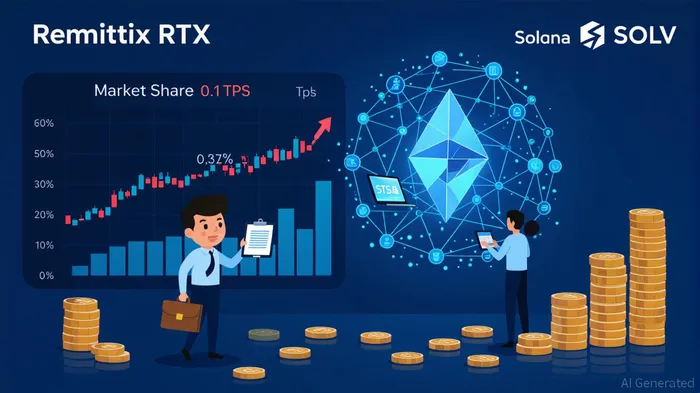
The cryptocurrency market in 2025 is witnessing a seismic shift in the PayFi (payments + DeFi) space, as projects with tangible real-world utility outpace generalized blockchain platforms. Remittix (RTX), a cross-border payment protocol, has emerged as a disruptive force, leveraging a deflationary tokenomics model and hyper-competitive fees to capture a significant share of the $19 trillion global remittance market. By contrast, SolanaSOL-- (SOL), despite its institutional adoption and technical prowess, faces challenges in maintaining market share due to volatility and a broader, less focused value proposition.
RTX’s Real-World Utility: A Niche-Driven Edge
Remittix’s success stems from its laser-like focus on remittances, a sector long plagued by high fees and inefficiencies. The platform offers cross-border transactions at 0.1% fees—far below the 6–8% charged by incumbents like Western UnionWU-- and SWIFT [1]. By Q3 2025, RTXRTX-- had already processed 400,000 transactions for 1.2 million users, supporting 40+ cryptocurrencies and 30+ fiat currencies for real-time FX conversions [2]. This hypergrowth is driven by direct-to-consumer adoption in high-remittance regions like Brazil and Kenya, where remittances account for 5–10% of GDP [3].
RTX’s deflationary model further amplifies its value proposition. By burning 10% of transaction fees to reduce token supply, the protocol creates scarcity and aligns token value with user growth [4]. This mechanism, combined with CertiK audits and listings on exchanges like BitMart and LBANK, has attracted institutional credibility and liquidity [5]. Analysts project that capturing just 1–2% of the global remittance market could generate $190–$380 billion in annual transaction volume within a year, fueling a 7,500% return on investment by late 2025 [1].
Solana’s Broad Infrastructure vs. RTX’s Vertical Integration
Solana, with its 100,000 TPS throughput and institutional partnerships (BlackRock, FTX), remains a dominant force in blockchain infrastructure. Its Alpenglow upgrade reduced transaction finality to 100 milliseconds, enabling real-world applications like DeFi and micropayments [2]. However, Solana’s broader ecosystem—spanning decentralized exchanges, tokenized real-world assets (RWAs), and gaming—spreads its utility thin compared to RTX’s vertical integration in remittances [3].
Moreover, Solana’s price volatility has raised concerns. A recent dip below $200 in September 2025 highlighted its susceptibility to market fluctuations, prompting investors to shift toward projects with proven use cases like RTX [5]. While Solana’s total value locked (TVL) reached $13 billion in 2025, its role in remittances remains indirect, relying on third-party platforms to leverage its infrastructure [4].
Market Share and ROI: The PayFi Revolution
The PayFi revolution is accelerating, with RTX’s ability to execute on its vision positioning it to outpace Solana and Ripple by 2026. RTX’s $22.4 million presale and institutional-grade security audits have laid the groundwork for rapid adoption, while Solana’s technical challenges and price instability create headwinds [6]. Analysts argue that RTX’s niche focus allows it to capture market share in a sector with immediate demand, whereas Solana’s broader ambitions risk diluting its impact [3].
As the global remittance market evolves, the project that best aligns with real-world utility—RTX—will likely redefine the PayFi landscape. With a deflationary model, low fees, and institutional validation, RTX is not just competing with Solana; it is redefining the rules of the game.
Source:
[1] Why Remittix (RTX) Could Be the 100x Opportunity of 2025 [https://www.ainvest.com/news/remittix-rtx-100x-opportunity-2025-2509/]
[2] Why Remittix (RTX) Outpaces Solana and Ripple in 2025/26 [https://www.ainvest.com/news/remittix-rtx-outpaces-solana-ripple-2025-26-2509/]
[3] Solana's Rally and the Emerging Challenge from Remittix [https://www.ainvest.com/news/solana-rally-emerging-challenge-remittix-strategic-august-2025-price-projections-2508/]
[4] Altcoins Statistics 2025: Uncover Profit & Trends [https://coinlaw.io/altcoins-statistics/]
[5] SOL Drop Below $200 So Are New Altcoins Like Remittix Taking Away Market Share? [https://coincentral.com/solana-price-prediction-sol-drop-below-200-so-are-new-altcoins-like-remittix-taking-away-market-share/]
[6] Remittix, Solana, VeChainVET-- And PolkadotDOT-- Predicted As The Top Cryptos To Rise In September [https://www.barchart.com/story/news/34499751/remittix-solana-vechain-and-polkadot-precited-as-the-top-cryptos-to-rise-in-september]

Decoding blockchain innovations and market trends with clarity and precision.
Latest Articles
Stay ahead of the market.
Get curated U.S. market news, insights and key dates delivered to your inbox.






Comments
No comments yet