
Why Remittix (RTX) Is a High-ROI Opportunity in 2025's Altcoin Landscape


 Aime Summary
The cryptocurrency market in 2025 is witnessing a paradigm shift in the PayFi (Payment Finance) sector, driven by projects that bridge the gap between blockchain innovation and real-world utility. Among these, Remittix (RTX) stands out as a compelling investment opportunity, combining robust presale performance with tangible adoption metrics. This analysis explores how RTX’s strategic focus on cross-border remittances, deflationary tokenomics, and institutional credibility positions it to outperform peers like XRPXRP-- and SolanaSOL-- in the race for PayFi dominance.
Presale Momentum and Capital Influx
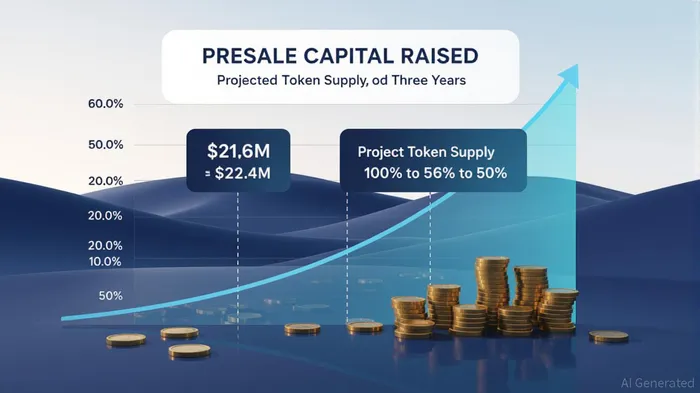
RTX’s presale has raised over $21.6 million by selling 629 million tokens at $0.0987 each, with subsequent rounds securing an additional $22.4 million for a total of 631 million tokens sold [1]. This capital influx has directly fueled on-chain activity: the platform now processes 400,000 cross-border transactions monthly for 1.2 million users, leveraging a beta wallet that enables stablecoin-to-fiat conversions in over 40 countries [2]. Such metrics underscore RTX’s ability to convert presale capital into real-world utility, a critical factor for long-term value creation.
In contrast, XRP, despite a 500% surge in Q3 2025 transaction volume, has seen its price stagnate between $2.75 and $3.05 [1]. This highlights a key distinction: RTX’s token model is designed to align price appreciation with user growth, while XRP’s institutional dominance and speculative ETF-driven demand lack the same retail adoption tailwinds.
Deflationary Tokenomics and Scarcity
RTX’s tokenomics introduce a 10% transaction fee burn mechanism, projected to reduce the token supply by 50% within three years [3]. This creates a deflationary flywheel: as transaction volume grows, the supply shrinks, potentially driving upward price pressure. For context, the global remittance market is valued at $19 trillion, and RTXRTX-- aims to capture 1–2% of this within 12 months through its 0.1% fee model [2]. If achieved, this would generate recurring revenue while accelerating token scarcity—a dual catalyst for ROI.
Real-World Adoption and Institutional Credibility
RTX’s beta wallet, which allows direct fiat deposits into bank accounts in 40+ countries, is a game-changer for retail users. Unlike XRP’s institutional focus, RTX’s retail-centric approach taps into the $750 billion annual remittance market for low-income households, a demographic often underserved by traditional finance [2]. This is further amplified by partnerships with exchanges like BitMart and LBank, which have secured RTX’s first CEX listing and global liquidity [4]. CertiK audits and presale verification add another layer of trust, critical for attracting both retail and institutional investors.
Strategic Positioning in the PayFi Ecosystem
The PayFi sector is increasingly competitive, but RTX’s combination of low fees, real-world utility, and deflationary design creates a unique value proposition. Solana, for instance, struggles with high gas fees and limited fiat integration, while XRP’s regulatory uncertainties and lack of retail tools hinder scalability. RTX’s roadmap—focusing on 1.2 million active users and 400,000 monthly transactions—demonstrates a clear path to network effects, a prerequisite for sustained ROI.
Conclusion
For investors seeking exposure to the PayFi boom, RTX offers a rare trifecta: presale momentum, real-world adoption, and institutional validation. Its deflationary model and retail-focused infrastructure position it to capture a significant slice of the remittance market, outpacing peers in both utility and price performance. As the sector matures, RTX’s ability to convert user growth into token value will likely make it one of 2025’s most rewarding altcoin plays.
Source:
[1] Why Remittix (RTX) Outpaces XRP as the 2025 PayFi ... [https://www.ainvest.com/news/remittix-rtx-outpaces-xrp-2025-payfi-investment-play-2508/]
[2] Why Remittix (RTX) Outpaces Solana in Real-World Crypto Adoption [https://www.bitget.com/news/detail/12560604934627]
[3] XRP 2.0 and the Emergence of Remittix as the Next PayFi ... [https://www.bitget.com/news/detail/12560604939407]
[4] Polygon Latest News & How Remittix Could Dominate PayFi [https://crypto-economy.com/solana-price-predictions-polygon-latest-news-how-remittix-could-dominate-payfi/]

Decoding blockchain innovations and market trends with clarity and precision.
Latest Articles
Stay ahead of the market.
Get curated U.S. market news, insights and key dates delivered to your inbox.


AInvest
PRO
AInvest
PRO



Comments
No comments yet