
Remittix (RTX) as the 2025 Altcoin Disrupting Cross-Border Payments


 Aime Summary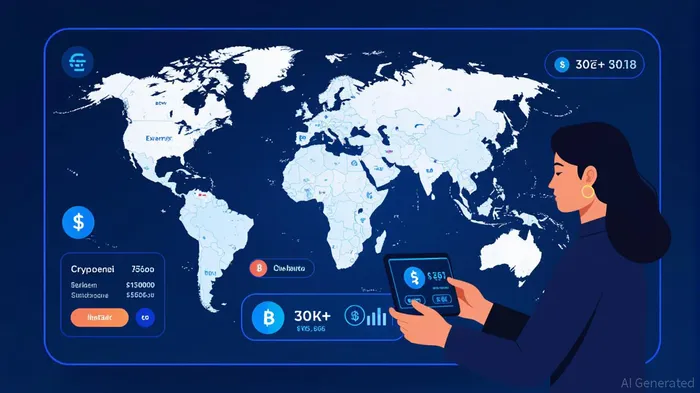
The global payments landscape is on the brink of a seismic shift. With the $19 trillion cross-border remittance market dominated by legacy systems like SWIFT and Western UnionWU--, the need for a decentralized, low-cost alternative has never been more urgent. Enter Remittix (RTX), a PayFi (Payment + DeFi) project poised to redefine how digital assets interact with traditional finance. By combining a deflationary tokenomics model with real-world utility, RTXRTX-- is not just another altcoin—it's a structural solution to a $19 trillion problem.
The $20.6M Presale: A Vote of Confidence
Remittix's presale has already raised $20.6 million, selling 614 million RTX tokens at $0.0969 each. This success reflects institutional and retail investor confidence in a project that bridges crypto and fiat with a clear roadmap. The presale's 50% token allocation has unlocked a listing on BitMart, a major centralized exchange, providing immediate liquidity for 5,000+ holders. This liquidity, combined with a $250,000 RTX token giveaway, has fueled community growth and positioned RTX as a top-tier 2025 presale.
Q3 2025 Beta Wallet: The On-Ramp to Mass Adoption
The Q3 2025 beta wallet launch is the linchpin of RTX's strategy. This non-custodial wallet supports 40+ cryptocurrencies and 30+ fiat currencies, enabling instant crypto-to-bank transfers in over 30 countries with fees as low as 0.1%. Unlike traditional remittance services, which charge 5–10% and take days, RTX's solution is instant, secure, and cost-effective. The wallet's multi-chain architecture—leveraging Solana's speed and Ethereum's security—ensures scalability and compliance, making it ideal for freelancers, small businesses, and underbanked populations.
The beta wallet isn't just a tool; it's a network effect engine. Every transaction generates fees that are burned, reducing RTX's circulating supply and increasing scarcity. With 1.5 billion tokens in total supply and a 4% staking reward allocation (up to 8% APY), RTX incentivizes long-term holding while aligning token value with real-world usage.
Deflationary Tokenomics: RTX vs. XRP and Dogecoin
RTX's tokenomics outshine both XRP and Dogecoin in critical ways.
- XRP relies on pre-mined supply (93% controlled by Ripple), creating volatility risks as whales liquidate holdings. Its deflationary mechanism is indirect—burns occur via transaction fees but are minimal compared to RTX's structured model.
- Dogecoin, an inflationary token with no burn mechanism, faces perpetual supply growth, diluting value over time.
RTX, by contrast, has a fixed supply of 1.5 billion tokens and a volume-driven burn rate. As transaction volume increases—driven by the beta wallet's adoption—more tokens are burned, creating scarcity and upward price pressure. This model mirrors Ethereum's post-EIP-1559 deflationary shift but is more tightly integrated with real-world utility.
Institutional Credibility and Strategic Partnerships
RTX's CertiK audit and KYC/AML compliance have attracted institutional interest, including EthereumETH-- whales diversifying into RTX. The project's partnership with BitMart ensures liquidity, while its $250,000 referral program drives organic adoption. These factors, combined with a transparent allocation plan (15% for marketing, 12% for exchange liquidity), position RTX as a regulation-ready asset in a market increasingly dominated by institutional-grade projects.
The 50x–100x Investment Case
To quantify RTX's potential, consider the following:
1. Market Capture: If RTX secures 1% of the $19 trillion remittance market, its annual transaction volume could exceed $190 billion. At 0.1% fees, this generates $190 million in revenue—enough to justify a $100+ valuation for RTX.
2. Token Burn Impact: With 614 million tokens already sold, the remaining 886 million could be burned as adoption grows. A 50% reduction in supply (to 750 million) would double token value, assuming constant demand.
3. Exchange Listings: The BitMart listing is just the beginning. A $22 million presale target will unlock a second major exchange listing, further boosting liquidity and visibility.
Risks and Mitigations
While RTX's fundamentals are strong, risks include regulatory shifts and competition from established players. However, its CertiK audit, multi-chain architecture, and real-world use cases mitigate these concerns. The project's focus on KYC/AML compliance also aligns with global regulatory trends, reducing the risk of de-listing or legal challenges.
Conclusion: A 2025 Must-Have
Remittix (RTX) is more than a speculative altcoin—it's a structural innovation in cross-border payments. With a $20.6M presale, a Q3 2025 beta wallet launch, and deflationary tokenomics that outperform XRPXRP-- and DogecoinDOGE--, RTX is uniquely positioned to capture the $19 trillion remittance market. For investors seeking a 50x–100x opportunity, RTX offers a compelling blend of real-world utility, institutional credibility, and scarcity-driven value creation.
Investment Advice: Allocate a portion of your 2025 crypto portfolio to RTX, especially ahead of the Q3 wallet launch. The combination of presale momentum, deflationary mechanics, and institutional adoption makes it a high-conviction play in the PayFi sector.

Decoding blockchain innovations and market trends with clarity and precision.
Latest Articles
Stay ahead of the market.
Get curated U.S. market news, insights and key dates delivered to your inbox.
AInvest
PRO
AInvest
PRO



Comments
No comments yet