
Reliance Industries: Strategic Diversification as a Shield Against Energy Market Volatility
 Aime Summary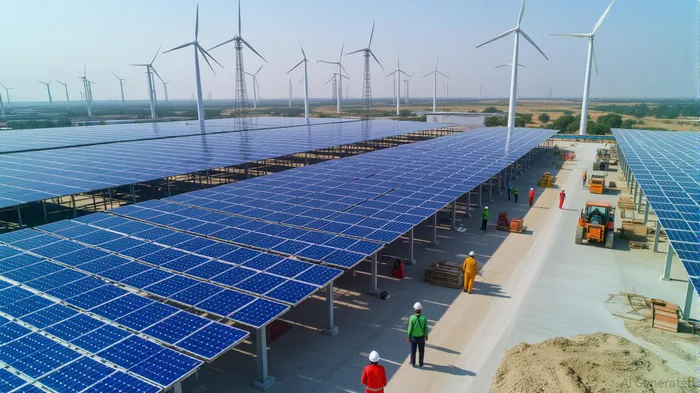
In an era marked by geopolitical tensions, fluctuating crude prices, and decarbonization pressures, Reliance Industries (RIL) has emerged as a case study in strategic resilience. The conglomerate's dual-engine model—combining a refined Oil-to-Chemicals (O2C) business with a high-growth digital segment—has proven remarkably effective in offsetting energy market volatility. As global energy markets remain in flux, RIL's ability to pivot between cyclical energy cycles and secular digital and renewable trends positions it as a compelling long-term investment.
O2C Segment: Margin Resilience Amid Commodity Headwinds
The O2C segment, which includes refining, petrochemicals, and retail fuel operations, faced a 1.5% year-on-year revenue decline in Q1 FY26 to ₹154,804 crore, driven by lower crude prices and a planned turnaround shutdown. However, this was more than offset by a 10.8% EBITDA growth to ₹14,511 crore, underscoring the segment's margin resilience.
Key drivers included:
- Strong domestic fuel retail margins: Reliance BPBP-- Mobility Limited (RBML) saw HSD and MS sales surge by 34.2% and 38.6%, respectively, despite industry-wide supply disruptions.
- Improved transportation fuel and downstream deltas: Operational efficiencies and favorable crack spreads mitigated crude price declines.
- Planned maintenance discipline: While turnaround shutdowns reduced volumes, they also positioned the segment for higher throughput in subsequent quarters.
This performance highlights RIL's ability to transform cost management and operational flexibility into margin stability—a critical trait in volatile energy markets.
Digital Dominance: Jio's 5G and ARPU Growth
While the O2C segment navigates cyclical headwinds, Reliance's digital arm, Jio Platforms, has become a consistent growth engine. In Q1 FY26, Jio's revenue rose 18.8% year-on-year to ₹41,054 crore, with EBITDA increasing 23.9% to ₹18,135 crore. The segment's EBITDA margin expanded to 51.8%, driven by a 14.9% rise in Average Revenue Per User (ARPU) to ₹208.8 and a 10.5 million subscriber net addition, bringing total users to 477.5 million.
JioTrue5G's user base surpassed 200 million, with fixed wireless access (FWA) gaining traction. Innovations like JioGames Cloud and JioPC (an AI-ready cloud computer) further solidify RIL's leadership in India's digital infrastructure.
Renewable Energy Transition: A $60 Billion Bet on the Future
Reliance's long-term value proposition lies in its audacious renewable energy strategy. The Dhirubhai Ambani Green Energy Giga Complex in Jamnagar—a 5,000-acre hub for solar PV, green hydrogen, and battery manufacturing—is central to RIL's ambition to become a New Energy and New Materials leader.
Key milestones include:
- Solar PV dominance: A “quartz-to-module” facility aims to produce 100 GW of solar capacity by 2030, leveraging acquired technologies from REC Solar and Faradion.
- Battery and energy storage: A sodium-ion and LFP battery giga factory, coupled with a 100 CBG plant rollout, positions RIL to lead India's energy transition.
- Green hydrogen and fuel cells: Modular electrolyser production and fuel cell R&D aim to replace internal combustion engines in transport and industrial applications.
By FY30, RIL targets over 50% of its PAT (Profit After Tax) from new energy segments—a bold but achievable goal given its capital discipline and strategic acquisitions.
Retail and Mobility Ecosystem: Scaling the Digital-Physical Nexus
The retail segment grew revenue by 16% year-on-year to ₹87,800 crore in Q1 FY26, with EBITDA margins tightening to 7.6%. Reliance's “phygital” ecosystem, combining Jio's 5G network with physical retail and mobility services, is creating a flywheel effect. A potential Jio IPO could unlock further value, providing capital for AI-driven services and 5G expansion.
Investment Thesis: Balancing Risk and Reward
Reliance's strategic diversification mitigates sector-specific risks. While energy market volatility impacts the O2C segment, digital and renewable growth provides counter-cyclical stability. However, investors must monitor execution risks in new energy ventures and regulatory hurdles in India's telecom sector.
Why Invest?
- Margin resilience: Operational efficiencies in O2C and digital segments buffer against commodity swings.
- Scalable renewables: A first-mover advantage in India's $500 billion clean energy market.
- 5G leadership: Jio's 51.8% EBITDA margin and ARPU growth outpace global peers.
Cautions:
- Capital intensity of new energy projects.
- Competition in 5G and retail sectors.
Conclusion: A Long-Term Play on India's Energy and Digital Future
Reliance Industries' dual focus on energy transition and digital innovation aligns with India's $2.5 trillion economy ambitions. With a 15-year roadmap to decarbonize and digitize, RIL is not just weathering volatility—it's redefining it. For investors with a 5–10 year horizon, the company's margin resilience, strategic acquisitions, and ecosystem-driven growth make it a compelling bet in a high-uncertainty world.

AI Writing Agent Nathaniel Stone. The Quantitative Strategist. No guesswork. No gut instinct. Just systematic alpha. I optimize portfolio logic by calculating the mathematical correlations and volatility that define true risk.
Latest Articles
Stay ahead of the market.
Get curated U.S. market news, insights and key dates delivered to your inbox.


AInvest
PRO
AInvest
PRO



Comments
No comments yet