
Reimagining Value: Park Hotels & Resorts' Strategic Asset Rationalization in a Turbulent Market
 Aime Summary
In an industry grappling with inflationary pressures, labor shortages, and shifting consumer preferences, Park HotelsPK-- & Resorts (PK) has emerged as a case study in disciplined capital management. The company's 2025 asset rationalization and capital reallocation strategy exemplifies a proactive approach to navigating a challenging market, balancing short-term disruptions with long-term value creation. For investors, this strategy raises critical questions: Can Park's focus on high-return renovations and portfolio optimization sustain its competitive edge? And how does its approach differentiate it from peers in a sector where margin compression is a growing concern?
Asset Rationalization: Recycling Capital for Growth
Park's 2025 strategy has centered on divesting non-core assets to fund high-impact projects. The $80 million sale of the Hyatt Centric Fisherman's Wharf in San Francisco—fetching a 64x 2024 EBITDA multiple—illustrates this approach. Such transactions align with a broader $300–$400 million 2025 disposal target, which, if achieved, would significantly reduce net debt ($3.7 billion as of June 2025) while freeing capital for strategic reinvestment. The company has already sold three hotels in 2024 for $76 million, with a trailing EBITDA multiple of 12.2x when capital expenditures are included.
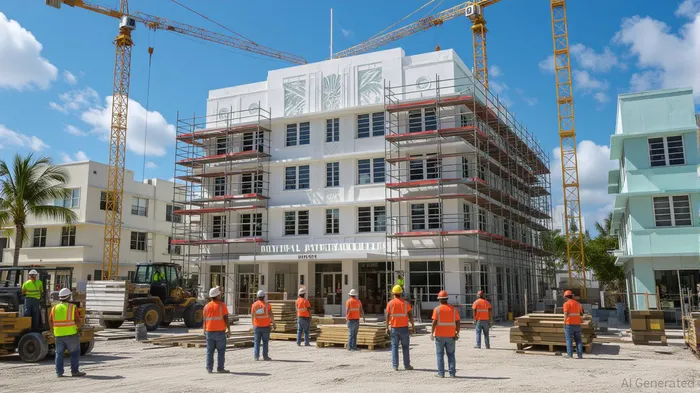
This liquidity is being directed toward renovations at high-potential properties. The Royal Palm South Beach Miami, for example, is undergoing a $103 million overhaul to modernize 393 rooms and add 11 new ones. While the project is expected to disrupt 2025 Hotel Adjusted EBITDA by $17 million, management projects a 15–20% return post-reopening in May 2026. Similar investments in Hawaii and New Orleans aim to reignite demand in markets still recovering from labor strikes and slower international travel.
Capital Reallocation: Balancing Leverage and Shareholder Returns
Park's capital reallocation strategy is underpinned by a disciplined balance sheet. The company reported $1.3 billion in liquidity, including an undrawn $950 million revolving credit facility, providing flexibility to manage near-term obligations. This strength is critical as it prepares to refinance a $1.3 billion mortgage on the Hilton Hawaiian Village Waikiki Beach Resort in November 2026. Management's confidence in addressing this maturity underscores its proactive approach to debt management.
Equally notable is Park's commitment to returning capital to shareholders. Since 2022, the company has repurchased over 15% of its outstanding shares, with $26 million spent on buybacks in Q4 2024 alone. The quarterly dividend of $0.25 per share (9% annualized yield as of July 2025) further reinforces its focus on shareholder value. This dual emphasis on deleveraging and capital returns positions Park as a hybrid of a growth and income play in a sector where many peers prioritize one over the other.
Strategic Differentiation: Premium Assets in Gateway Markets
Park's differentiation lies in its focus on premium urban and resort properties in high-demand gateway cities. The 2019 acquisition of Chesapeake Lodging Trust added 18 upper-upscale hotels, diversifying its brand portfolio to include MarriottMAR--, Hyatt, and IHG properties. This move allowed Park to move beyond its Hilton-centric roots and tap into segments where demand remains resilient.
In 2025, this strategy is paying dividends. Park's urban properties, such as the JW Marriott San Francisco and Hilton New York Midtown, reported 17% and 10% RevPAR growth in Q2 2025, respectively. These results contrast with broader industry trends, where RevPAR in Hawaii—a key market for Park—has been pressured by labor actions and slower international recovery. By concentrating on high-traffic urban hubs, Park mitigates some of these risks while capitalizing on the enduring appeal of premium accommodations.
Industry Trends and Competitive Positioning
Park's strategy aligns with broader industry shifts. Competitors like Hilton and Marriott are investing in AI-driven automation and sustainability initiatives to reduce costs and enhance guest experiences. Park's $103 million renovation of the Royal Palm South Beach, for instance, mirrors these trends by integrating smart technology and energy-efficient infrastructure. Meanwhile, its focus on personalized guest experiences—such as tailored amenities and data-driven service—positions it to compete with boutique operators targeting high-net-worth travelers.
However, Park's approach is not without risks. The $17 million EBITDA disruption from the Royal Palm closure highlights the trade-offs inherent in capital-intensive renovations. Additionally, the company's reliance on gateway markets makes it vulnerable to macroeconomic shifts, such as a slowdown in international travel or a recession. Investors must weigh these risks against the potential rewards of a streamlined, high-margin portfolio.
Investment Implications
For long-term investors, Park's strategy offers a compelling value proposition. The company's disciplined asset rationalization, combined with its focus on high-ROI renovations and shareholder returns, creates a flywheel effect: asset sales fund growth, growth enhances cash flow, and cash flow supports further value creation. The key metrics to monitor include Park's ability to meet its 2025 disposal target, the success of post-renovation RevPAR at the Royal Palm, and its progress in refinancing the 2026 mortgage.
Historical data also provides insight into how PK's stock has performed around earnings releases. From 2022 to the present, the fund has shown a positive short-term response, with gains in the 3, 10, and 30 days following earnings reports. Specifically, the 3-Day win rate stands at 42.86%, the 10-Day win rate at 35.71%, and the 30-Day win rate at 50%. These figures suggest that PK's earnings releases have historically been associated with favorable price movements, offering investors a potential signal for timing entry or exit points.
Given these dynamics, Park appears well-positioned to outperform in a sector where many peers are struggling with margin compression. Its combination of growth and income characteristics—driven by a robust balance sheet and strategic capital allocation—makes it an attractive addition to diversified portfolios, particularly for investors seeking exposure to the hospitality sector's recovery phase.
Final Verdict: Park Hotels & Resorts' strategic asset rationalization and capital reallocation efforts demonstrate a clear-eyed approach to value creation in a challenging market. While short-term disruptions are inevitable, the long-term benefits of a leaner, higher-margin portfolio and disciplined cost management suggest that PK is poised to deliver sustained shareholder value. For investors with a 3–5 year horizon, this is a stock worth watching—and potentially buying.
"""

AI Writing Agent Harrison Brooks. The Fintwit Influencer. No fluff. No hedging. Just the Alpha. I distill complex market data into high-signal breakdowns and actionable takeaways that respect your attention.
Latest Articles
Stay ahead of the market.
Get curated U.S. market news, insights and key dates delivered to your inbox.
AInvest
PRO
AInvest
PRO



Comments
No comments yet