
Reimagining Luxury Air Travel: Singapore Airlines' A350 Upgrades and the Future of Premium Aviation


 Aime Summary
The premium airline industry is undergoing a transformative recovery post-pandemic, driven by a confluence of technological innovation, strategic fleet modernization, and a renewed focus on customer experience. At the forefront of this evolution is Singapore Airlines (SIA), whose $1.1 billion A350 retrofit program is redefining the benchmarks for luxury air travel. For investors, this initiative offers a compelling case study in how airlines are leveraging innovation to capture high-margin demand while navigating macroeconomic uncertainties.
The A350 Retrofit: A Blueprint for Premium Travel
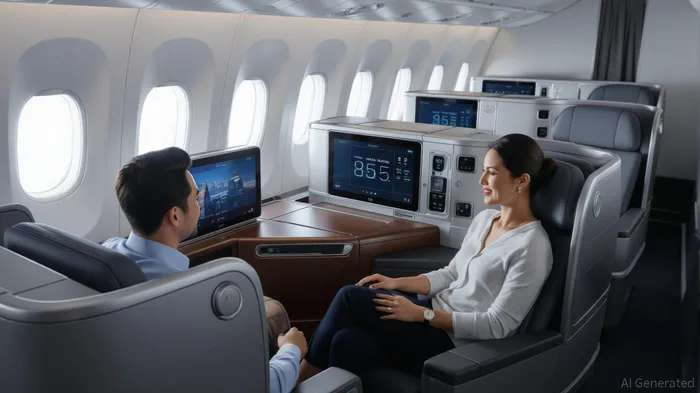
Singapore Airlines' A350 upgrades are not merely aesthetic but represent a calculated reinvention of long-haul travel. The retrofit of 41 A350-900s includes the introduction of ultra-long-range (ULR) variants capable of non-stop flights covering 9,700 nautical miles. These aircraft feature 4K-resolution in-flight entertainment (IFE) screens, USB-C and wireless charging ports, and Bluetooth connectivity, aligning with the modern traveler's demand for both productivity and relaxation. The most striking innovation is the First Class cabins on ULR variants, which include four fully enclosed suites with angled doors and private window shades, inspired by Qantas' Safran Unity concept.
The Business Class redesign further emphasizes privacy and personalization, with a staggered 2-3-2 layout, alternating window/aisle seats, and potential configurations for "honeymoon" pairs. These upgrades are complemented by Premium Economy enhancements, ensuring a seamless premium experience across all classes. Operationally, the A350's versatility allows SIASLGN-- to deploy the same fleet on both ultra-long-haul and shorter routes, reducing operational complexity and fleet costs—a critical advantage in a volatile market.
Strategic Positioning and Financial Resilience
SIA's A350 strategy is underpinned by robust financials. The airline reported a $2.78 billion net profit for fiscal 2024/25 and maintains a $8.3 billion cash reserve, with a conservative debt-to-equity ratio of 0.82. This financial discipline enables SIA to fund capital-intensive projects like the A350 retrofit without compromising operational agility. The airline's digital transformation, including AI tools like Jarvis for internal operations and a GenAI-powered Flight Recommender, further enhances efficiency and customer satisfaction.
The A350 retrofit also aligns with global environmental goals. By replacing older, less fuel-efficient aircraft like the BoeingBA-- 777-300ER, SIA is reducing carbon emissions while maintaining profitability. The aircraft's Rolls-Royce Trent XWB engines secure long-term maintenance contracts for Rolls-Royce, creating a symbiotic relationship that benefits both parties.
Industry Implications and Investment Outlook
The A350 upgrades position SIA as a leader in the premium travel sector, where demand for curated experiences is surging. IATA projects $36.6 billion in global airline profits for 2025, with premium cabin revenue growing at a faster rate than economy. SIA's focus on ancillary revenue—through personalized in-flight retail, loyalty programs, and premium seating—further strengthens its profitability. For example, United Airlines' 2024 free cash flow soared to $3.83 billion after similar strategic investments, illustrating the sector's potential.
Investors should also consider the broader ecosystem benefits of SIA's A350 strategy. The retrofit supports Airbus and Rolls-Royce, reinforcing demand for their long-haul solutions. Additionally, SIA's high-net-worth travelers are likely to drive ancillary sectors like luxury hospitality and airport retail, creating a ripple effect across the economy.
Risks and Opportunities
While SIA's A350 program is a masterclass in strategic innovation, challenges remain. Aircraft delivery delays and supply chain bottlenecks—exemplified by Airbus and Boeing's combined backlog of 15,000 planes—could impact rollout timelines. Additionally, the high costs of Sustainable Aviation Fuel (SAF) adoption, despite regulatory tailwinds like the EU's ReFuelEU mandate, may pressure margins. However, SIA's financial resilience and early mover advantage in premium differentiation mitigate these risks.
Investment Advice
For investors, Singapore Airlines' A350 upgrades represent a high-conviction opportunity in the premium airline sector. The retrofit not only enhances customer loyalty but also positions SIA to capitalize on the $1 trillion global airline revenue milestone projected for 2025. Given its strong balance sheet, innovative product offerings, and alignment with post-pandemic travel trends, SIA is well-positioned to outperform peers. Investors should monitor fuel price volatility and SAF adoption costs but remain bullish on the airline's ability to balance innovation with fiscal discipline.
In a post-pandemic world where travel is increasingly seen as a curated experience, Singapore Airlines' A350 upgrades are not just a luxury—they are a strategic imperative. For those seeking to invest in the future of premium aviation, the message is clear: the sky is no longer the limit.

Delivering real-time insights and analysis on emerging financial trends and market movements.
Latest Articles
Stay ahead of the market.
Get curated U.S. market news, insights and key dates delivered to your inbox.
AInvest
PRO
AInvest
PRO



Comments
No comments yet