
Reimagining Housing Valuation: How Sustainable Urban Development is Reshaping Real Estate Investments
The traditional calculus of real estate valuation—centered on location, size, and macroeconomic trends—is undergoing a seismic shift. As buyer preferences evolve toward affordability, sustainability, and resilience, the industry must adapt its models to reflect new realities. Berkshire Hathaway's recent outlook, amplified through its subsidiary Clayton Homes, underscores a paradigm where innovative construction methods and urban infill strategies are not just trends but foundational to future market valuations. For investors, this presents a critical juncture to reallocate capital toward sectors poised to dominate the evolving housing landscape.
The New Demand Drivers: Affordability Meets Sustainability
Buyers today are no longer passive consumers of housing; they are active participants in a market demanding equitable pricing and environmental responsibility. CrossMod® homes, pioneered by Clayton, exemplify this shift. These hybrid structures—blending modular efficiency with traditional aesthetics—are designed to fit seamlessly into urban neighborhoods, addressing shortages without overburdening infrastructure. A 1,065-square-foot CrossMod home in Omaha, for instance, combines a covered porch and permanent foundation with energy-saving features like solar roof shingles and smart thermostats.
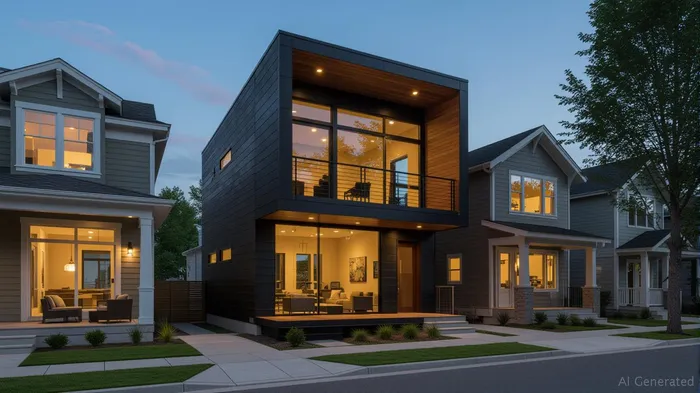
The FHFA's 2024 study reveals that such homes appreciate at rates comparable to site-built homes since 2020, dismantling the historical valuation gap. This data upends the notion that affordability equates to diminished equity potential, paving the way for CrossMod and similar innovations to redefine what constitutes “prime” real estate.
Valuation Models in Flux: Modular Construction as the New Benchmark
Traditional metrics like price-to-rent ratios or location-based premiums now must account for construction methodology and energy efficiency. Consider the eBuilt® program, which equips CrossMod homes to meet DOE Zero Energy Ready standards, slashing energy costs by up to 50%. In Omaha, this translates to annual savings of $832 per household, a critical factor for buyers in a high-interest-rate environment.
Investors should also monitor modular construction companies like Clayton (part of Berkshire Hathaway) and Toll BrothersTOL-- (TOL), which are scaling up panelized and off-site methods. The 5-year performance of modular-focused firms (e.g., TOLTOL--, KBH) versus traditional builders (LEN, DHI) reveals a narrowing gap in valuation multiples, signaling investor recognition of this trend's staying power.
Urban Infill: The New Frontier for Land Value Appreciation
Urban infill projects, enabled by zoning reforms and modular construction, are transforming undervalued urban lots into prime assets. In Denver, Clayton's HybridMod homes—combining modular components with site-built elements—are creating dense, affordable townhouse communities. Similarly, Atlanta's zoning updates have unlocked opportunities for CrossMod neighborhoods on previously overlooked parcels.
These developments highlight a critical insight: land use efficiency is now a key determinant of value. Investors should prioritize regions where zoning policies favor denser, sustainable development—such as the Midwest and Southwest, where markets remain neutral and adaptable.
Smart Tech and Resilience: The Backstop for Long-Term Returns
The push for sustainability extends beyond construction to smart home technologies and climate resilience. Solar integration, smart thermostats, and disaster-resistant designs (e.g., post-Hurricane Helene recovery efforts in North Carolina) are no longer luxuries but prerequisites for market competitiveness.
Investors in smart home tech (e.g., ecobee [a subsidiary of Amazon], or SolarEdgeSEDG-- [SEDG]) stand to benefit from rising demand. Meanwhile, regions like Florida and the Carolinas, where resilience is a priority, offer opportunities in disaster-resistant materials and flood-proof construction.
Market Outlook: A Balanced Landscape Demands Strategic Allocation
Zillow's 2024 survey paints a mixed but optimistic picture: 67% of agents expect rising prices in 2025, driven by pent-up demand and buyer adaptation to higher rates. Coastal markets remain seller-dominated, while the Southeast transitions to a buyer's market, creating a “sweet spot” for affordability-driven investments.
The Western North Carolina recovery—bolstered by $200 million in resilient housing funds—illustrates how policy and private capital can align to create value. Investors should pair exposure to affordable housing developers with positions in regions undergoing zoning modernization.
Investment Recommendations: Where to Deploy Capital
- Modular Construction Leaders:
- Berkshire Hathaway (BRK.B): Clayton's CrossMod initiatives are a strategic advantage, but investors should also consider pure-play firms like KB Home (KBH) or Lennar (LEN), which are scaling modular production.
ETFs: The iShares U.S. Home Construction ETF (ITC) offers diversified exposure to construction innovators.
Smart Home and Energy Efficiency:
- SolarEdge (SEDG): Leverages solar integration trends.
Amazon (AMZN): Owns ecobee, a leader in smart thermostats.
Regional Real Estate Plays:
- Urban-focused REITs: Consider Equity Residential (EQR) or Mack-Cali Realty (CLI) for exposure to densifying cities.
- Affordable housing funds: Explore American Homes 4 Rent (HOME), which targets price-sensitive buyers.
Conclusion: Adapt or Be Left Behind
The housing market is no longer about chasing traditional metrics—it's about aligning with buyer priorities and technological progress. Berkshire Hathaway's innovations, backed by data on CrossMod's equity potential and urban infill's value, signal a future where sustainability and affordability are the cornerstones of valuation. Investors who pivot toward modular construction, smart technologies, and resilient urban development will position themselves to capitalize on a market in the midst of profound transformation.
The time to act is now. The housing market's next chapter is being written—and it's one where old rules no longer apply.

Stay ahead of the market.
Get curated U.S. market news, insights and key dates delivered to your inbox.
AInvest
PRO
AInvest
PRO



Comments
No comments yet