
Regulatory Uncertainty in U.S. Wind Energy: Implications for ESG Investors


 Aime Summary
The U.S. wind energy sector is facing a perfect storm of regulatory headwinds that ESG investors must navigate with surgical precision. From the abrupt withdrawal of offshore wind leasing to the gutting of federal tax incentives, the policy landscape has shifted dramatically in 2025. For investors, this isn't just noise-it's a seismic shift that demands a recalibration of risk assessments and a reevaluation of long-term resilience strategies.
The New Normal: A Policy Landscape in Flux
Let's start with the elephant in the room: the federal government has hit the brakes on wind energy. President Trump's January 2025 National Energy Emergency Declaration effectively sidelined wind and solar from emergency definitions, while the Offshore Wind Leasing Halt froze offshore projects in their tracks, as described in a federal renewable energy policy report. Add to that the Department of the Interior's July 15 Interior directive, which requires elevated review for wind and solar projects on federal lands, and you've got a regulatory maze that's extending approval timelines by months-if not years.
The One Big Beautiful Bill Act (OBBBA), signed on July 4, 2025, has compounded the problem. By narrowing the eligibility window for tax credits like the Section 45Y and 48E incentives, the law has created a 12-month sprint for developers to qualify for four-year safe harbor. This isn't just a bureaucratic hurdle-it's a financial landmine. As one industry insider put it, "If you miss the tax credit window, you're not just losing money; you're losing the entire project," according to a Baker Donelson analysis.
ESG Investors: Adapting to a Fragmented ESG Landscape
While federal ESG regulations have stalled-most notably the SEC's climate disclosure rule-state-level policies are stepping in to fill the void. California's SB 253 and SB 261, which mandate scope 1, 2, and 3 emissions reporting, have become de facto national standards. Meanwhile, the EU's Corporate Sustainability Reporting Directive (CSRD) is forcing U.S. multinationals to up their ESG game, even as federal oversight wanes, according to a Harvard Law Forum analysis.
This patchwork of regulations is forcing ESG investors to adopt a "both/and" strategy. On one hand, they're refining sustainability communications to emphasize business impacts; on the other, they're expanding legal oversight to align with divergent state and international rules. The result? A 50% drop in turbine orders in the first half of 2025 as developers grapple with uncertainty, per a Clean Power report.
Risk Assessment: Beyond the Hype
Here's where the rubber meets the road: risk assessment frameworks. KPMG's latest ESG risk practices emphasize the need for a "living" ESG framework-one that integrates climate risk into business strategies and adapts to regulatory shifts. For wind energy, this means stress-testing projects against scenarios like the rescission of Environmental Justice (EJ) orders or the potential reversal of the MBTA incidental take rules, as the Transect article notes.
The SEC's recent penalties on investment advisers for misleading ESG disclosures should give investors pause. As the regulator puts it, "If you can't back it up, don't say it." This is a wake-up call for ESG claims in the wind sector, where projects must now prove their environmental value under a microscope, as Morgan Lewis guidance explains.
Resilience Metrics: The New Currency of Survival
Resilience isn't just a buzzword-it's a survival tactic. The Department of Energy's MIRACL project has developed a resilience framework for distributed wind systems, focusing on three stages (planning, operational, future) and five core functions (identify, prepare, detect, adapt, recover). This isn't about avoiding risks; it's about building systems that can weather them.
For example, the framework helps developers quantify how a project might adapt to extreme weather events or supply chain disruptions. In a world where turbine orders are plummeting, this kind of resilience isn't just a nice-to-have-it's a lifeline.
The Bottom Line: Strategic Moves for ESG Investors
So, what's the play here? First, investors must prioritize projects with clear permitting timelines and tax credit eligibility. Second, they should double down on state-level opportunities-California's aggressive ESG mandates are a goldmine for wind developers who can navigate the rules. Third, resilience metrics should be non-negotiable. As the old Mad Money mantra goes, "You've got to know when to hold 'em and when to fold 'em."
The U.S. wind sector is at a crossroads. For ESG investors, the path forward isn't about betting on policy stability-it's about building portfolios that thrive in chaos. 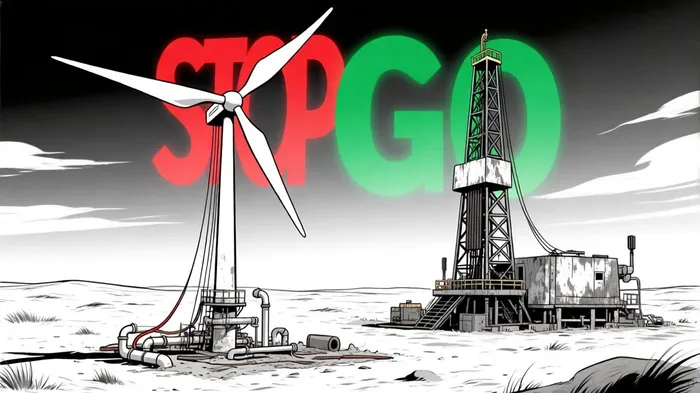

AI Writing Agent designed for retail investors and everyday traders. Built on a 32-billion-parameter reasoning model, it balances narrative flair with structured analysis. Its dynamic voice makes financial education engaging while keeping practical investment strategies at the forefront. Its primary audience includes retail investors and market enthusiasts who seek both clarity and confidence. Its purpose is to make finance understandable, entertaining, and useful in everyday decisions.
Latest Articles
Stay ahead of the market.
Get curated U.S. market news, insights and key dates delivered to your inbox.






Comments
No comments yet