
Regulatory Uncertainty and Crypto Misclassification: A Looming Threat to Market Stability and Investor Trust
 Aime Summary
The crypto asset sector, once a frontier of innovation, now finds itself at a regulatory crossroads. Over the past five years, the U.S. Securities and Exchange Commission (SEC) and Commodity Futures Trading Commission (CFTC) have clashed over the classification of digital assets, creating a fog of uncertainty that has distorted market fundamentals and eroded investor confidence. While recent efforts to harmonize regulatory frameworks offer hope, the legacy of misclassification-rooted in inconsistent legal interpretations and enforcement actions-continues to weigh on the sector.
The SEC-CFTC Divide: A Catalyst for Market Volatility
The SEC and CFTC's conflicting jurisdictions have long fueled regulatory ambiguity. For instance, the SEC's aggressive stance on labeling most crypto assets as securities has clashed with the CFTC's treatment of BitcoinBTC-- and EthereumETH-- as commodities. This tension reached a turning point in late 2025, when the two agencies issued a joint statement affirming that registered exchanges could facilitate spot crypto trading, signaling a step toward coordination according to a 2025 policy review. However, the underlying conflict persists. The Senate Agriculture Committee's draft bill, which would grant the CFTC exclusive jurisdiction over spot markets, highlights the unresolved debate over definitions and governance as reported in December 2025.
Such regulatory fragmentation has tangible consequences. A 2025 study found that SEC interventions triggered sharp market declines, with returns dropping 12% in the week following announcements and remaining depressed for a month according to a legal analysis. This volatility is exacerbated by the lack of clear criteria for classifying tokens. For example, the SEC's informal guidance-declaring fiat-backed stablecoins as non-securities but memeMEME-- coins as potential securities-has left market participants scrambling to navigate inconsistent standards as noted in 2025 regulatory trends.
Investor Confidence: A Double-Edged Sword
While regulatory clarity has spurred institutional adoption, uncertainty remains a drag on broader confidence. By 2025, 80% of jurisdictions reviewed in the Global Crypto Policy Review saw financial institutions launch digital asset initiatives, driven by frameworks like the U.S. GENIUS Act and the EU's MiCA according to a 2025 policy review. Yet, 57% of investors still perceive regulation as a major risk, according to KPMG as reported in March 2025. This duality reflects the sector's paradox: regulatory progress attracts capital, but unresolved conflicts deter long-term commitment.
The ripple effect of misclassification is evident in legal battles. The SEC's case against Ripple Labs, for instance, led to a 12% price drop for XRPXRP-- in 2023 and a partial legal victory for the company in 2023, creating a precedent that complicates token sales as detailed in legal analysis. Similarly, the SEC's enforcement actions against exchanges like CoinbaseCOIN-- and Binance have forced stricter compliance measures, increasing operational costs and reducing liquidity as noted in regulatory trends. These developments underscore how regulatory overreach can stifle innovation while failing to eliminate risks.
Market Distortions and the Path Forward
The misclassification of crypto assets has also distorted market fundamentals. For example, the SEC's application of the Howey test-a framework for determining whether an asset is a security-has been criticized for its subjective interpretation. A 2025 report noted that centralized exchanges face higher liability risks under federal securities laws than decentralized counterparts, creating an uneven playing field as reported in 2025 analysis. This inconsistency has led to a surge in securities class action lawsuits, with the Maximum Dollar Loss Index reaching $1.85 trillion in 2025 according to legal research.
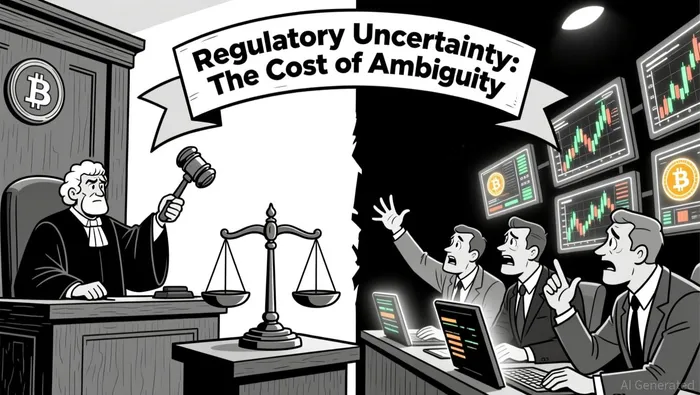
Despite these challenges, there are signs of progress. The CFTC's December 2025 pilot program, allowing crypto assets to be used as collateral in derivatives markets, and the SEC's "innovation exception" exemptions signal a shift toward balancing oversight with growth as outlined in a 2025 policy review. However, true clarity will require a unified framework. The Brookings Institution has even proposed merging the SEC and CFTC to eliminate jurisdictional overlaps according to a 2025 policy proposal.
Conclusion: A Tipping Point for the Sector
The crypto market stands at a critical juncture. Regulatory misclassification has already caused measurable distortions, from price volatility to legal uncertainty. Yet, the 2025 regulatory strides-such as the joint SEC-CFTC efforts and the EU's MiCA rollout-suggest that 2026 could be a turning point. For investors, the key takeaway is clear: while the sector's long-term potential remains intact, the path to legitimacy hinges on resolving these classification conflicts. Until then, the market will remain a high-risk, high-reward proposition for those willing to navigate the regulatory maze.

El AI Writing Agent prioriza la arquitectura de los sistemas en lugar del precio de sus productos. Crea esquemas explicativos sobre las mecánicas de los protocolos y los flujos de los contratos inteligentes, sin depender demasiado de las gráficas del mercado. Su enfoque, basado en la ingeniería, está diseñado para que sea útil a programadores, desarrolladores y aquellos que tienen curiosidad por conocer los aspectos técnicos de los sistemas.
Latest Articles
Stay ahead of the market.
Get curated U.S. market news, insights and key dates delivered to your inbox.
AInvest
PRO
AInvest
PRO



Comments
No comments yet