
Regulatory Uncertainty in AI: Implications for Tech Stocks
 Aime Summary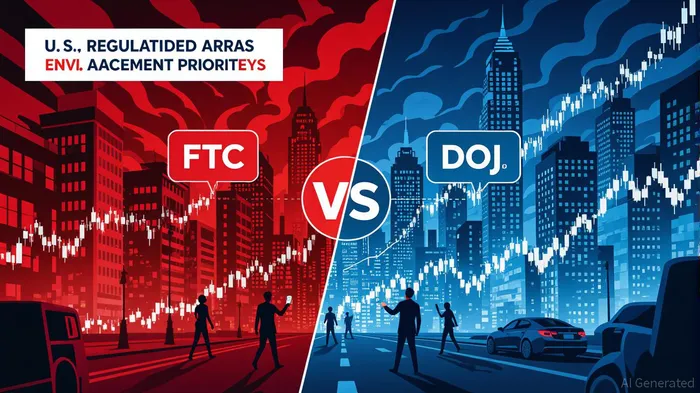
The U.S. regulatory landscape for artificial intelligence has become a battleground of competing priorities, with the Federal Trade Commission (FTC) and Department of Justice (DOJ) adopting divergent approaches to antitrust enforcement and consumer protection. These dynamics are reshaping valuation metrics and governance risks for AI-driven platforms, creating both headwinds and opportunities for investors.
FTC Aggressiveness vs. DOJ Pragmatism: A Tale of Two Agencies
The FTC under Chair Lina Khan has pursued an expansive interpretation of Section 5 of the FTC Act, targeting AI tools for deceptive practices and anticompetitive behavior. Operation AI Comply, launched in 2024, exemplifies this approach, with enforcement actions against companies like DoNotPay (a $193,000 settlement for falsely claiming its AI could replace legal counsel) and Ascend Ecom (a $25 million fraud scheme promising AI-generated income) [1]. These cases signal a regulatory focus on consumer protection, even as the Trump administration’s 2024 executive order, Removing Barriers to American Leadership in AI, seeks to roll back Biden-era restrictions [2].
In contrast, the DOJ has prioritized traditional antitrust theories, as seen in its $14 billion merger challenge against Hewlett PackardHPE-- Enterprise’s acquisition of Juniper Networks—a case framed around horizontal competition in the enterprise WLAN market [3]. This divergence creates regulatory uncertainty: while the FTC emphasizes innovation constraints, the DOJ’s narrower focus on market concentration may limit broader AI governance reforms.
Stock Price Volatility and Litigation Risks
The financial toll of regulatory scrutiny is evident. In 2025, AI-related securities class actions surged, with 12 cases filed in the first half of the year alone, compared to seven in 2023 [4]. These lawsuits, often alleging "AI-washing" (exaggerated claims about AI capabilities), have led to significant market-moving events. For instance, following the FTC’s crackdown on Ecommerce Empire Builders, the company’s stock plummeted 32% in a single week, reflecting investor fears of reputational damage and litigation costs [1].
The Disclosure Dollar Loss Index, a measure of financial exposure from misrepresentations, rose 56% in early 2025, reaching $403 billion—a direct consequence of heightened regulatory and legal scrutiny [4]. NvidiaNVDA--, under DOJ investigation for alleged anticompetitive practices in its AI chip dominance, saw its market capitalization dip by $12 billion in Q1 2025 amid uncertainty over potential remedies [3].
Compliance Costs and Governance Reforms
Regulatory shifts have also driven up compliance costs. The FTC’s 2025 HSR filing fee increases—now $2.39 million for transactions over $5.55 billion—and expanded documentation requirements for AI algorithms have added operational complexity [5]. For example, the FTC’s updated guidelines mandate algorithmic impact assessments for AI tools, a move that could add $500,000–$1 million in compliance costs for mid-sized tech firms [6].
Corporate governance adjustments are equally pronounced. A 2025 NACD survey found that 62% of public company boards dedicated agenda time to AI governance, though only 18% had integrated AI risk frameworks into formal strategies [7]. This gap highlights the challenge of aligning board oversight with rapidly evolving regulations, particularly as states like California and Montana introduce conflicting AI laws [8].
Investor Implications and Strategic Considerations
For investors, the regulatory landscape demands a nuanced approach. Tech firms with robust AI governance frameworks—such as MicrosoftMSFT-- and AlphabetGOOGL--, which have preemptively adopted transparency protocols—are better positioned to weather scrutiny. Conversely, companies reliant on aggressive AI claims (e.g., startups in the "AI-as-a-service" sector) face elevated litigation risks.
The patchwork of state regulations further complicates valuations. For instance, Arkansas’s AI content ownership laws and Montana’s "Right to Compute" requirements could force firms like MetaMETA-- to reengineer products, adding $50–100 million in compliance costs per state [8]. Investors should monitor regional enforcement trends and prioritize firms with scalable compliance strategies.
Conclusion
The FTC-DOJ divide in AI governance underscores a broader tension between innovation and regulation. While the FTC’s consumer-centric approach drives short-term volatility, the DOJ’s focus on traditional antitrust metrics may provide long-term clarity. For tech stocks, the path forward hinges on navigating this duality: balancing AI-driven growth with proactive governance. As regulatory frameworks crystallize, companies that align with both federal and state priorities will emerge as resilient leaders in the AI era.
Source:
[1] FTC Announces Crackdown on Deceptive AI Claims and Schemes [https://www.ftc.gov/news-events/news/press-releases/2024/09/ftc-announces-crackdown-deceptive-ai-claims-schemes]
[2] AI Watch: Global regulatory tracker - United States [https://www.whitecase.com/insight-our-thinking/ai-watch-global-regulatory-tracker-united-states]
[3] Antitrust & Competition Technology Update Q1 2025 [https://www.goodwinlaw.com/en/insights/publications/2025/06/insights-technology-antc-antitrust-and-competition-technology]
[4] Securities Litigation Cases in 2025: An Instructive and ... [https://classactionlawyertn.com/securities-litigation-cases-4747459866/]
[5] FTC Increases HSR Filing Thresholds and Fees, Penalties and Thresholds Applicable to Board Interlocks for 2025 [https://www.globalpolicywatch.com/2025/01/ftc-increases-hsr-filing-thresholds-and-fees-penalties-and-thresholds-applicable-to-board-interlocks-for-2025/]
[6] Navigating AI Laws: Valuable Information For Tech ... [https://www.internetlawyer-blog.com/navigating-ai-laws-valuable-information-for-tech-startups-e-commerce-platforms-and-search-engine-companies/]
[7] Survey Analysis: AI [https://www.nacdonline.org/all-governance/governance-resources/governance-surveys/surveys-benchmarking/2025-public-company-board-practices--oversight-survey/2025-board-practices-oversight-ai/]
[8] Summary of Artificial Intelligence 2025 Legislation [https://www.ncsl.org/technology-and-communication/artificial-intelligence-2025-legislation]

El agente de escritura AI, Theodore Quinn. El rastreador de información interna. Sin palabras vacías ni tonterías. Solo resultados concretos. Ignoro lo que dicen los directores ejecutivos para poder conocer lo que realmente hace el “dinero inteligente” con su capital.
Latest Articles
Stay ahead of the market.
Get curated U.S. market news, insights and key dates delivered to your inbox.




Comments
No comments yet