
Regulatory Tailwinds: How Developer Protections Could Reshape the U.S. Crypto Landscape


 Aime Summary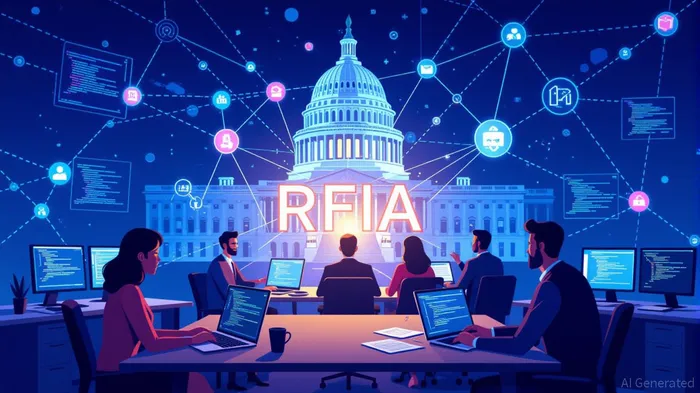
The U.S. cryptocurrency sector is on the cusp of a pivotal regulatory shift that could redefine its competitive edge in the global blockchain race. At the heart of this transformation lies the Responsible Financial Innovation Act (RFIA), a legislative proposal that has galvanized over 112 crypto builders, investors, and advocacy groups—including industry giants like CoinbaseCOIN--, Kraken, and UniswapUNI-- Labs—into a unified coalition. Their shared demand? Legal clarity for software developers to prevent them from being misclassified as financial intermediaries under existing laws.
The Developer Dilemma: A Growing Innovation Exodus
The urgency behind this push is stark. Data from Electric Capital reveals that the U.S. share of open-source blockchain developers has plummeted from 25% in 2021 to 18% in 2025. This decline mirrors a broader trend: top talent is migrating to jurisdictions like Singapore and the EU, where regulatory frameworks explicitly treat blockchain as infrastructure rather than a financial product. Without protections, developers face existential risks—such as being regulated as money transmitters under the Bank Secrecy Act—threatening the very foundation of decentralized innovation.
The coalition's letter to Congress underscores a critical point: developers are the lifeblood of Web3. By shielding them from arbitrary prosecution, the U.S. could reverse this brain drain and reestablish itself as the global “crypto capital.” The Blockchain Regulatory Certainty Act and Keep Your Coins Act, already included in the RFIA, are seen as foundational but insufficient. The industry is now demanding broader federal preemption of state laws (e.g., New York's restrictive BitLicense regime) and explicit exemptions for non-custodial platforms from money transmitter rules.
The RFIA: A Blueprint for Market Confidence
The RFIA's potential to unlock value is twofold. First, it addresses regulatory ambiguity that has stifled institutional investment. For example, venture capital firms like a16z and Paradigm have long argued that DeFi protocols should not be subject to the same compliance burdens as traditional banks. Second, it creates a level playing field for blockchain infrastructure stocks, which have lagged behind their tech counterparts due to uncertainty.
Consider the case of Coinbase (COIN). Despite holding a dominant market share in U.S. crypto trading, its valuation has been constrained by regulatory overhangs. If the RFIA passes, COIN's enterprise solutions—such as its institutional custody and developer tools—could see a surge in adoption, particularly from banks and fintechs seeking compliant on-ramps to blockchain. Similarly, Kraken (KRKN)'s non-custodial wallet business, currently under scrutiny in several states, could gain a competitive edge if the law clarifies that such services are not subject to money transmitter licenses.
Investment Implications: Where to Position for the RFIA
For investors, the RFIA represents a regulatory tailwind that could catalyze a re-rating of blockchain infrastructure stocks. Here's how to position:
- Prioritize Developer-Driven Platforms: Firms like Uniswap Labs and Compound Finance (now part of Compound Governance) are poised to benefit from a regulatory environment that treats smart contracts as neutral infrastructure. Their open-source models thrive when developers are free to innovate without fear of prosecution.
- Bet on Compliance-as-a-Service Providers: Companies offering regulatory tech (RegTech) solutions—such as Chainalysis (CHAIN) and Elliptic—stand to gain from the RFIA's emphasis on data transparency and anti-money laundering (AML) frameworks.
- Monitor Stablecoin Exposure: While the RFIA aims to resolve ambiguities around stablecoins, investors should remain cautious. The Reserve Currency (RSV) and USDC issuers could face volatility if the final bill imposes stricter capital requirements.
The Road Ahead: Risks and Opportunities
The Senate's final vote on the RFIA, expected by late September 2025, will be a litmus test for the U.S.'s commitment to leading the crypto revolution. While bipartisan support is strong, challenges remain—particularly around stablecoin oversight and data privacy mandates. However, the DOJ's recent shift in enforcement (e.g., no longer targeting DeFi developers for unlicensed money transfers) signals growing recognition of the sector's economic potential.
For investors, the key takeaway is clear: regulatory clarity is the ultimate catalyst. If the RFIA delivers on its promise, the U.S. could see a surge in venture capital inflows, a renaissance in open-source innovation, and a new generation of blockchain-native companies. The question is no longer if the crypto sector will mature—it's how quickly the U.S. can adapt to lead it.
In the end, the RFIA isn't just about protecting developers—it's about protecting the U.S.'s future in the digital financial age. For those willing to bet on the infrastructure layer, the rewards could be as transformative as the internet itself.

Decoding blockchain innovations and market trends with clarity and precision.
Latest Articles
Stay ahead of the market.
Get curated U.S. market news, insights and key dates delivered to your inbox.




Comments
No comments yet