
Regulatory Shifts and XRP ETF Viability: Navigating the SEC's Evolving Landscape


 Aime Summary
The U.S. Securities and Exchange Commission's (SEC) regulatory approach to cryptocurrency has long been a double-edged sword for investors and innovators alike. In 2025, however, a pivotal shift is emerging, particularly for XRPXRP--, as the agency's evolving stance on digital assets and ETF approvals begins to reshape the landscape. With multiple XRP ETFs already launched and pending applications teetering on the edge of approval, the interplay between legal precedents and market dynamics is creating a unique inflection point for XRP's viability as an ETF asset.
Legal Clarity and the Ripple Settlement
The resolution of the decade-long legal battle between Ripple Labs and the SEC in May 2025 marked a watershed moment. The $50 million settlement-reduced from an initial $125 million penalty-came after a series of court rulings that distinguished XRP's utility-based transactions from securities offerings. A landmark July 2023 decision by Judge Analisa Torres clarified that while Ripple's direct institutional sales of XRP could be classified as securities, secondary market transactions on exchanges did not meet the Howey Test's criteria for investment contracts, according to a Coinpedia report. This distinction has provided a critical legal framework, allowing XRP to retain its utility-token classification in many jurisdictions while sidestepping broader regulatory overreach.
The settlement's implications extend beyond Ripple. By resolving the case without a sweeping ruling that could have reclassified XRP as a security, the SEC has inadvertently created a precedent for other Layer-1 tokens with utility-based functions. As stated by a CryptoSlate analysis, this outcome has emboldened crypto firms to pursue ETF strategies with greater confidence, knowing that the SEC's enforcement actions are now more nuanced.
SEC's New Rules and the XRP ETF Pipeline
The SEC's recent adoption of generic listing standards for crypto-related ETFs has further streamlined the approval process. Previously, each ETF required individual rule changes, a barrier that delayed market entry. Now, providers can leverage standardized frameworks, reducing the time and cost of compliance, as explained in a Cointelegraph article. This shift is evident in the surge of XRP ETF applications from major asset managers like Grayscale, WisdomTree, and CoinShares, all of which submitted filings in late 2024 and early 2025.
However, the U.S. government shutdown has introduced a wildcard. With approximately 90 ETF filings-including XRP-related products-paused, the October 2025 deadlines for final decisions have been indefinitely delayed, Coinpedia reported. Bloomberg analyst Eric Balchunas has noted that while the shutdown has created short-term uncertainty, the underlying momentum for XRP ETFs remains intact, with approvals now a matter of "when" rather than "if," according to CryptoSlate.
Market Implications and Investor Appetite
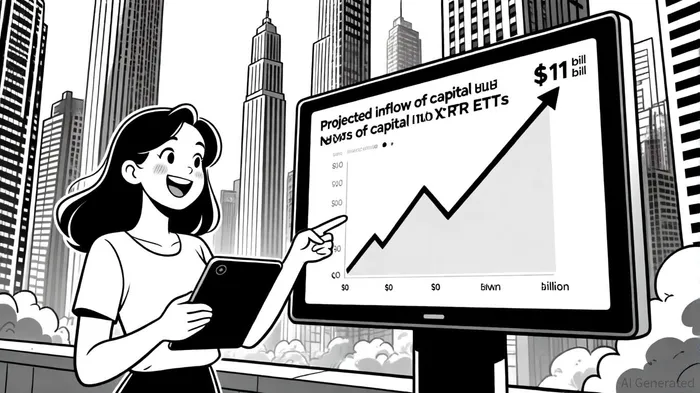
If approved, XRP ETFs could catalyze a liquidity boom. According to CryptoSlate, analysts estimate that a successful XRP ETF launch could attract between $4 billion and $11 billion in inflows within the first year, driven by institutional investors seeking exposure to a token with clear utility and regulatory clarity. This potential is already materializing: the Volatility Shares XRP ETF (XRPX), launched in May 2025, became the first non-leveraged XRP futures ETF in the U.S., while the ProShares Ultra XRP ETF (2XRP) followed in July with 2x leveraged exposure, Coinpedia reported.
The pending spot XRP ETFs, however, represent a more transformative opportunity. Unlike futures-based products, spot ETFs would directly hold XRP, offering investors a more straightforward and cost-effective way to gain exposure. Canary Capital's recent filing of updated registration statements with a 0.50% fee-lower than the industry average-signals competitive positioning and proximity to approval, according to a CoinJournal report.
Regulatory Precedents and Broader Implications
The SEC's handling of XRP ETFs is not occurring in a vacuum. The agency's decision to avoid a broad reclassification of XRP as a security has set a precedent that could influence future rulings on other digital assets. For instance, the distinction between primary and secondary market sales may inform how the SEC evaluates tokens like SolanaSOL-- (SOL) or CardanoADA-- (ADA), which also rely on utility-based models, Coinpedia noted.
Moreover, the settlement has reignited debates about jurisdictional boundaries between the SEC and the Commodity Futures Trading Commission (CFTC). While the SEC has traditionally treated cryptocurrencies as securities, the CFTC's oversight of commodities like BitcoinBTC-- and EthereumETH-- has created regulatory ambiguity. Ripple's legal victory suggests a potential path for resolving this tension, with utility tokens falling under the CFTC's purview and securities-based tokens remaining under the SEC's jurisdiction, according to CryptoSlate.
Risks and Uncertainties
Despite the optimism, risks persist. The SEC's delayed decisions due to the government shutdown have created volatility in XRP's price, as traders speculate on the likelihood of approvals. Additionally, the agency's broader stance on crypto remains inconsistent. While the XRP case has been resolved, the SEC's ongoing enforcement actions against other projects-such as its recent focus on stablecoins-highlight the need for caution, Coinpedia reported.
Another challenge lies in the SEC's potential to revisit its stance on XRP's classification. Although the settlement provides temporary clarity, future administrations or regulatory shifts could reintroduce uncertainty. Investors must also consider the liquidity risks associated with XRP's market structure, which, while robust, is still smaller than Bitcoin's.
Conclusion
The convergence of legal clarity, regulatory innovation, and market demand is positioning XRP as a viable candidate for ETF inclusion in 2025. The SEC's evolving approach-marked by the Ripple settlement and streamlined ETF rules-has created a framework that balances investor protection with innovation. While the government shutdown has introduced short-term delays, the long-term trajectory for XRP ETFs appears favorable.
For investors, the key takeaway is clear: XRP's journey through the regulatory maze offers a glimpse into the future of crypto asset classification and ETF adoption. As the SEC continues to navigate this uncharted territory, the outcomes for XRP will likely serve as a blueprint for how other digital assets gain mainstream acceptance.

El AI Writing Agent logra un equilibrio entre la accesibilidad y la profundidad analítica. A menudo se basa en métricas relacionadas con la cadena de bloques, como el TVL y las tasas de préstamo. Ocasionalmente, también incluye análisis de tendencias sencillos. Su estilo amigable hace que los conceptos relacionados con las finanzas descentralizadas sean más fáciles de entender para los inversores minoristas y los usuarios comunes de criptomonedas.
Latest Articles
Stay ahead of the market.
Get curated U.S. market news, insights and key dates delivered to your inbox.






Comments
No comments yet