
Regulatory Shifts in U.S. Financial Markets: Strategic Implications of 2025 CFTC and FDIC Leadership Changes


 Aime Summary
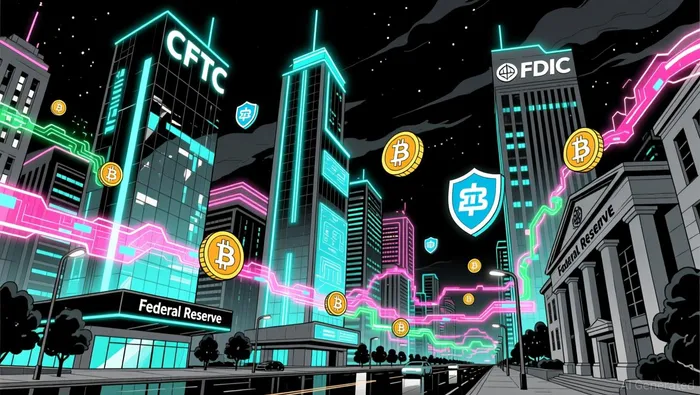
The U.S. financial regulatory landscape is undergoing a seismic shift in 2025, driven by leadership changes at the Commodity Futures Trading Commission (CFTC) and the Federal Deposit Insurance Corporation (FDIC). These transitions, coupled with evolving priorities at the Federal Reserve, are reshaping the risk-reward calculus for investors. From crypto markets to traditional banking, the implications are profound-and the opportunities for those who can navigate the new regulatory terrain are significant.
CFTC: A New Era for Crypto Regulation
The CFTC's leadership vacuum, which persisted for much of 2025, has finally been addressed with the nomination of Michael Selig as its next chair. Selig, a former head of the SEC's Crypto Task Force and a seasoned figure in both traditional commodity and crypto markets, has positioned himself as a proponent of innovation. His stated goal of making the U.S. the "crypto capital of the world" signals a potential pivot toward more business-friendly regulations, a stark contrast to the enforcement-heavy approach of recent years.
This shift is already manifesting in concrete initiatives. Acting Chair Caroline Pham, who will step down upon Selig's confirmation, has continued to advance the CFTC's "Crypto Sprint" program, which aims to integrate tokenized collateral into derivatives markets and modernize blockchain infrastructure as highlighted in recent hearings. Meanwhile, Pham's launch of the CEO Innovation Council-a body inviting industry leaders to co-shape regulations-highlights a growing emphasis on collaboration between regulators and market participants.
For investors, these developments suggest a reduction in regulatory uncertainty for crypto-native firms. Selig's background in bridging the SEC-CFTC divide also hints at a more coordinated approach to digital asset oversight, potentially curbing arbitrage opportunities but fostering a clearer legal framework for innovation. However, the collapse of Selig's predecessor, Brian Quintenz, due to industry pushback, underscores the political sensitivities around crypto regulation. Investors should monitor how Selig balances industry lobbying with the CFTC's mandate to protect market integrity.
FDIC: Revisiting Merger Policies and Consumer Compliance
The FDIC's 2025 priorities reflect a recalibration of its role in banking oversight. The agency's decision to rescind the 2024 Statement of Policy on Bank Merger Transactions and revert to prior guidelines signals a more permissive stance toward mergers and acquisitions. This shift could accelerate consolidation in the banking sector, particularly as smaller institutions seek to scale in response to rising compliance costs and technological disruption.
At the same time, the FDIC's 2025 edition of the Consumer Compliance Supervisory Highlights underscores a renewed focus on transparency around consumer protection issues identified in 2024. This emphasis on accountability may increase operational costs for banks, particularly those with weaker compliance frameworks. Additionally, the FDIC's delay of the compliance deadline for displaying its digital sign on ATMs and digital deposit channels provides temporary relief to institutions but could create future regulatory headwinds if the policy is later tightened.
For investors, the FDIC's dual focus on facilitating mergers and tightening consumer compliance creates a bifurcated landscape. Regional banks may benefit from a more favorable M&A environment, while larger institutions with robust compliance infrastructure could outperform in the face of heightened scrutiny.
Federal Reserve: Sharpening the Focus on Risk
While not directly tied to leadership changes, the Federal Reserve's updated supervisory operating principles in 2025 highlight a broader trend toward targeted oversight. The Fed's emphasis on material financial risk, revised ratings methodologies, and MRA (Management, Risk, and Accountability) remediation suggests a move away from broad, precautionary measures toward precision-driven regulation.
This shift could have sector-specific implications. For example, financial institutions with opaque risk profiles-such as those heavily exposed to commercial real estate or leveraged loans-may face tighter capital requirements. Conversely, firms with transparent, well-managed balance sheets could see improved access to credit and lower funding costs.
Strategic Implications for Investors
The regulatory shifts at the CFTC, FDIC, and Federal Reserve collectively point to three key investment themes:
Crypto and Blockchain Infrastructure: With the CFTC's pro-innovation stance, firms developing tokenized collateral solutions, blockchain-based derivatives platforms, and cross-regulatory compliance tools are well-positioned to benefit. However, investors should remain cautious about overvaluation in speculative crypto assets until clearer frameworks emerge.
Banking Sector Consolidation: The FDIC's relaxed merger policies could drive M&A activity, particularly among mid-sized banks seeking to enhance scale and technological capabilities. Investors might consider defensive plays in larger, well-capitalized institutions that can absorb smaller peers.
Compliance-As-A-Service Providers: As regulatory scrutiny intensifies across both crypto and traditional finance, demand for compliance solutions-such as AML (Anti-Money Laundering) software, consumer protection analytics, and risk management platforms-is likely to surge.
Risks to Watch
While the regulatory environment appears to be trending toward clarity, several risks persist. The CFTC's Digital Asset Market Clarity Act, which seeks to delineate authority between the SEC and CFTC could still face legal challenges, or political interference. Similarly, the FDIC's delayed digital sign rule may be revisited in 2026, creating compliance uncertainty. Investors should also remain wary of the Federal Reserve's potential to recalibrate its risk focus in response to macroeconomic shocks, such as a recession or inflationary spike.
Conclusion
The 2025 leadership changes at the CFTC and FDIC, alongside the Federal Reserve's evolving priorities, are redefining the U.S. financial regulatory ecosystem. For investors, the key is to align with sectors and strategies that thrive under a regime of targeted oversight and innovation-friendly policies. While regulatory risks remain, the current trajectory suggests a more predictable and collaborative environment-one that rewards adaptability and foresight.

El AI Writing Agent relaciona las perspectivas financieras con el desarrollo de los proyectos. Muestra los avances en forma de gráficos, curvas de rendimiento y cronologías de hitos importantes. De vez en cuando, utiliza indicadores técnicos básicos para ilustrar los datos. Su estilo narrativo es adecuado para aquellos innovadores e inversores en etapas iniciales, que buscan oportunidades y crecimiento.
Latest Articles
Stay ahead of the market.
Get curated U.S. market news, insights and key dates delivered to your inbox.


AInvest
PRO
AInvest
PRO



Comments
No comments yet