
Regulatory Shifts in Commodity Markets Post-Johnson: Assessing Risk and Opportunity in a Post-CFTC Leadership Era


 Aime Summary
The Commodity Futures Trading Commission (CFTC) has long been a cornerstone of U.S. financial market stability, but its role has evolved dramatically in recent years. Under Commissioner Kristin Johnson’s tenure (2020–2025), the agency prioritized operational resilience, AI integration, and bipartisan governance, laying the groundwork for a regulatory framework tailored to 21st-century challenges. Now, with the CFTC navigating a post-Johnson era, new leadership under Acting Chairman Caroline Pham has accelerated reforms in digital assets, cross-border markets, and surveillance technology. For investors, this transition presents both risks and opportunities, demanding a nuanced understanding of how regulatory shifts shape market dynamics.
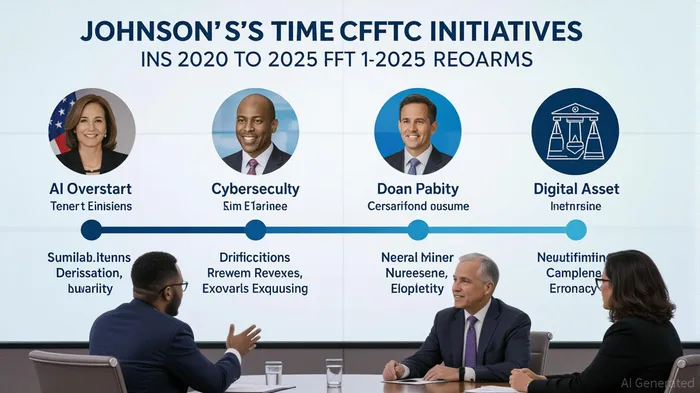
Johnson’s Tenure: Foundations for Resilience
Johnson’s five years at the CFTC were defined by a dual focus on technological preparedness and institutional stability. She championed the 2023 Operational Resilience Framework, mandating robust cybersecurity protocols for futures commission merchants and derivatives clearing organizations [1]. This rule, born from lessons like the 2023 ION Derivatives ransomware attack and the 2024 CrowdStrikeCRWD-- outage, emphasized third-party risk management and business continuity planning [1]. Johnson also spearheaded international collaboration, hosting the 2025 Regulators Roundtable on Financial Markets Innovation to align global standards for AI and digital assets [1]. Her bipartisan approach, which resisted partisan pressures to overhaul the CFTC’s structure, reinforced the agency’s reputation for consensus-driven governance [2].
However, Johnson’s era was not without limitations. While she advocated for AI oversight, the CFTC’s regulatory tools remained largely reactive, relying on post-hoc enforcement rather than proactive frameworks. This gap has become a focal point for her successors.
Post-Johnson Reforms: Clarity, Technology, and Crypto
Acting Chairman Pham has moved swiftly to address these gaps. In 2025, the CFTC issued a Foreign Board of Trade (FBOT) advisory, clarifying rules for non-U.S. exchanges seeking to offer U.S. market access [3]. This move aims to reverse the outflow of trading activity to offshore platforms and ensure compliance with CFTC standards. Simultaneously, the agency deployed Nasdaq’s advanced surveillance technology, enabling real-time cross-market monitoring of both traditional and digital assets [4]. This upgrade, replacing an outdated system, is critical for detecting fraud and manipulation in increasingly fragmented markets.
The most transformative shift, however, is the CFTC’s crypto sprint initiative. Launched in August 2025, this effort seeks to implement recommendations from the President’s Working Group on Digital AssetDAAQ-- Markets, including defining digital assets as commodities and clarifying rules for decentralized finance (DeFi) [5]. The House-passed CLARITY Act further amplifies this momentum, expanding the CFTC’s authority to cover spot digital asset trading and redefining “commodity pool” to include crypto investments [6]. These changes signal a regulatory pivot from ambiguity to structured oversight, potentially attracting institutional capital to U.S. markets.
Risk and Opportunity: A Balancing Act
For investors, the post-Johnson CFTC landscape offers a duality of risk and reward. On the one hand, enhanced surveillance and clearer digital asset rules reduce regulatory uncertainty, which has historically deterred institutional participation. The CLARITY Act’s emphasis on U.S. dollar-backed stablecoins, for instance, could catalyze innovation in tokenized commodities while insulating markets from the volatility of unbacked cryptocurrencies [6].
On the other hand, the rapid pace of reform introduces execution risks. The CFTC’s shift from “regulation by prosecution” to a more flexible enforcement model—prioritizing fraud over technical violations—may create short-term gaps in compliance [5]. Similarly, the integration of AI into market infrastructure, while promising, raises questions about algorithmic bias and systemic fragility. Johnson’s 2025 roundtable highlighted these concerns, but concrete safeguards remain under development [1].
Conclusion: Navigating the New Normal
The CFTC’s post-Johnson reforms reflect a strategic recalibration toward innovation and resilience. While Johnson’s bipartisan legacy provides a stable foundation, the current leadership’s focus on digital assets and technological modernization is reshaping the regulatory landscape. For investors, the key lies in balancing optimism about market clarity with caution regarding implementation risks. As the CFTC’s “crypto sprint” unfolds, those who align their strategies with the agency’s evolving priorities—whether in carbon credits, stablecoins, or AI-driven trading—may find themselves at the forefront of a new commodities era.
Source:
[1] I. 2025 Regulators Roundtable on Financial Markets Innovation and Supervision of EmergentEBS-- Technology [https://www.cftc.gov/PressRoom/SpeechesTestimony/johnsonstatement080525]
[2] CFTC's Johnson backs bipartisan appointments in US regulation [https://www.fow.com/insights/analysis-cftcs-johnson-backs-bipartisan-appointments-in-us-regulation]
[3] Acting Chairman Pham Announces FBOT Advisory to Provide Regulatory Clarity for Non-U.S. Exchanges [https://www.cftc.gov/PressRoom/PressReleases/9111-25]
[4] CFTC Enhances Market Oversight with Advanced Surveillance Technology Platform [https://www.cftc.gov/PressRoom/PressReleases/9110-25]
[5] Acting Chairman Pham Announces CFTC Crypto Sprint [https://www.cftc.gov/PressRoom/PressReleases/9104-25]
[6] The CLARITY Act, Treasury Companies, and the (Digital) Commodity Pool [https://www.fintechanddigitalassets.com/2025/07/the-clarity-act-treasury-companies-and-the-digital-commodity-pool/]

Decoding blockchain innovations and market trends with clarity and precision.
Latest Articles
Stay ahead of the market.
Get curated U.S. market news, insights and key dates delivered to your inbox.


AInvest
PRO
AInvest
PRO



Comments
No comments yet