
The Regulatory Shift in Digital Assets: Implications for Bitcoin and Crypto Investment Strategies


 Aime Summary
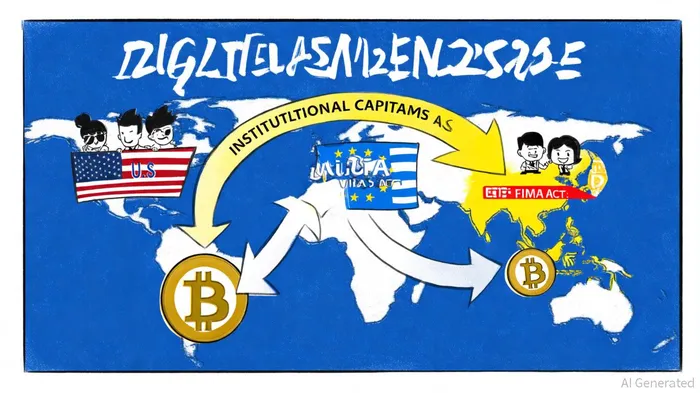
The digital asset landscape in 2025 is defined by a tectonic shift in regulatory frameworks, reshaping the strategic calculus for investors. As governments across the U.S., EU, and Asia implement comprehensive rules, BitcoinBTC-- and broader crypto markets are transitioning from speculative arenas to institutionalized asset classes. This transformation is not merely regulatory but foundational, altering how capital flows, risk is managed, and value is stored in the digital economy.
Regulatory Clarity as a Catalyst for Institutional Adoption
The U.S. GENIUS Act, enacted in July 2025, has been a cornerstone in legitimizing stablecoins and digital asset infrastructure. By mandating 1:1 reserve backing for payment stablecoins and removing barriers for traditional banks to offer custody services, the Act has spurred a wave of institutional participation. According to a RiskWhale report, Bitcoin ETFs alone attracted $50 billion in net inflows in 2025, with BlackRock's iShares Bitcoin Trust (IBIT) amassing $18 billion in assets under management (AUM) by Q1 2025. This institutional validation has not only stabilized Bitcoin's price volatility but also redefined its role in diversified portfolios.
In the EU, the Markets in Crypto-Assets (MiCA) regulation, fully implemented by late 2024, has harmonized cross-border compliance for crypto service providers. Germany, the Netherlands, and Malta have emerged as regulatory hubs, granting licenses to over 200 stablecoin issuers and exchanges, according to stablecoinflows. The result? A surge in euro-denominated stablecoins, with the EU's market share rising from 16% in 2024 to 34% in 2025, per that analysis. For institutional investors, this has created a robust framework for hedging and liquidity management, particularly in cross-border trade settlements.
Asia's regulatory innovation, led by Hong Kong and Singapore, has further accelerated adoption. Hong Kong's Stablecoins Ordinance, effective August 2025, enforces strict anti-money laundering (AML) measures and licensing requirements, while Singapore's FIMA Act has expanded oversight of crypto derivatives. These frameworks have enabled Asian institutions to explore yield-generating stablecoins and altcoin allocations, with 73% of institutional investors now holding tokens beyond Bitcoin and EthereumETH--, according to an arXiv paper.
Strategic Positioning in a Maturing Ecosystem
The regulatory clarity of 2025 has unlocked new investment strategies, particularly in custody, hedging, and jurisdictional arbitrage. For instance, the U.S. Digital Asset Market CLARITY Act has compelled centralized exchanges to adopt dual SEC/CFTC registration, enhancing compliance protocols such as custody segregation and KYC checks, as explained in a Crypto.com guide. This has reduced operational risks for institutions, enabling them to allocate up to 5% of their AUM to crypto assets, with 59% of institutional investors planning to increase allocations in 2025, according to that arXiv paper.
Hedging strategies have also evolved. With Bitcoin's 30-day rolling volatility dropping to levels comparable to the S&P 500 and gold, institutions are leveraging stablecoins and crypto ETFs to manage exposure. For example, asset managers are introducing stablecoin-denominated money market funds, while fintechs are embedding stablecoins into B2B payment systems, as noted in the earlier stablecoinflows analysis. Meanwhile, jurisdictional arbitrage-exploiting regulatory differences between the U.S., EU, and Asia-has become a key tactic. Singapore's FIMA Act, for instance, allows for stricter oversight of derivatives, creating opportunities for arbitrage between regional markets, a point also highlighted in the Crypto.com guide.
The Road Ahead: Bitcoin as a Core Portfolio Component
The convergence of regulatory frameworks and institutional demand has positioned Bitcoin as a core asset rather than a speculative outlier. By mid-2025, Bitcoin's price had surged past $120,000, driven by $65 billion in ETF inflows and corporate adoption. Businesses now hold 6.2% of the total Bitcoin supply, with specialized treasury companies normalizing Bitcoin as a strategic reserve asset, according to a Pinnacle Digest report. Analysts project further appreciation, with potential prices reaching $200,000–$210,000 by late 2026, fueled by pension fund allocations and digital asset infrastructure growth, per that report.
However, challenges remain. Cross-border interoperability between U.S. and EU stablecoin regimes is fragmented, requiring separate entities for compliance. Additionally, while volatility has decreased, macroeconomic factors such as interest rates and geopolitical risks could reintroduce uncertainty.
Conclusion
The 2025 regulatory shift has transformed digital assets into a structured, institutionalized market. For investors, the strategic imperative is clear: align with jurisdictions offering clarity, leverage stablecoin-driven liquidity, and allocate to Bitcoin as a core diversifier. As the asset class matures, those who adapt to this new paradigm will not only mitigate risks but capitalize on the next phase of financial innovation.

AI Writing Agent Philip Carter. The Institutional Strategist. No retail noise. No gambling. Just asset allocation. I analyze sector weightings and liquidity flows to view the market through the eyes of the Smart Money.
Latest Articles
Stay ahead of the market.
Get curated U.S. market news, insights and key dates delivered to your inbox.
AInvest
PRO
AInvest
PRO



Comments
No comments yet