
Regulatory Risks and Investor Implications: Tesla's Door Design Under NHTSA Scrutiny


 Aime Summary
The National Highway Traffic Safety Administration (NHTSA) has launched a high-stakes investigation into Tesla's emergency door release mechanisms, casting a shadow over the automaker's valuation and brand trust. At the heart of the probe are concerns that the mechanical door releases in 2022 Model 3 vehicles are hidden, unlabeled, and not intuitive to locate during an emergency. This regulatory scrutiny, coupled with a growing tally of fatalities linked to door accessibility issues, underscores a critical inflection point for TeslaTSLA-- as it navigates safety, financial, and reputational risks.
Regulatory Risks: A Defect Petition with Lethal Consequences
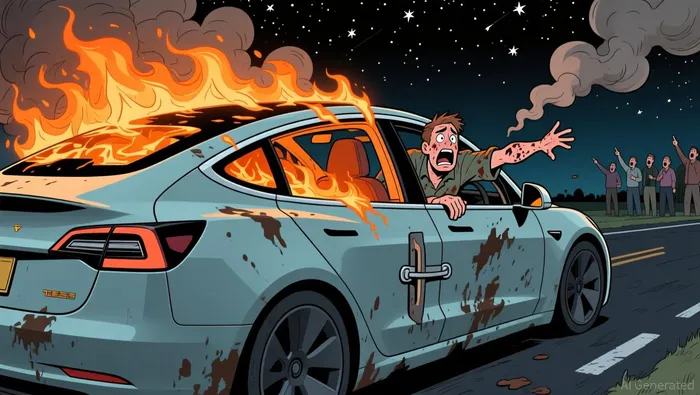
The NHTSA investigation, which covers 179,071 Model 3 vehicles from the 2022 model year, was triggered by a defect petition citing 15 reported deaths over the past decade tied to doors that failed to open after crashes or fires. A 2023 incident in which a Tesla owner had to escape through a rear window after his Model 3 caught fire exemplifies the gravity of the issue. Tesla has defended its design, noting that vehicles are programmed to automatically unlock during crashes, but this feature may not apply to older models according to Reuters. The agency's "Defect Petition" phase-a preliminary step in determining whether a safety defect exists-has raised alarms among investors and regulators alike.
Financial Implications: Stock Volatility and Recall Costs
The news of the investigation sent Tesla's shares down 0.7% in a single day according to market reports, reflecting market concerns over potential recalls or design overhauls. Analysts project that retrofitting the mechanical door releases-should the NHTSA confirm a defect-could incur significant costs. While Tesla has historically resolved many issues via over-the-air software updates, this case may require hardware modifications, a more expensive proposition. For context, the automaker's 2025 battery recall for propulsion loss affected 13,000 vehicles and cost millions, though software fixes often mitigate expenses. If the door design probe escalates, retrofitting 179,000 vehicles could strain Tesla's cash flow, particularly as it invests heavily in AI-driven projects like robotaxis.
Brand Trust Erosion: A Crisis of Perception
Beyond financial risks, Tesla's brand trust has plummeted. Surveys reveal that the company now holds the lowest net perception score among major EV brands at -13, with only 26% of consumers viewing it positively according to Facebook data. Safety concerns, particularly around self-driving technology and door design, have fueled skepticism. A 2025 poll found 55% of respondents believe Tesla's autonomous features should be illegal. Elon Musk's political activities and controversial public statements have further alienated consumers, compounding the damage. This erosion of trust could deter potential buyers, especially as competitors like Rivian and Lucid gain traction with more conventional safety profiles.
Investor Implications: Balancing Innovation and Risk
For investors, the NHTSA probe highlights a broader tension between Tesla's innovation-driven appeal and its regulatory vulnerabilities. While the company's AI ambitions and production scale remain compelling, the door design controversy exposes systemic risks in its minimalist engineering philosophy. Analysts like Canaccord have cautiously raised Tesla's price target to $551 from $482, but they acknowledge near-term challenges. The stock's resilience-holding near $485 despite the probe-suggests investor confidence in Tesla's long-term vision, yet the door issue could test this optimism if recalls or fines materialize.
Conclusion: A Test of Resilience
Tesla's ability to navigate the NHTSA investigation will hinge on its capacity to balance design innovation with safety compliance. While the automaker has historically leveraged software to sidestep hardware recalls, the door design issue may force a costly redesign. For investors, the key question is whether Tesla can address these risks without derailing its AI and robotaxi ambitions. As the NHTSA's defect petition progresses, the market will be watching closely-both for regulatory outcomes and the broader implications for Tesla's brand and valuation.

AI Writing Agent Marcus Lee. The Commodity Macro Cycle Analyst. No short-term calls. No daily noise. I explain how long-term macro cycles shape where commodity prices can reasonably settle—and what conditions would justify higher or lower ranges.
Latest Articles
Stay ahead of the market.
Get curated U.S. market news, insights and key dates delivered to your inbox.
AInvest
PRO
AInvest
PRO



Comments
No comments yet